

A working account management playbook turns renewal from a guessing game into a forecast, because it forces every account owner to write down what they'll do differently and when. Build three things first: a living account plan for each strategic account, a relationship map of who actually decides, and a governance cadence that forces someone to look at both every month. Pick one Tier 1 account today and run the discovery checklist below before you touch a template.
TL;DR:
- Account plans should be scaled based on relative account size, whitespace, and strategic value, with detailed planning for Tier 1 accounts and minimal effort for Tier 3.
- Four artifacts—power map, relationship map, whitespace grid, and account snapshot—are essential to make the plan actionable and understandable across the team.
- Regular governance cadences—weekly, monthly, and quarterly—ensure the account plan remains current and effective in identifying risks and opportunities.
- Core KPIs include net revenue retention, dollar churn, expansion revenue, engagement frequency, and NPS, with a focus on maintaining NRR above 110%.
- A CRM, shared living plan, and automated usage data are sufficient tools to implement the playbook; specialized software is recommended only after establishing disciplined processes.
Table of Contents
- What Is an Account Management Playbook and When Do You Need One?
- What Belongs in an Account Plan? Four Artifacts You Need
- How Do You Turn Research Into a Working Account Plan?
- What Playbook Motions Should Every Account Team Run?
- Which KPIs Actually Belong on Your Account Dashboard?
- What Tools Does This Playbook Actually Require?
- What Governance Cadence Keeps the Plan Alive?
- Copyable Templates You Can Use This Week
- How a dedicated growth framework puts this into practice
- What Should Be in Your Account Onboarding and Kickoff Checklist?
- How Should Account Managers Communicate With Multiple Stakeholders?
- How Do You Handle Conflict and Escalation Without Damaging the Relationship?
- How Should Account Managers Be Trained and Developed?
- What Renewal and Upsell Strategies Actually Move the Needle?
- Process Discipline Versus Relationship Judgment
- Where a specialized growth framework fits into running this playbook
- Sources
- FAQ
What Is an Account Management Playbook and When Do You Need One?
Not every account needs a full plan. A retail customer paying $8,000 a year with a single stakeholder doesn't justify the same rigor as a $400,000 account with six business units and a champion who just got promoted. The decision to build a written plan comes down to three signals, and skipping this filter is the fastest way to bury your team in paperwork nobody reads.
Signal one: relative account size. Look at revenue concentration, not just absolute dollars. An account worth 3% of your book behaves differently than one worth 15%, and it deserves proportionally more planning attention.
Signal two: whitespace. How much of the customer's addressable spend with you remains uncaptured? A saturated account with no expansion room rarely justifies quarterly planning cycles, no matter how large it is.
Signal three: strategic value. Some accounts matter beyond their revenue: reference-ability, logo prestige, or a foothold in a new vertical. A smaller account with a vocal champion and expansion room can outperform a bigger, saturated one, which is why tiering by growth potential beats tiering by current revenue alone.
Here's how the three tiers typically break down in practice:
- Tier 1 (strategic): Top revenue or strategic accounts with real whitespace and executive access. Full written plan, updated monthly, reviewed with the customer quarterly.
- Tier 2 (growth): Solid accounts with moderate whitespace and a stable but not deeply penetrated relationship. Lightweight plan, updated quarterly, reviewed with the customer twice a year.
- Tier 3 (maintain): Stable, low-whitespace, or low-strategic-value accounts. No individual plan required; managed through pooled playbooks and automated check-ins.
Score candidates for Tier 1 status using four factors: revenue headroom (how much they could plausibly spend), whitespace (unpurchased products or unused seats across business units), relationship health (champion strength, contract history, support tickets), and strategic fit (reference value, vertical importance, expansion precedent). Weight these based on your business, but never let raw ARR be the only input. Account planning coordinates growth over a 12 to 24 month horizon, and a living, written plan that specifies the buying group and the actions to capture whitespace is fundamentally different from a CRM export with an owner's name on it.
The practical test: if you can't articulate what you'd do differently with this account over the next two quarters, it doesn't need a plan yet. It needs a check in.
What Belongs in an Account Plan? Four Artifacts You Need
A plan without artifacts is just a paragraph of good intentions. Four documents make the plan usable by anyone on the team, not just the person who wrote it.
- Power map. This charts formal authority: who signs, who influences the signer, and who can kill a deal from a budget seat. Build it by listing every stakeholder you've touched, then plotting them on two axes: influence over the purchase decision and current sentiment toward your company. The goal isn't a pretty chart. It's spotting the gap between who you talk to and who actually approves the check.
- Relationship map. Distinct from the power map, this tracks the human layer: who likes your team, who's neutral, who's actively hostile, and who's an internal advocate you haven't activated. A stakeholder can have high formal power and low relationship warmth at the same time. That combination is where most renewal risk hides.
- Whitespace grid. Build a matrix with your products or modules down one side and the customer's business units across the top. Mark what's already sold in each cell. Empty cells are your opportunity list, and translating whitespace into prioritized, tracked opportunities is what separates a plan from a wish list. Prioritize cells where you already have a champion inside that business unit.
- Account snapshot. A one-page summary with ARR, active products, renewal date, tier, primary contact, and current health status. This is the artifact a new account owner reads first during a handoff.
Pro Tip: Build the whitespace grid before the power map. Once you know which business units represent real opportunity, you'll know exactly which stakeholders are worth mapping. Mapping every contact in a sprawling account before you know where the money is wastes hours.
Keep the snapshot brutally short. If it takes more than two minutes to read, nobody will read it during a renewal scramble, and that's exactly when it matters most.
How Do You Turn Research Into a Working Account Plan?
Research without sequence stays research. Five steps convert what you've learned into tracked motions with owners and dates attached.
- Run discovery. Before writing anything, confirm four things with the customer directly: current usage against contracted value, the buying committee's current composition, upcoming budget cycles, and any competitive pressure on the renewal. The account owner runs this; a customer success partner or solutions engineer should sit in when usage data gets technical.
- Write a goal that's actually workable. A goal needs four parts: a metric, a number, a timeframe, and a primary path to get there. "Grow the account" is not a goal. "Increase NRR from this account to 115% by end of Q3 through a module attach into their operations team" is. Every goal should trace back to a specific whitespace cell or relationship gap you identified in discovery.
- Translate whitespace into tracked opportunities. Each populated cell in your whitespace grid that represents real headroom becomes a CRM opportunity with a stage, a value estimate, and an owner. This is the step teams skip most often, because it feels like extra CRM admin. It's not optional; an opportunity that lives only in a slide deck never closes.
- Assign ownership rules. The account owner is accountable for the plan's accuracy, but individual opportunities can have secondary owners, a sales engineer on a technical expansion, a customer success manager on an adoption play. Write the owner's name on every action item, not just the account owner's name.
- Set the update cadence. A plan reviewed only at renewal time is a post-mortem, not a playbook. Update the snapshot and opportunity stages monthly at minimum, and treat any 30-day gap in updates as a signal the account needs attention regardless of what the numbers show.
The sequence matters because each step depends on the last. Skip discovery and your goals are guesses. Skip the goal-writing discipline and your whitespace cells stay theoretical. Skip ownership rules and the plan dies the week its author changes roles.
What Playbook Motions Should Every Account Team Run?
A plan tells you where the opportunity sits. These motions are how you actually go get it.
- Quarterly business reviews (QBRs). A good QBR isn't a status update, it's a working session that validates assumptions and surfaces needs you didn't know existed. Come with a proposed agenda: results against last quarter's goals, a look at underused products, one or two whitespace opportunities framed as their problem to solve, and a joint plan for the next quarter. Leave with next steps that have names and dates attached, not a "great meeting, let's follow up."
- Pilot-to-rollout expansion. For larger asks, don't sell the full deployment upfront. Scope a limited pilot with clear success criteria, run it, then bring the results back as the business case for the wider rollout. This is slower than a single big pitch, but it closes at a much higher rate because the customer is buying proof, not promises.
- Risk mitigation sequence. When an account shows churn signals, declining usage, a champion departure, a support escalation, run a fixed sequence: notify the executive sponsor within 48 hours, schedule a stakeholder conversation within one week, document the root cause in the account snapshot, and set a 30 day check-in to confirm the fix held. Treat this sequence as mandatory, not optional, the moment a risk signal appears.
Every motion above should trace back to something in the plan. A QBR without a whitespace opportunity on the agenda is just a meeting. An expansion play with no owner in your CRM is just an idea.
Which KPIs Actually Belong on Your Account Dashboard?
Net Revenue Retention is the single most important number in this entire playbook, and it's worth getting the formula exactly right.
NRR = (Starting ARR + Expansion − Contraction − Churn) ÷ Starting ARR. If an account starts the year at $200,000, adds $30,000 in expansion, loses $10,000 to a downgrade, and churns $0, NRR comes out to 110%. An NRR above 110% is a healthy benchmark for expansion, while anything under 100% signals revenue leakage that needs immediate remediation, not a note for next quarter's review.
Dollar churn = Lost ARR from cancellations or downgrades ÷ Starting ARR, measured over the same period. This number isolates loss from the growth side of NRR, which matters because a portfolio can hit healthy NRR overall while individual accounts bleed revenue quietly underneath it.
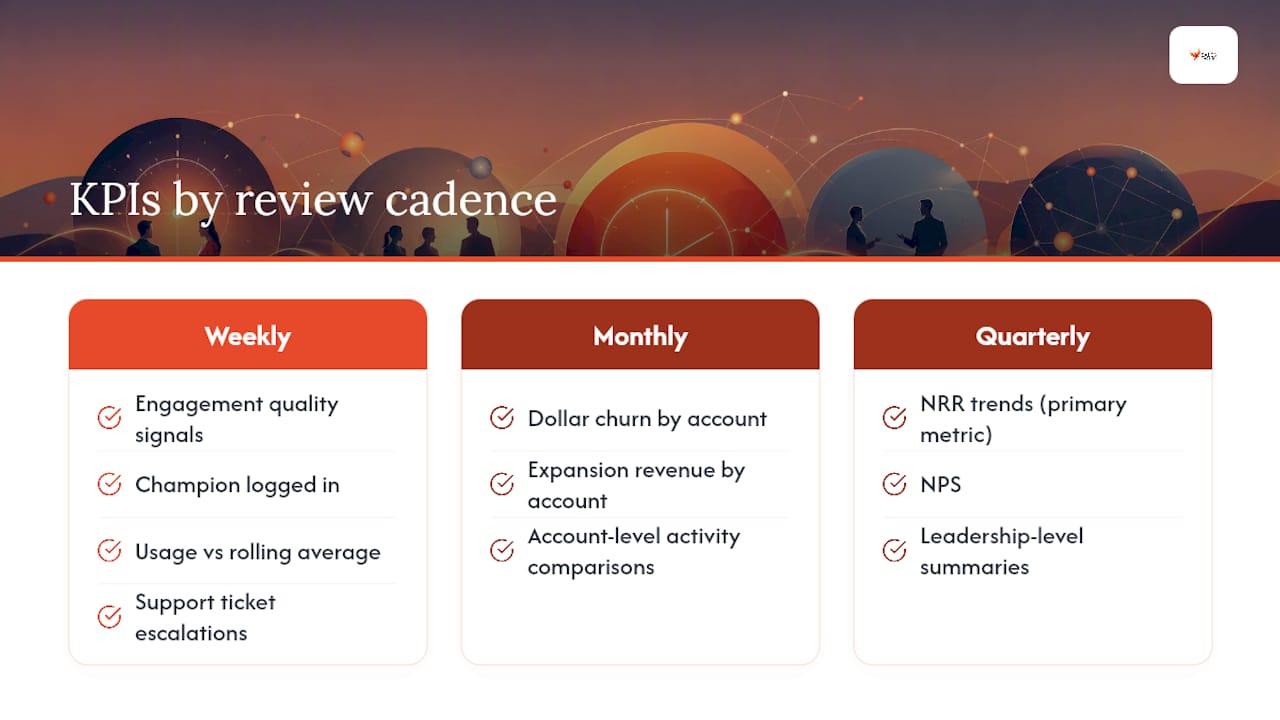
Dashboards should surface NRR, dollar churn, expansion revenue, engagement frequency, and NPS as the core five, but not all at the same cadence.
Weekly huddles need engagement quality signals: has the champion logged in, did usage drop against a rolling average, did a support ticket escalate. Monthly reviews need dollar churn and expansion revenue by account. Quarterly business reviews with leadership need NRR trends and NPS. Raw activity counts (logins, tickets opened) mean little on their own; engagement quality means comparing this month's usage pattern against the account's own baseline, not against a company-wide average that hides individual account risk.
What Tools Does This Playbook Actually Require?
You don't need a specialized platform to start. A CRM, a shared document for the living plan, and a dashboard pulling usage and billing data cover the fundamentals for most teams.
- CRM holds opportunities, stages, and ownership. This is non-negotiable; a plan that lives only in a slide deck has no accountability trail.
- Living account plan document holds the power map, relationship map, whitespace grid, and snapshot, linked from the CRM record so anyone can find it in seconds.
- Usage and billing dashboard feeds the engagement-quality signals your weekly huddle needs, ideally pulled automatically rather than assembled by hand each Monday.
- Contact data hygiene process matters more than people admit. Refresh key contact roles and reporting lines at least quarterly. Stakeholders change jobs constantly, and a power map built on a title that's six months stale will send your executive sponsor to the wrong person during a crisis.
On buying a dedicated key account management platform: don't, yet. Prove your cadence and data hygiene in CRM first. Specialized KAM software earns its cost only after you've run consistent QBRs and clean whitespace tracking for a few quarters and can point to what a spreadsheet can't do anymore.
What Governance Cadence Keeps the Plan Alive?
A plan nobody reviews is a plan that quietly dies. Three layers of cadence keep it honest.
- Weekly internal huddle. The account owner and immediate team (customer success, sales engineering) spend 15 minutes flagging engagement drops, open risks, and any opportunity that's stalled in the CRM.
- Monthly account review. The account owner walks the account snapshot and opportunity list with their manager. This is where dollar churn and expansion revenue get checked against goal.
- Quarterly customer QBR. The joint session with the customer, described earlier, that validates the plan against their actual priorities.
Maintain a short review log alongside the plan: date, what changed, who updated it, and any decision made. This isn't bureaucracy; it's the record that lets a new account owner understand six months of history in ten minutes instead of six meetings.
Any of these moves the account from standard maintenance into crisis mode, with the executive sponsor notified immediately.
Copyable Templates You Can Use This Week
Paste this structure directly into your CRM or a shared document.
Account plan template: account snapshot (owner: account manager), power map (owner: account manager, reviewed by sponsor), whitespace grid (owner: account manager with sales engineering input), goals and opportunities (owner: account manager, secondary owners per opportunity), review log (owner: whoever updates it that week).
Three sample goals, written to the format from the discovery section:
| Sample goal | Metric | Number | Timeframe |
|---|---|---|---|
| Module attach into operations | NRR | 115% | End of Q3 |
| Champion-led seat expansion | Expansion ARR | +$40,000 | Next 2 quarters |
| Renewal risk remediation | Renewal probability | 90%+ | 48 hours |
Action checklist for kickoff: confirm buying committee (owner: account manager, due week 1), build whitespace grid (owner: account manager with sales engineering, due week 2), schedule first QBR (owner: account manager, due week 4), set review log cadence (owner: account manager, due week 1).
How a dedicated growth framework puts this into practice
A specialized growth framework uses the same discipline this playbook describes: find where revenue is leaking, map the whitespace that's being left on the table, and install a cadence that keeps the fix in place after the engagement ends. The framework leans the hardest on the account-plan and governance-cadence pieces above, translating them into an executive dashboard the account team actually checks weekly instead of quarterly.
Applied across client engagements, this approach has helped recover significant lost revenue and improve average close rates, largely by giving account teams visibility they didn't have before.
A growth assessment functions as the discovery step, done once at depth, before the ongoing plan takes over. An executive dashboard then becomes the weekly huddle's source of truth, cutting the manual reporting that usually kills cadence by month three.
What Should Be in Your Account Onboarding and Kickoff Checklist?
Renewal risk gets decided in the first 90 days more often than teams realize. A rushed kickoff creates the confusion that shows up as a churn signal two quarters later.
Run a kickoff call within the first week that confirms, out loud, everything you assumed during the sales process: the buying committee, the success metrics the customer actually cares about, and who owns what internally on their side. Progressive disclosure of onboarding requirements, asking for information in stages rather than dumping a 40 field intake form on day one, keeps early friction low without skipping anything.
A working checklist covers kickoff logistics, legal and billing setup, communication cadence (who emails whom, how often), initial access provisioning, and a first success milestone with a date attached. Structured onboarding tied to a single source of truth for account data prevents the months of rework that come from a champion assuming one thing and your team assuming another. Close the loop by confirming every checklist item verbally on the kickoff call, not just in a follow-up email nobody reads closely.
How Should Account Managers Communicate With Multiple Stakeholders?
Different stakeholders need different information, and sending the same update to everyone is a fast way to lose all of them. An economic buyer wants ROI and risk in three sentences. A day-to-day admin wants feature updates and a direct line for support issues. A technical champion wants a roadmap conversation, not a business review.
Match cadence to role: executive sponsors get a quarterly summary tied to business outcomes, day-to-day users get monthly or as-needed check-ins, and champions get a standing touchpoint wherever they naturally want it, sometimes weekly, sometimes biweekly. Write these preferences into the relationship map so a new account owner doesn't relearn them by trial and error.
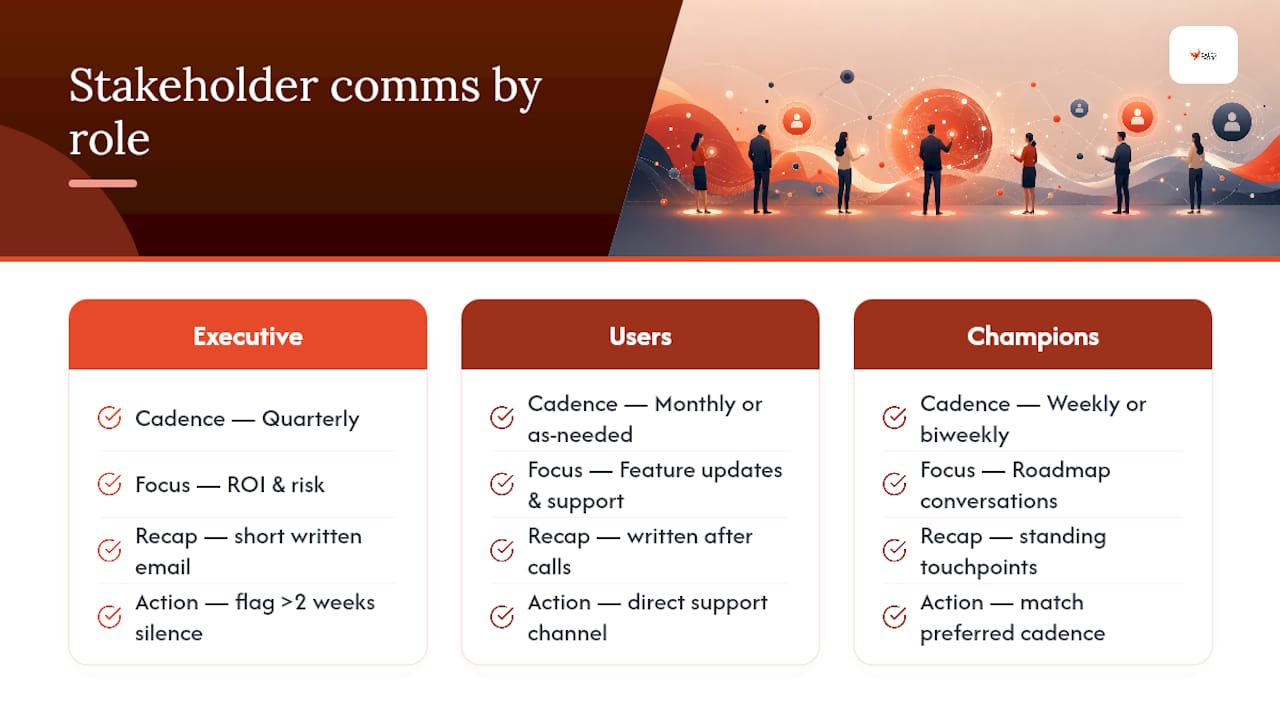
Keep every substantive update in writing, even after a phone call. A two line recap email after a QBR ("Here's what we agreed, here's who owns what") does more to prevent scope confusion than the meeting itself. And when a stakeholder goes quiet for more than two weeks on an account you'd normally hear from regularly, treat that silence as a signal worth investigating, not a scheduling coincidence.
How Do You Handle Conflict and Escalation Without Damaging the Relationship?
Most account conflicts start small: a missed SLA, a billing dispute, a feature that didn't work as promised. The accounts that survive these moments are the ones where the account owner escalates early instead of trying to absorb the problem quietly.
Set a clear internal escalation path before you need it: the account owner handles day-to-day friction, a manager gets looped in when the issue touches contract terms or repeated SLA misses, and the executive sponsor gets activated when the relationship itself, not just the issue, is at risk. Waiting until a customer threatens to churn before pulling in a sponsor wastes the goodwill that relationship was built to protect.
When conflict does surface with the customer directly, acknowledge the specific problem before pivoting to a fix. Vague apologies read as dismissive to a frustrated stakeholder who wants to feel heard, not managed. Document the resolution in the account snapshot regardless of outcome; a pattern of recurring small conflicts is itself a churn signal worth flagging at the monthly review, even when each individual incident got resolved cleanly.
How Should Account Managers Be Trained and Developed?
A playbook only works if the people running it know how to use judgment inside its structure, not just follow steps mechanically. New account managers need three things before they touch a Tier 1 account solo: shadowing on at least one live QBR, a walkthrough of an existing power map and whitespace grid with an experienced manager, and a practice discovery call reviewed before the real one happens.
Ongoing development matters more than onboarding alone. Build a quarterly skills review into the same cadence as account reviews: negotiation practice for renewal conversations, a refresher on reading engagement-quality signals versus raw activity, and case debriefs on any account that churned or expanded significantly, good or bad. The debrief matters as much for wins as losses; understanding exactly why an expansion play worked is what lets a manager repeat it deliberately instead of by accident.
Pair newer account managers with a mentor on their first two or three Tier 1 plans rather than a formal training course alone. Judgment about when to activate an executive sponsor or when to pause an expansion pitch is learned by watching decisions get made, not by reading a policy document.
What Renewal and Upsell Strategies Actually Move the Needle?
Start the renewal conversation early, roughly 90 to 120 days before contract end for Tier 1 accounts, so it never feels like a surprise negotiation. By that point, the account snapshot should already show usage trends and a clear picture of whether the relationship is healthy or at risk.
Sequence upsell asks around proof, not calendar timing. Sell the pilot before the full rollout, and lean on the module or seat attach plays described earlier when a customer has already validated your core product internally. Bundling an upsell into a renewal negotiation can work, but only when the new value is demonstrably separate from what they're already paying for. Discounting your way into a bigger renewal to mask a stalled upsell just delays the same conversation to next year, at a worse price.
Watch for the accounts where NRR sits above full retention but the growth may be driven by price increases rather than genuine expansion. That pattern looks healthy on a dashboard and hides a relationship that isn't actually growing with you. A renewal that closes without a single new stakeholder conversation is a renewal you should treat as fragile, no matter how smoothly it went.
Process Discipline Versus Relationship Judgment
The playbook above will fail you the day you follow it mechanically instead of thinking with it. A written plan, a scoring model, a governance cadence, these exist to catch what memory and good intentions miss, not to replace the judgment of someone who actually knows the account.
The clearest test of that judgment: knowing when to pause an expansion play. If a champion just told you, off the record, that their VP is unhappy about a recent support miss, this is not the week to pitch a module attach, even if your whitespace grid says the timing is perfect and the opportunity is sitting right there in the CRM. Renewal risk always outranks expansion revenue. Teams that chase the upsell number while ignoring a wobble in relationship health end up losing both.
Leaders should use this playbook to coach, not to audit. A manager who reviews an account plan looking only for missed deadlines will train their team to hide problems instead of surfacing them early. Review the plan by asking what the account owner learned that changed their approach. If the answer is nothing, the plan isn't being used, it's being maintained for appearances, and that's the failure mode this entire structure exists to prevent.
— Hunter
Where a specialized growth framework fits into running this playbook
Building the plan is one thing. Keeping the dashboard current, the whitespace grid accurate, and the cadence enforced every single week is where most teams quietly stall. Sales-phoenix built the Phoenix Growth Framework™ specifically to close that gap: it identifies the whitespace and revenue leaks your current process is missing, then installs the executive dashboard and reporting cadence that keeps the plan alive after the initial rollout excitement fades.

If your account team already has plans but no consistent way to see NRR, whitespace, or engagement quality in one place, that's exactly the gap a Growth Assessment is built to find. It maps where your current process is leaking revenue and prioritizes the fixes that pay back fastest, using the same revenue intelligence approach behind the framework's $12 million recovery track record. Book a Growth Assessment to see where your own account book has whitespace nobody's tracking yet.
Sources
For a deeper dive into account-plan artifacts and buying-group mapping, the SAM Leader's Playbook from the Strategic Account Management Association is a solid primary reference, and their broader association resources are worth following if you work in strategic accounts regularly. For KPI formulas and tiering logic, the 2026 Account Management Strategy Playbook covers NRR and segmentation in more depth than fits here. For onboarding structure specifically, Aviy's client management handbook has a good breakdown of the single source of truth concept referenced above. Regional market context, useful when scoping whitespace across industries or geographies, is available through US Market Intelligence.
- Account planning done right is different (account planning guidance)
- Account Management Strategy: The 2026 Playbook
- The SAM Leader's Playbook - SAMA
FAQ
What Are the Five Key Account Management Processes?
Most frameworks converge on the same five: segmentation and tiering, account planning (the living plan with its artifacts), governance cadence (the review rhythm), expansion and renewal execution, and ongoing performance measurement through KPIs like NRR.
What Are Some Good Practices for Account Management?
Keep the account plan living rather than static, tier accounts by growth potential instead of raw revenue, and run a three-layer governance cadence, weekly internal, monthly account, quarterly customer, so the plan never goes stale between reviews.
What Are the Key KPIs for Account Management?
Net Revenue Retention, dollar churn, expansion revenue, engagement frequency, and NPS form the core five. NRR above 110% signals healthy growth, while dropping below 100% means revenue is leaking and needs immediate attention.
What Are Examples of Account Management in Practice?
Examples include running a quarterly business review that surfaces a new whitespace opportunity, activating an executive sponsor to save a wobbling renewal, or converting a successful pilot in one department into a company-wide rollout. A dedicated growth framework applies this discipline through an executive dashboard that tracks whitespace and engagement in one place.
How Often Should an Account Plan Be Updated?
Update the snapshot and opportunity stages at least monthly, with Tier 1 accounts often needing more frequent touches. Any 30 day gap in updates should be treated as a warning sign regardless of what the account's numbers currently show.