

AI sales forecasting converts per-deal probabilities into a continuously updated revenue number instead of a spreadsheet guess collected once a week. Practitioner experience shows teams moving from roughly 45 to 55 percent forecast accuracy toward 80 percent or better within a few quarters, but only once CRM data is clean. The methods matter less than most vendors claim. What follows is the data work, rollout sequence, and validation habits that actually move the number.
TL;DR:
- Achieving 80 percent forecast accuracy depends heavily on clean and consistent CRM data, especially deal group completeness and stage definitions.
- Tree-based models like XGBoost are the default choice for deal scoring, but benchmarking against simple seasonal-naive forecasts is essential to detect data issues.
- Forecast accuracy improvements translate into better pipeline management, reducing surprises, guiding coaching, and improving quota attainment.
- Proper rollout includes auditing data, shadow testing for at least a quarter, and using model disagreements as coaching triggers, not punishments.
- Ongoing validation of forecast quality requires regular error and bias checks, with retraining schedules aligned to sales cycle velocity to prevent drift.
Table of Contents
- What Is AI Sales Forecasting, and How Does It Differ From Manual Forecasting
- Core AI Methods and When to Use Each One
- How Better Forecasts Change Pipeline Management
- The Data Signals That Actually Drive Forecast Accuracy
- Rolling Out AI Forecasting Without Blowing Up Trust
- Measuring and Monitoring Forecast Quality Over Time
- Where AI Forecasting Breaks, and How to Limit the Damage
- Phoenix Growth Framework™ Results Behind This Playbook
- AI Forecasting in Practice Across Different Industries
- Connecting AI Forecasting Tools to Your Existing CRM Stack
- Ethics and Data Privacy Considerations in AI Sales Forecasting
- What's Next for AI-Driven Revenue Forecasting
- A Working Playbook, Not a Wish List
- Get a Straight Read on Your Own Forecast Gap
- Sources
What Is AI Sales Forecasting, and How Does It Differ From Manual Forecasting
AI sales forecasting scores every open deal with a probability of closing, attaches an expected revenue value, and rolls those numbers up into a single, continuously refreshed forecast.
Technically, two things are happening at once. A classification or regression model scores each individual deal (will it close, and for how much), while a separate time-series layer aggregates those scores into period totals, smoothing out noise at the portfolio level.
Here's the part most teams skip: the model is only as good as what feeds it.
- Deal records need a complete buying group, not just one contact
- Stage definitions have to mean the same thing across every rep and region
- Historical deals need consistent, non-retroactive timestamps
Get those wrong and the fanciest neural network in the world will still produce garbage. Data hygiene, not model sophistication, is the actual bottleneck for most sales organizations.
Core AI Methods and When to Use Each One
Not every forecasting problem needs the same tool, and picking the wrong one wastes months. Match the method to your data volume, your forecasting horizon, and how much you need to explain the answer to your CFO.
- Time-series models (ARIMA, Prophet) work well for aggregated demand with clear seasonality, like quarterly SaaS renewals or retail order cycles
- Tree-based models (XGBoost, LightGBM, CatBoost) are the practical default for deal-level scoring because they handle messy, mixed CRM data without heavy preprocessing
- Ensembles and hierarchical ensembles blend multiple models across product lines or regions, which increases robustness when one segment behaves differently than another
- Deep learning and sequence models (transformers, RL-based approaches) can outperform simpler models but demand far more data, engineering, and monitoring than most mid-market sales teams can support
A recent ensemble framework combining hierarchical partitioning with architectural diversity showed measurable gains in forecast accuracy and stability across product hierarchies, using techniques validated on datasets like M5 that stress-test models across many overlapping time series (arXiv, 2025). Hybrid models pairing decomposition methods with transformer variants and exponential smoothing have also cut forecast error meaningfully in complex, seasonal retail-style settings (MDPI, 2025).
Pro Tip: Benchmark any new model against a simple seasonal-naive forecast first. If you can't beat that baseline by 10 to 15 percent, you have a data problem, not a modeling problem, and no amount of algorithm swapping will fix it.
The trade-off is always the same triangle: accuracy, interpretability, and operational cost. Tree-based models usually win on the first two for sales teams; deep models win only when you have the volume and staff to feed them.
How Better Forecasts Change Pipeline Management
Accuracy gains only matter if they change what a sales leader actually does on a Monday morning. This is where forecasting stops being a math exercise and starts being an operating system.
- Quarter-end surprises shrink because the model flags slipping deals weeks before a rep admits it in a pipeline review
- Confidence intervals replace single-point guesses, so leadership can plan around a range instead of a hopeful number
- Coaching time gets redirected toward deals the model flags as at-risk, instead of whichever deal is loudest in a forecast call
- Scenario planning (best case, worst case, most likely) becomes a real exercise instead of a gut-feel spreadsheet tab
Reps who once buried a stalling deal until the last week now get flagged by risk signals derived from engagement drop-off and stage velocity. That surfaces problems early enough to actually save the deal, or at least stop planning revenue around it.
Pro Tip: Use the model's disagreement with a rep's own forecast as a coaching trigger, not a scorecard. The gap tells you where a rep's instincts and the data diverge, which is far more useful than punishing the miss.

The real payoff shows up in quota attainment and cycle time. Teams with more accurate forecasts commit to numbers they can defend in the boardroom, and defensible numbers change how finance treats sales altogether.
The Data Signals That Actually Drive Forecast Accuracy
Model architecture gets the attention, but the signals you feed it decide the outcome. Four categories of data matter most: deal attributes (size, product line, source), engagement metrics (email opens, call frequency, meeting cadence), buyer profile (company size, industry, buying committee completeness), and velocity or recency signals (time in stage, days since last activity).
Concrete features worth building before you touch a model:
- Lag features — deal value and stage 12 months prior, to catch seasonal repeat patterns
- Rolling averages — 30/60/90-day win rates by segment, smoothed to avoid single-week noise
- Quarter-end flags — a binary marker for deals that historically get rushed or discounted near close dates
- Days-in-stage — how long a deal has sat versus the segment's historical median.
The greatest accuracy gains in most sales organizations come from fixing input signals and enforcing process discipline, not from chasing exotic model architectures.
Before any of that works, a hygiene checklist has to pass: complete contact records for every buying-group member, one shared definition of what "Stage 3" means across every team, and activity logging that isn't optional. Skip the checklist and you'll hit two classic pitfalls: data leakage (features that accidentally encode the outcome you're predicting) and misaligned time splits, where training data quietly includes information from after the point you're trying to predict from. Sparse pipelines, common in newer sales orgs, also starve models of the volume they need to generalize.
Rolling Out AI Forecasting Without Blowing Up Trust
The rollout sequence matters more than the model you pick, because a technically perfect forecast that reps don't trust never gets used. Practitioner playbooks consistently recommend a four-phase sequence: audit, shadow, coach, then productionize (Prospeo).
- Audit and fix data first. Standardize stage definitions across teams, enrich incomplete contact records, and backfill activity logs before touching a model.
- Run shadow mode for at least one full quarter. Let the model generate forecasts silently alongside the existing manual process, then compare errors side by side without letting either number drive decisions yet.
- Use disagreements for coaching, not policing. When the model and a rep diverge sharply on a deal, treat it as a conversation starter about what the rep sees that the data doesn't, or vice versa.
- Productionize with a retrain cadence and a named owner. RevOps typically owns monitoring, scheduled retraining (often quarterly), and the escalation path when accuracy drifts.
Pro Tip: Publish the shadow-mode comparison to the sales team before the model goes live. Reps who see the model beat their own gut call on real historical deals adopt it far faster than reps told to "just trust it."
Change management is the quiet variable that decides success. Teams that show one early win, a deal the model flagged three weeks before a rep noticed the risk, build momentum that no rollout deck can manufacture on its own.
Measuring and Monitoring Forecast Quality Over Time
A forecast that looked accurate last quarter can quietly degrade without anyone noticing, which is why validation has to be ongoing, not a one-time launch check.
- MAE and WAPE/MAPE measure raw forecast error in absolute and percentage terms across periods
- Calibration checks confirm that deals scored at 70% probability actually close around 70% of the time, not 40% or 90%
- Bias checks catch systematic over or under-forecasting by segment, rep, or region
Validation has to respect time. Temporal holdouts and walk-forward cross-validation, where the model only ever trains on data that predates what it's tested against, prevent the common mistake of accidentally letting future information leak into training. Organizations combining strong data governance with predictive models see meaningfully better forecasting outcomes than those relying on model sophistication alone (Gartner). Watch for feature-importance drift and widening real-versus-predicted gaps as your retrain triggers.
Where AI Forecasting Breaks, and How to Limit the Damage
No model survives a regime shift unscathed. A sudden pricing change, a new competitor, or a macro shock can make historical patterns useless overnight, and the forecast will lag reality until it retrains on new data.
- Watch for model-encoded bias, like a system quietly learning that deep discounting predicts closes and start nudging reps toward it
- Treat AI output as a baseline, not a final answer; keep a human sign-off step on every forecast that goes to the board
- Budget for ongoing data engineering and monitoring, not just the initial build; this is a maintained system, not a one-time project
Phoenix Growth Framework™ Results Behind This Playbook
Everything above reflects patterns Sales-phoenix has seen play out inside real service businesses and professional firms, not theory.
For readers weighing where to start, the relevant Sales-phoenix services line up directly with the rollout steps above:
- Revenue Intelligence for building the dashboards and visibility layer forecasting depends on
- Intelligence Report for a diagnostic snapshot of where your current pipeline data is breaking down
- Growth Assessment for a structured review of where revenue is currently leaking out of the funnel
AI Forecasting in Practice Across Different Industries
The mechanics of AI sales forecasting stay consistent, but the signals that matter shift by industry. A SaaS company with monthly recurring revenue leans heavily on usage and engagement data (login frequency, feature adoption, support ticket volume) as leading indicators of renewal or churn risk, feeding models that predict revenue months ahead rather than just deal-by-deal closes.
Manufacturing and distribution businesses, by contrast, deal with longer sales cycles and heavier seasonality tied to procurement calendars and fiscal-year budget cycles. Time-series methods that capture recurring seasonal demand tend to outperform pure deal-scoring approaches here, since a single large order can distort a deal-level model's assumptions.
Professional services firms, the audience Sales-phoenix works with most, face a different problem entirely: pipelines that are thinner in volume but higher in per-deal value, where a single lost engagement can swing a quarter. For these firms, engagement and relationship signals (how many stakeholders have engaged, how recently, at what seniority) often predict outcomes better than firmographic data alone, because the sale rides on trust as much as fit.
Retail and e-commerce sit closest to the hybrid modeling research already covered. The MDPI study on decomposition-transformer-ETS hybrids showed measurable error reduction specifically in complex, seasonal retail-style demand patterns, which reflects how promotional calendars and holiday spikes distort simpler models. Across all four industries, the pattern holds: the model architecture adapts to the data, but the underlying discipline of clean inputs and consistent definitions never changes.
Connecting AI Forecasting Tools to Your Existing CRM Stack
A forecasting model that lives outside your CRM is a report nobody opens after the first week. Real adoption depends on the forecast showing up where reps already work, not in a separate dashboard they have to remember to check.
Most modern CRM platforms now expose the API hooks needed to pull deal-level fields (stage, value, activity timestamps, contact records) into a modeling pipeline and push scored probabilities back into the deal record itself. That round-trip matters: reps see an AI-generated win probability sitting right next to the deal they're working, not buried in a quarterly slide deck.
Integration typically happens one of three ways. Native forecasting modules built into larger CRM suites offer the least setup but the least flexibility. Middleware or iPaaS connectors let a custom model pull CRM data on a schedule and push scores back through a webhook or API call, which suits most mid-market teams. Fully custom pipelines, common among engineering-heavy organizations, pull raw data into a warehouse, model it independently, and sync results back on a defined cadence, often nightly.
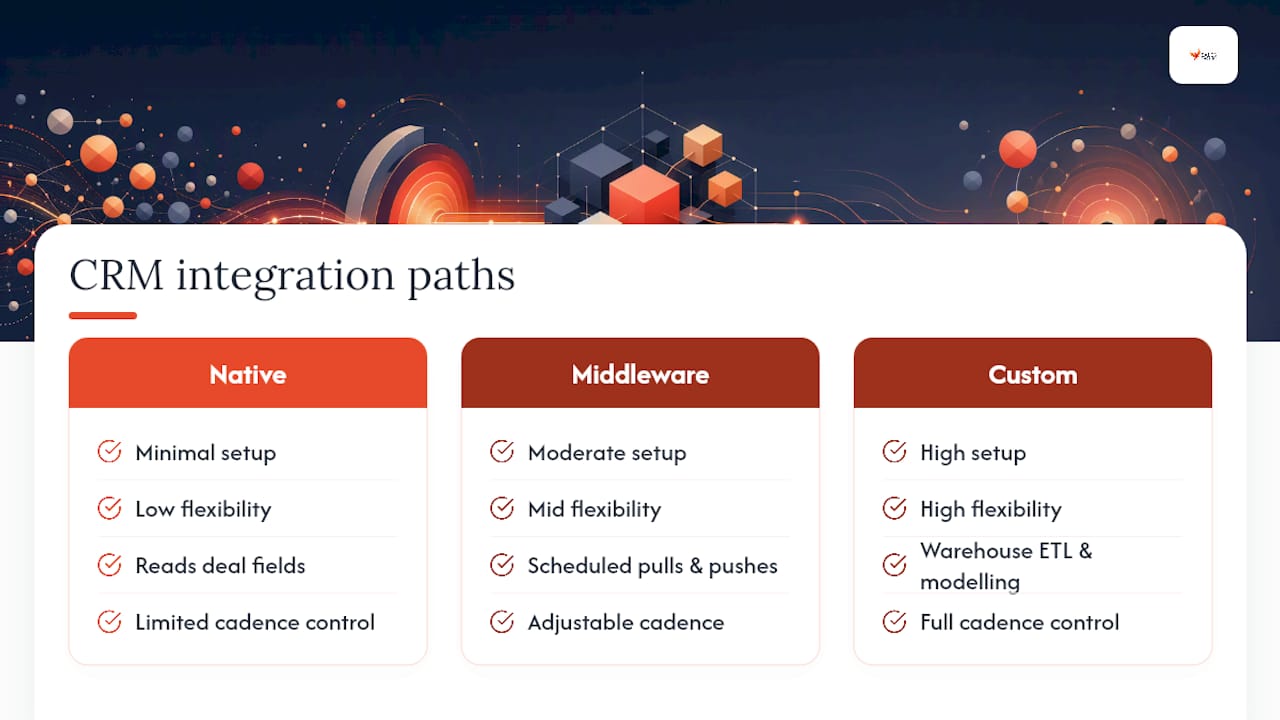
Whichever path you choose, the failure point is almost always the same: sync frequency mismatched to sales velocity. A model updating deal scores once a week is useless for a sales cycle that turns in days. Match the retrain and resync cadence to how fast your pipeline actually moves, not to whatever the default setting happens to be.
Ethics and Data Privacy Considerations in AI Sales Forecasting
Sales forecasting models run on personal and behavioral data, which means privacy obligations don't disappear just because the use case is internal rather than customer-facing. Contact records, engagement logs, and email metadata all count as personal data under most privacy frameworks, and a model trained on them needs the same access controls as any other system touching customer information.
The subtler risk is encoded bias. A model trained on years of historical wins can quietly learn to favor deals from certain regions, company sizes, or even certain reps' territories, simply because that's what closed in the past. Left unchecked, that pattern can steer coaching attention and resource allocation toward already-favored segments, deepening an imbalance rather than correcting it.
There's also a fairness question inside the sales team itself. If a forecasting model's scores start influencing compensation decisions or performance reviews, reps deserve to know how the score is generated and what inputs drive it. Treating the model as a black box that quietly shapes who gets flagged as underperforming is a governance failure waiting to surface in a much less comfortable conversation.
The practical fix is boring but effective: restrict model access to the data it actually needs, audit outputs periodically for demographic or territorial skew, and keep a documented human review step before any forecast output touches compensation or headcount decisions.
What's Next for AI-Driven Revenue Forecasting
The next wave of AI sales forecasting is less about new algorithms and more about models that explain themselves. Expect more forecasting tools to surface the specific signals (a stalled email thread, a missing stakeholder, a slipping close date) behind every score change.
Real-time and continuous forecasting is also replacing the weekly or monthly snapshot. Instead of a forecast that updates when someone remembers to refresh a report, models are increasingly event-driven, recalculating the moment a deal's stage, activity, or engagement changes.
Foundation models and large language models are starting to enter the picture too, less as replacements for tree-based scoring and more as an interface layer, letting a sales VP ask a plain-language question about pipeline risk and get a synthesized answer pulled from the underlying forecast data. The heavy lifting still happens in the ensemble and tree-based layers underneath; the LLM just makes the output conversational.
None of this changes the core lesson this playbook keeps returning to. Better models amplify good data and expose bad data faster than any manual process ever could. The teams winning with predictive sales analytics right now aren't the ones with the fanciest architecture. They're the ones who fixed their CRM hygiene first.
A Working Playbook, Not a Wish List
The gap between what AI sales forecasting promises and what most teams actually get comes down to one uncomfortable truth: nobody wants to do the data cleanup first. Vendors sell the model. Nobody sells the six weeks of standardizing stage definitions across four regional teams, because that part doesn't demo well.
What consistently moves accuracy in practice is boring: complete contact records, one shared definition of "qualified," and a shadow-mode period long enough to build trust before the number goes live. Skip that sequence and you'll get a forecast that's technically sophisticated and practically ignored by the reps who feed it.
This article draws on operational patterns Sales-phoenix has observed across service-business engagements; case-specific outcomes and client examples are detailed in Sales-phoenix case studies.
— Hunter
Get a Straight Read on Your Own Forecast Gap
If your pipeline numbers keep missing by a wide margin, the fix usually isn't a new tool. It's finding exactly where the data breaks down before it reaches a forecast at all.
A Revenue Leak Assessment gives you a clear picture of where your pipeline data and process are quietly costing you accuracy, without requiring a model rebuild first. Pair that with an Intelligence Report if you want the specific gaps documented before you commit to any forecasting overhaul. Sales leaders who want a broader view of demand planning around seasonal shifts can also check this seasonal lead budgeting guide for calendar-driven planning that complements forecast work. Start with the assessment, and you'll know within weeks whether your next move is a data fix or a full growth system rebuild.
Sources
- Gartner research brief
- Hierarchical and architectural ensemble framework for time series forecasting (arXiv, 2025-07-29)
- AI Sales Forecast: A No‑Fluff 2026 Guide - Tomba Blog
- STL‑DCSInformer‑ETS hybrid model for sales forecasting (MDPI, 2025-02-02)
- Machine learning sales forecasting: Practitioner's guide (Prospeo)