

Client onboarding is the structured work between a signed contract and the client's first measurable win, and the single number that should drive every decision inside it is time-to-value. Shorten that span and retention, referrals, and cash flow all move in your favor. The fastest firms complete this process quickly using a repeatable phase sequence: welcome, intake, kickoff, delivery, and review.
TL;DR:
- Completing onboarding within 7 to 10 days typically results in faster client renewal, increased revenue, and improved referral potential.
- Having clearly assigned ownership for each onboarding phase prevents stalls and ensures tasks like credential collection and kickoff calls are completed promptly.
- Automating repetitive administrative tasks, such as sending welcome emails and tracking milestone progress, supports a smooth and scalable onboarding process.
- Using a structured seven-phase checklist with defined SLAs and artifacts helps prevent scope creep and keeps onboarding on track.
- Implementing minimal touchpoints, clear communication, and regular feedback during onboarding reduces the risk of early client churn.
Table of Contents
- What Is the Client Onboarding Process, Really?
- Why Fast Onboarding Drives Retention and Revenue
- The Seven-Phase Client Onboarding Checklist
- How Do You Measure Onboarding Success?
- Common Onboarding Pitfalls That Predict Churn
- Tools That Automate Onboarding Without Losing the Human Touch
- The Phoenix Growth Framework in Practice
- How to Tailor Onboarding by Client Segment or Industry
- Who Owns What During Onboarding
- Communicating With Clients Throughout Onboarding
- Training and Support for New Clients
- Connecting Onboarding to Your CRM and Internal Systems
- Collecting Client Feedback During and After Onboarding
- Three Experiments to Run This Week
- Fix Onboarding Leaks With Sales Phoenix
- Sources
What Is the Client Onboarding Process, Really?
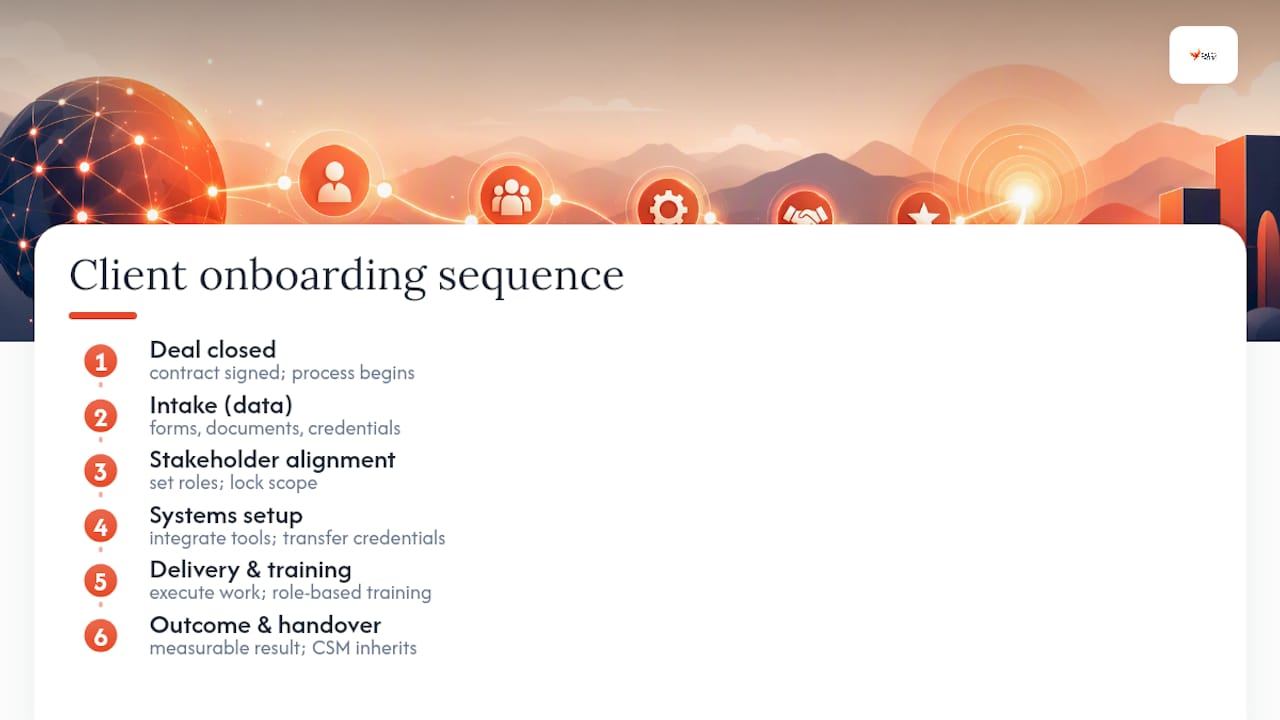
Client onboarding is the post-sale sequence that turns a signature into a working relationship. It starts the moment a deal closes and ends when the client experiences a measurable result, whether that's a live dashboard, a completed audit, or a first campaign launch. Everything in between, gathering information, aligning stakeholders, setting up systems, belongs to onboarding.
That's a different job than "intake," which is really just the data-collection piece: forms, documents, credentials. Intake is a phase inside onboarding, not a synonym for it. And it's a different job again from user onboarding, the product-side term for teaching someone to click the right buttons in software. Professional services onboarding is heavier than either. It usually requires stakeholder alignment across departments, some degree of change management, role-based training for different users at the client, and often a credential or systems exchange that a SaaS product never touches.
Scope matters because scope creep is where onboarding budgets die quietly. The work spans everything from the first welcome email to the point where a client can point to a concrete outcome and say "that's working." Miss that boundary and onboarding either ends too early, leaving a client confused about next steps, or drags on for months disguised as "getting settled in."
Ownership needs a name attached to it, not a department. In smaller agencies, the account executive who closed the deal often stays involved through the first milestone. Larger firms split this into distinct roles: sales owns the close, an onboarding manager or project lead owns the sequence itself, and a customer success manager (CSM) inherits the relationship once the client is stable. Delivery teams execute the actual work. Whatever structure you use, write down who owns which phase before the first client hits it. Ambiguity here is the single most common reason onboarding stalls in week one.
Why Fast Onboarding Drives Retention and Revenue
Time-to-value isn't an operations metric buried in a dashboard somewhere. It's the leading indicator of whether a client renews, expands, or quietly starts shopping competitors before their first invoice cycle ends. B2B onboarding research frames this plainly: onboarding is the structured path from signature to first measurable outcome, and the faster a client reaches that outcome, the more likely they are to stick around and buy more later.
The mechanics are straightforward once you see them. A client who gets a quick, visible win trusts the relationship enough to hand over more scope, more budget, or a referral. A client who spends three weeks waiting on a kickoff call starts wondering what else is slow. That doubt compounds. Slow onboarding doesn't just delay revenue, it actively seeds churn before the engagement has even started delivering.
The five-touchpoint minimum: OnboardMap's playbook identifies five touchpoints as the practical floor for onboarding cadence: the signed-contract confirmation, a welcome packet, a kickoff call, a day-3 check-in, and a week-2 first-deliverable review. Fewer than that and clients feel neglected. More than that, and most firms can't sustain the cadence at scale.
Cash flow benefits show up too, though less obviously. Faster onboarding means faster first invoices for milestone-based contracts, and it shortens the window where a client can walk away before you've delivered anything billable. Referrals follow a similar logic: clients refer you when they can already describe a result, and they can only describe a result once onboarding has produced one.
None of this requires guesswork about what "fast" means. The firms that treat time-to-value as the metric to protect, rather than an afterthought behind scope and pricing, are the ones whose onboarding function actually earns its keep.
The Seven-Phase Client Onboarding Checklist
This is the operational core: seven phases, each with an owner, a deliverable, a target SLA in days, and the specific artifacts that phase needs to produce. Treat it as a checklist you can hand to a project manager on day one, not a philosophy to absorb.
1. Welcome and portal access
Owner: Sales or onboarding manager Deliverable: Client has login credentials and a clear first task SLA: Same business day, ideally within hours of the signature
OnboardMap calls this the "golden hour": the first few hours after a contract closes are the highest-leverage moment in the entire relationship, because expectations are still forming. Send portal access, a welcome packet, and a single clear next step (usually the intake form) before the end of the day the contract is signed. Waiting until "next week" to say hello is the single most avoidable mistake in this list.
Required artifact: Welcome email template with portal link, primary contact name, and a one-line description of what happens next.
2. Discovery and intake
Owner: Onboarding manager or CSM Deliverable: Completed intake form and initial risk flags identified SLA: 2 to 3 business days from welcome
Intake should be the first substantive thing a client does inside your portal, not an afterthought buried in a PDF. A well-built 10 to 15 minute intake form surfaces most of the alignment risk you'd otherwise discover the hard way three weeks in, according to onboarding sequencing research. Build the form to ask about goals, existing systems, internal stakeholders, and any prior vendor history that might explain hesitation or specific requirements.
Sample intake field list:
- Primary business goal for this engagement (in the client's own words)
- Key stakeholders and their role in decision-making
- Existing tools/systems that need to integrate or migrate
- Budget approval process and who signs off on changes
- Prior experience with similar vendors (what worked, what didn't)
- Preferred communication channel and cadence
- Any hard deadlines or external dependencies
3. Document and credential collection
Owner: Onboarding manager, supported by delivery lead Deliverable: All named documents received and verified; credentials securely stored SLA: 3 to 5 business days, tracked against named deadlines per document
Vague requests like "send over your marketing materials" create weeks of back-and-forth. Name the exact document, set a deadline, and track status in real time as waiting, received, or reviewed. Document collection best practices are explicit on one security point: never request sensitive credentials over email. Use encrypted upload or a dedicated secrets manager instead, every time, regardless of how small the client is.
Credential checklist example:
- CRM or analytics platform access (specify exact tool and permission level)
- Billing or financial system read access if required for the scope
- Brand assets: logo files, style guide, existing content library
- Legal or compliance documents relevant to the engagement
- Any third-party API keys or integration credentials
Pro Tip: Build your document request list into the intake form itself as a checklist with due dates, rather than emailing it separately. Clients complete checklists inside a portal far more reliably than they respond to a list buried in an email thread.
4. Kickoff call
Owner: Onboarding manager, with delivery lead and key client stakeholder present Deliverable: Shared understanding of scope, timeline, and success criteria SLA: Within 5 to 7 business days of contract signature
The kickoff call is where onboarding either earns trust or loses it. A rushed 15-minute call with the wrong person on the client side accomplishes nothing. A well-run 45-minute call with the actual decision-maker sets the tone for the entire engagement.
Kickoff agenda bullets:
- Introductions and roles on both sides (5 minutes)
- Recap of goals from the intake form, confirmed live with the client (10 minutes)
- Walk through the project timeline and major milestones (10 minutes)
- Confirm communication cadence and preferred channels (5 minutes)
- Review what's needed from the client before the next milestone (10 minutes)
- Confirm next steps and send recap email within 24 hours (5 minutes)
Required artifact: Kickoff recap email sent within one business day, listing decisions made, action items with owners, and the date of the next check-in.
5. Implementation and setup
Owner: Delivery team lead Deliverable: Core systems configured, integrations tested, first workstream underway SLA: Varies by engagement complexity, but flag if setup exceeds 10 business days without a client-facing update
This is the phase most likely to run long without anyone noticing, because it's internal work that doesn't naturally generate client touchpoints. Force a check-in here even if there's nothing dramatic to report. A brief "here's where we are" message at the midpoint prevents the client from wondering if anything is happening at all.
6. Go-live and hypercare
Owner: Delivery lead, with CSM shadowing for handoff Deliverable: First deliverable or system goes live; issues triaged within a defined response window SLA: 48 to 72 hour hypercare window post go-live
Hypercare means treating the first few days after go-live as a heightened-attention period, not business as usual. Response times should be faster than your standard SLA during this window, because early friction here shapes the client's entire perception of ongoing support.
7. Handoff and first-week/30-day review
Owner: CSM (receiving), onboarding manager (transferring) Deliverable: Formal handoff to ongoing account management, plus a documented first-value milestone SLA: Handoff meeting within 3 days of go-live; 30-day review scheduled at handoff
Required handoff fields (the information that must transfer from sales and onboarding to whoever owns the account long-term):
- Original deal terms and any verbal commitments made during sales
- Key stakeholder map with decision-making authority noted
- All intake responses and document collection status
- Kickoff recap and any scope adjustments made since
- Outstanding risks or client concerns flagged during onboarding
- Date and description of the first measurable outcome delivered
A firm seven-phase structure like this, completed efficiently, commonly closes out core onboarding inside a week to ten days. Slower engagements aren't necessarily failing, but every extra week without a documented result increases the odds a client starts questioning the investment before they've seen the payoff.
How Do You Measure Onboarding Success?
Time-to-value is the headline metric, but it needs supporting numbers to be actionable rather than just aspirational. A minimum onboarding scorecard should track five things: time-to-value itself, activation rate (the percentage of new clients who reach a defined "active" state), milestone completion rate, time to first deliverable, and early engagement signals like portal logins or response speed to your outreach.
HubSpot's B2B guidance recommends setting between three and seven major milestones per account and tying each one to a client-facing outcome rather than an internal task. "Configured the dashboard" is an internal task. "Client can see their first weekly revenue report" is a milestone. The distinction matters because internal tasks measure your effort; outcomes measure the client's experience.
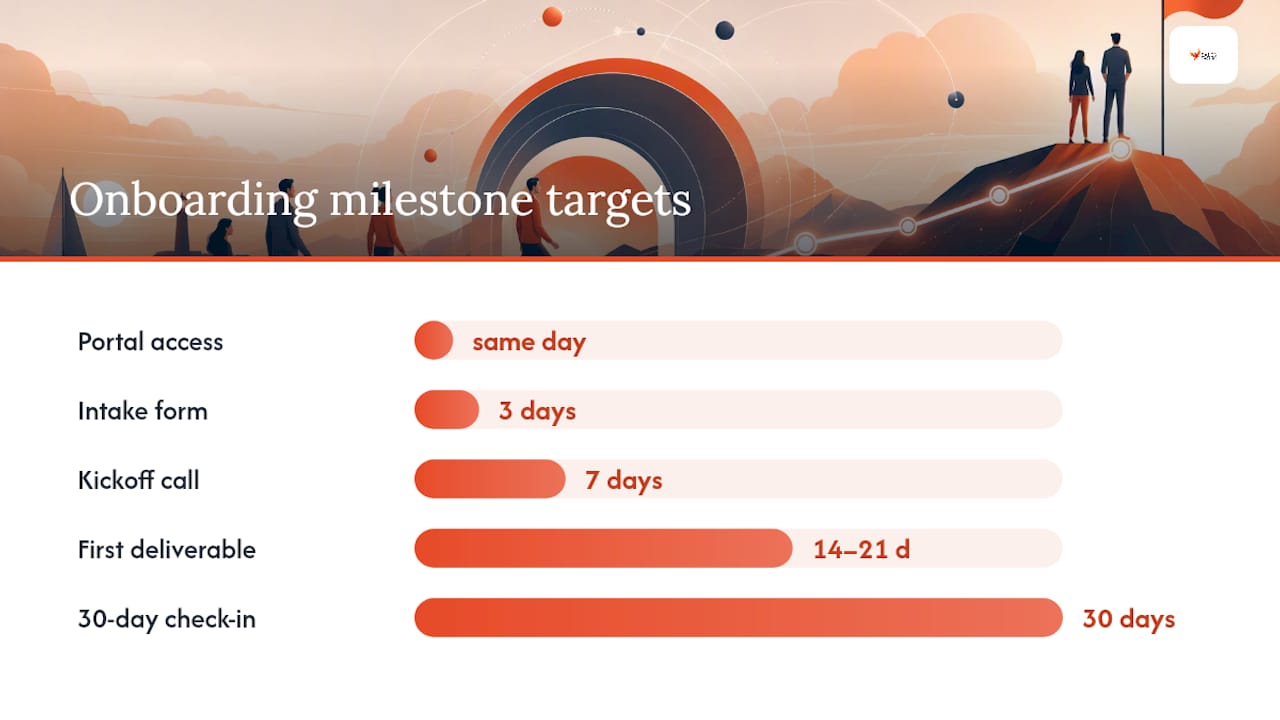
A workable milestone set for most service engagements:
- Contract signed to portal access granted (target: same day)
- Intake form completed (target: 3 days)
- Kickoff call held with correct stakeholder present (target: 7 days)
- First deliverable or system live (target: 14 to 21 days, engagement-dependent)
- 30-day check-in completed with documented client feedback (target: day 30)
Sample scorecard fields for a dashboard:
- Account name and onboarding start date
- Current phase and days in phase
- Milestone completion status (on track, at risk, delayed)
- Last client touchpoint date
- Assigned owner for current phase
Reporting cadence should match who's reading it. Operations teams need a weekly view of accounts by phase and any that are flagged at risk. Leadership needs a monthly rollup: average time-to-value across the client base, percentage of accounts hitting milestone targets, and any pattern in where accounts stall. If the same phase keeps showing delays across multiple clients, that's not a client problem, it's a process problem worth fixing once rather than patching account by account.
Common Onboarding Pitfalls That Predict Churn
Certain warning signs show up early and predict trouble reliably enough that they deserve a standing response plan rather than case-by-case improvisation.
- Slow welcome response. If more than 24 hours pass before a new client hears from anyone, the relationship starts on the back foot. Fix: enforce a same-day welcome SLA and assign backup coverage so no single person's calendar can block it.
- Missing decision-maker at kickoff. A kickoff call with a junior contact who can't confirm scope or approve changes wastes the meeting. Fix: confirm attendee names and titles before scheduling, and reschedule rather than proceed without the right person.
- Poor sales-to-success handoff. Weak handoffs are the most common root cause of onboarding failure, because the receiving team ends up reconstructing context the sales rep already had. Fix: make handoff fields mandatory in your CRM before a deal can be marked closed won.
- Delayed credentials or documents. A client who stalls on providing access for more than a week is often signaling deeper hesitation, not just being busy. Fix: escalate to a named contact after the second missed deadline, and ask directly whether something has changed.
- Scope slippage during setup. Requests that quietly expand beyond the signed contract during implementation erode margin and timeline both. Fix: pause and renegotiate in writing the moment scope shifts, rather than absorbing it silently to keep the client happy.
Pro Tip: Track how many onboarding red flags appear per account, not just whether one occurred. An account with two or three flags in the first two weeks is a strong candidate for a direct conversation about whether the engagement needs to be restructured before it goes further.
Know when to stop and renegotiate rather than push through. If a client has missed two deadlines, hasn't produced a decision-maker, and scope has already crept once, that's not a client to onboard faster, it's a client to have a frank conversation with before you invest more delivery hours against an unstable foundation.
Tools That Automate Onboarding Without Losing the Human Touch
The minimum effective stack for most service businesses is five pieces: a CRM to hold the client record, an intake form tool, a secure file portal, a task automation layer, and a shared workspace the client can actually see into. You don't need more than this to run a tight onboarding process, and adding more tools usually adds friction instead of removing it.
Automation should target the repetitive, time-sensitive administrative work, not the moments where a human voice matters. Good patterns include:
- A triggered welcome email the moment a deal moves to closed won, so the golden hour doesn't depend on someone remembering
- Milestone-triggered task creation, so completing intake automatically spins up the kickoff scheduling task without manual handoff
- Automated reminder cadences for outstanding documents, commonly set at day 3, day 7, and day 10 after the initial request
- Escalation alerts that notify a manager automatically when a phase exceeds its SLA, rather than relying on someone to notice
What automation should never replace is the kickoff call, the day-3 check-in, or the 30-day review conversation. Those are relationship moments, and clients notice immediately when a firm has automated its way out of talking to them.
A client-facing portal matters more than most firms initially assume, because internal-only project tools like a Kanban board built for your team leave the client guessing about status. A shared portal where they can see document status, upcoming milestones, and message history removes an entire category of "just checking in" emails. On security, treat credential handling as non-negotiable: never collect sensitive access credentials over email or unencrypted chat. Route them through encrypted upload or a secrets manager, and document who has access to what internally, since a client will eventually ask.
The Phoenix Growth Framework in Practice
Most onboarding failures aren't onboarding problems at all. They're revenue leaks that happen to surface during onboarding, a handoff nobody standardized, a milestone nobody defined, a follow-up nobody owned. The Phoenix Growth Framework™ maps directly onto the seven-phase structure above, standardizing the handoff fields between sales and delivery, defining SLA targets phase by phase, and building the milestone scorecard into an ongoing revenue leak assessment rather than a one-time audit.
The pattern shows up account after account: the deal that closes cleanly but stalls in week one almost always traces back to a handoff gap, not a client problem. Fix the handoff, and the rest of onboarding tends to fix itself.
Applying this discipline across client engagements has been part of how Sales Phoenix has helped recover more than $12 million in lost revenue and improve average close rates by 34%, gains tied directly to tightening the process failures that generic onboarding advice tends to skip past.
Two changes worth testing in week one: make handoff fields mandatory in your CRM before a deal can close, and set a hard SLA on welcome-email response time. Both are free to implement and both address the two most common leaks in the framework's diagnostic work.
How to Tailor Onboarding by Client Segment or Industry
A single onboarding template rarely fits every client type, and forcing one usually shows up as friction in the first two weeks. Segment-specific playbooks work better because each stakeholder sees only the steps relevant to their situation, rather than wading through irrelevant instructions built for a different kind of client.
Enterprise clients typically need a longer discovery phase, more stakeholders in the kickoff call, and formal change-management steps for internal teams adopting new processes. A 15-minute intake form that works for a small business client will feel dismissive to an enterprise buyer who has procurement, legal, and IT all expecting a voice in the process.
Smaller service businesses, by contrast, often move faster and want less ceremony. A solo consultant or a five-person agency doesn't need a formal kickoff deck; they need a fast, friendly call and a clear first task. Overbuilding process for this segment slows them down and can read as bureaucratic overhead they didn't sign up for.
Industry matters too. A client in a regulated field like healthcare or financial services needs compliance documentation and security review built into the credential collection phase from day one, not bolted on when someone asks about it. A creative agency client, by contrast, may care more about brand alignment and creative approval workflows than technical integration steps.
The practical fix is a tiered template system: two or three onboarding variants keyed to deal size, industry, or complexity, with automated enrollment based on CRM fields set at the point of sale. Build the branching logic once, and every new client gets the right version automatically instead of a project manager deciding case by case.
Who Owns What During Onboarding
Onboarding fails most often not because a task gets missed, but because everyone assumed someone else owned it. Assigning roles explicitly, in writing, before the first client goes through the process removes most of that ambiguity.
Sales typically owns the relationship through contract signature and the handoff itself, meaning they're responsible for populating the mandatory handoff fields, not just closing the deal and moving on. The onboarding manager or project lead owns the sequence from welcome through go-live, coordinating between the client and whichever internal teams need to deliver. Delivery or implementation teams own the actual configuration, setup, or production work happening behind the scenes. The customer success manager inherits the account at handoff and owns the ongoing relationship, including the 30-day review and beyond.
Smaller firms often collapse two or three of these roles into one person, and that's fine as long as the responsibilities are still named explicitly rather than assumed. The failure mode isn't having fewer people, it's having unclear boundaries between the people you do have. A common gap: nobody owns the period between "delivery finishes setup" and "CSM formally takes over," and that gap is exactly where onboarding tends to stall silently for a week or two.
Leadership's role is different from any of the above: they own the scorecard, not the day-to-day execution. Reviewing the monthly rollup of time-to-value and milestone completion is a leadership responsibility, and it's the mechanism that catches systemic problems before they show up as a pattern of lost renewals.
Communicating With Clients Throughout Onboarding
The cadence matters as much as the content. Five touchpoints, spaced deliberately, outperform either a flood of check-ins or long silences between milestones. That means a confirmation email at signature, a welcome packet, the kickoff call, a brief day-3 check-in, and a week-2 review of the first deliverable, each one earning its place rather than existing as a box to check.
Match the channel to the message. Status updates and document requests belong in the portal or email, where there's a written record both sides can reference later. Anything involving a decision, a scope question, or a concern belongs on a call, because tone and nuance get lost in a message thread exactly when they matter most.
Set expectations for response time explicitly during kickoff rather than letting clients guess. Tell them directly: "You'll hear from us within one business day on any request, and we'll flag proactively if something's going to take longer." That single sentence prevents most of the "are they still working on this?" anxiety that drives premature check-in emails from the client side.
Silence is the most damaging communication failure in onboarding, more damaging than an honest delay. A client who hears "this is taking longer than expected, here's why" tolerates it far better than a client who hears nothing for a week and fills the silence with their own worst assumptions. Build a rule into your process: no phase should go more than five business days without some client-facing update, even if the update is just "still on track, next milestone is Thursday."
Training and Support for New Clients
Onboarding doesn't end at go-live, it transitions into a support phase that needs its own structure, particularly for engagements involving new systems, dashboards, or processes the client's team has to adopt.
Role-based training works better than one-size-fits-all walkthroughs, because the person approving budgets doesn't need the same training as the person using a dashboard daily. Build short, role-specific resources, a two-minute video for the daily user, a one-page summary for the executive sponsor, rather than a single hour-long training session everyone sits through regardless of relevance.
Documentation should live somewhere permanent and searchable, not buried in a kickoff slide deck nobody opens again. A shared portal with a simple knowledge base, even just a handful of short articles covering the most common questions, cuts down on repetitive support requests substantially.
The hypercare window covered in the seven-phase playbook is the highest-support period by design, but support shouldn't cliff-edge to nothing once that window closes. A defined "first 30 days" support tier, with slightly faster response times than standard ongoing support, bridges the gap between hypercare and normal account management. Tell clients explicitly when that tier ends and what support looks like afterward, so there's no unpleasant surprise when response times shift back to standard.
Connecting Onboarding to Your CRM and Internal Systems
Onboarding data that lives only in someone's inbox or a standalone spreadsheet disappears the moment that person is out sick or leaves the company. Every phase, milestone, and handoff field belongs in the CRM, where it's visible to whoever needs it and survives staff turnover.
The handoff fields named earlier in this piece should be CRM fields, not notes in a deal description. Deal terms, stakeholder map, intake responses, and first-value milestone date all need dedicated, structured fields that populate automatically as the deal moves through pipeline stages. This is what makes automation possible in the first place. You can't trigger a welcome email off "closed won" if closed won doesn't reliably carry the information that email needs.
Integration between the CRM and your intake form or portal tool avoids the double-entry problem, where a client fills out information once and someone on your team manually retypes it into the system of record. That manual step is where data goes stale or gets lost. A direct integration, even a simple one, removes an entire category of onboarding delay caused by nothing more than administrative lag.
The payoff shows up at the reporting level. If milestone data lives in the CRM, the weekly and monthly scorecards described earlier build themselves from existing fields instead of requiring someone to manually compile a report every week. That's the difference between a scorecard people actually check and one that quietly stops getting updated after the second month.
Collecting Client Feedback During and After Onboarding
Feedback collected only at the very end of onboarding arrives too late to fix anything in that engagement, it just tells you what to change for the next client. Building in feedback checkpoints during the process itself catches problems while there's still time to course-correct.
A short pulse check after the kickoff call, even a single question like "did this cover what you needed?", surfaces misalignment before it compounds into a bigger issue by week three. The day-3 and week-2 touchpoints in the five-touchpoint cadence are natural moments to ask this without it feeling like a separate survey process bolted onto the relationship.
The 30-day review is the more formal feedback moment, and it should be treated as a real conversation rather than a satisfaction score to log and forget. Ask specifically what worked, what felt slow, and whether the client would describe the first-value milestone as genuinely valuable or just technically complete. That distinction matters: a deliverable can be "done" without the client feeling like they got what they actually needed.
Feed what you learn back into the process itself, not just into that one client's file. If three consecutive clients flag the same phase as confusing or slow, that's a playbook problem worth fixing at the template level rather than a coincidence to note and move past. The firms that treat onboarding feedback as product feedback for their own operations are the ones whose time-to-value keeps improving year over year instead of staying flat.
Three Experiments to Run This Week
Pick a stakeholder for each and measure before you overhaul anything. First, set a same-day SLA for the welcome email and assign a backup owner so it never slips; you'll know it's working when every new client hears from you within hours instead of days. Second, make handoff fields mandatory in your CRM before a deal marks closed won, owned by sales leadership; success looks like zero "reconstructing context" conversations in week one. Third, run a 15-minute day-10 check-in owned by the onboarding manager. If clients start volunteering concerns before you ask, the experiment worked.
— Hunter
Fix Onboarding Leaks With Sales Phoenix
Everything in this playbook works better with visibility into where your onboarding is actually leaking revenue, not just where it feels slow. Sales Phoenix's Revenue Intelligence service diagnoses exactly that: which handoff fields are missing, which milestones stall consistently, and where time-to-value is quietly costing you renewals before anyone flags it internally.
An engagement typically produces three concrete deliverables: a diagnostic assessment of your current onboarding sequence against the seven-phase structure, a prioritized success plan ranking which fixes recover the most revenue fastest, and an automation runbook your team can implement without hiring outside help. For firms further along, Growth Operations builds the standardized systems that make this repeatable across every new client, not just the next one.
If onboarding delays are costing you renewals you can't quite explain, start with a Revenue Leak Assessment to see exactly where the gaps are before you rebuild anything.
Sources
For deeper templates and checklists referenced throughout this playbook: HubSpot's B2B onboarding best practices covers time-to-value fundamentals and handoff field recommendations. OnboardMap's complete playbook offers free templates for intake and kickoff. Ditch Manual's interactive checklist works well for professional services firms building their first structured process.
- 10 B2B customer onboarding best practices to accelerate time-to-value
- Client Onboarding Guide 2026: The Complete Playbook + Free Templates | OnboardMap