

Yes, run it, if you follow the sequence that protects your sender reputation while it works: audit dormant contacts, segment by churn reason and recency, send in gated waves, and escalate the offer over a short, multi-touch sequence. Sales-phoenix built its Phoenix Growth Framework™ around exactly this order because skipping steps is what tanks deliverability and wastes the list.
TL;DR:
- Segment dormant contacts by churn reason and recency to prioritize high-value and recent contacts for more effective outreach.
- Match your message to specific hesitations, such as value proof for price-sensitive contacts or product updates for feature-missing users.
- Start with warm cohorts and expand gradually, monitoring bounce and complaint rates to protect overall deliverability.
- Verify email authentication and clean your list before sending to avoid damaging your domain's reputation and ensure higher inbox placement.
- Measure success through reactivation and revenue recovery, tracking engagement signals beyond opens, and sunset unresponsive segments promptly.
Table of Contents
- How to audit and segment a dormant database
- What offer and message actually gets someone to come back?
- How should you sequence sends across channels?
- What deliverability checks do you need before sending?
- How do you measure whether it's working?
- What Sales-phoenix has learned from running reactivation programs
- Get a database reactivation and revenue leak assessment
- Sources
How to audit and segment a dormant database
Before you write a single subject line, pull the data that tells you who is actually worth emailing. Your CRM already has most of it: last meaningful action (not last login, but last purchase, quote, or reply), stated cancellation reason if you captured one, and purchase or renewal dates. Churnkey's research on reactivation campaigns makes a strong case that the cancellation moment itself is often your highest-converting intervention point, because the reason for leaving is fresh and specific rather than guessed at months later.
Once you have that data, sort contacts into segments that reflect why they went quiet, not just that they did:
- Involuntary churn — a failed payment, expired card, or lapsed subscription that was never a deliberate exit
- Price-sensitive — canceled or stopped buying after a price increase or a competing quote
- Feature-missing — left because the product didn't do something they needed at the time
- Passive/inactive — never explicitly churned, just stopped opening or clicking
- Competitor-switch — a known move to a rival, often the hardest segment to win back
Recency matters as much as reason. RevenueCat's research on app reactivation found that lapse windows should match the product's natural repurchase cycle rather than a blanket 90-day rule. A monthly subscriber going quiet for 30 days is a different signal than an annual buyer at 30 days. Order your outreach warmest-first: send to the 14 to 30-day lapsed group before you touch anyone dormant for six months or more. And weight your list with RFM (recency, frequency, monetary value) so your best former customers get first and deepest attention, while long-cold, low-value contacts get lighter touches or none at all.
What offer and message actually gets someone to come back?

Generic "we miss you" emails convert poorly because they ignore the real objection behind each churn reason. The fix is matching your message to the specific hesitation: price objections need proof of value before they need a discount, feature-missing contacts need to hear what changed in the product, and passive users often just need a reason to remember you exist. Growth Models documented a case where a sequence built around removing distinct hesitations, one email per objection, drove revenue out of a list that looked dead on paper.
A workable message framework follows this order:
- Reconnect with value, no ask attached. Remind them what they got, what's new, or what they're missing.
- Answer the specific objection. Price-sensitive segments see proof of ROI or a case study; feature-missing segments see a product update.
- Reduce friction. Offer a pause, a downgrade, a shorter commitment, or a guided onboarding call instead of jumping straight to a discount.
- Time-boxed incentive. Only now does a discount or credit show up, sized by RFM so your highest-value accounts get treated differently than your lowest.
That ordering matters. Digital Applied's win-back research found that four-step escalating sequences beat single discount blasts on cumulative conversion, largely because leading with a discount trains your list to wait you out instead of engaging with the value pitch.
Pro Tip: *Size your incentive to customer value, not campaign convenience.
How should you sequence sends across channels?
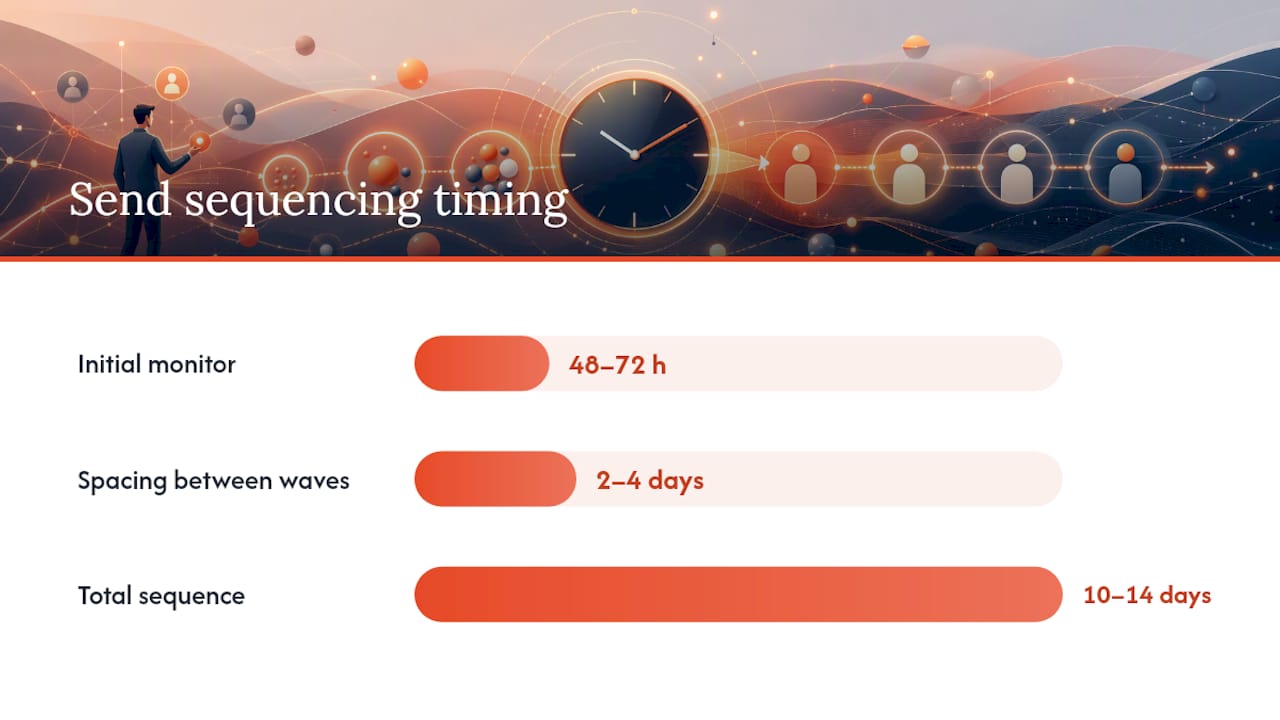
Deliverability is the constraint that decides whether any of this works, so treat your send order as a risk ladder, not a broadcast list. Start with your warmest, most recently engaged cohort, watch bounce and complaint rates for 48 to 72 hours, and only expand to colder segments once those signals stay clean. Martech's guidance on reviving dormant lists backs this gated approach directly: mailbox providers judge your whole domain by how recipients react to the first wave, so a bad reaction from a cold segment can suppress inbox placement for everyone after it.
A four-step sequence compressed into roughly 10 to 14 days, spaced two to four days apart, tends to outperform a slower drip because it captures attention while your brand is fresh in the recipient's inbox again. Beyond email:
- Add SMS for high-value or time-sensitive offers where you have consent and a mobile number on file
- Use retargeting ads to reinforce the message for contacts who opened but didn't click
- Try LinkedIn outreach for B2B contacts where email has gone consistently unopened
- Enrich contact records with updated job titles, phone numbers, or firmographic data before your final push, since stale records are often why "inactive" contacts never engaged in the first place
Consider a warmed subdomain for the coldest tier of your list. It isolates risk from your primary sending domain, but it also means starting reputation from zero, so weigh that tradeoff against how large that cold segment actually is.
What deliverability checks do you need before sending?
Skip this section and you risk more than a failed campaign. You risk your entire email program landing in spam for months. Confirm your authentication is correct first: SPF, DKIM, and DMARC alignment, checked and validated, not just configured once years ago and forgotten. The SBA's email marketing guidance treats these basics, along with clear permission and consent records, as non-negotiable groundwork for any small business email program, and that holds just as true for a one-time reactivation push as for routine sends.
Run your list through an email verification tool before the first send and suppress anything flagged as invalid, risky, or a known spam trap.
- Suppress immediately: hard bounces, role-based addresses (info@, sales@), and anything a verifier scores high-risk
- Watch closely: bounce rate above roughly 2% or complaint rate above 0.1% on any single wave
- Pause the campaign if either threshold trips during a wave, and investigate before resuming
- Sunset non-responders after two or three full cycles with no opens or clicks, and stop mailing them
Reactivating an existing customer reportedly costs 5 to 7 times less than acquiring a new one, with win-back odds in the 20 to 40% range against 5 to 20% for cold prospects, which is exactly why the deliverability discipline is worth the extra week it takes to do right.
How do you measure whether it's working?
Reactivation rate (contacts who take a meaningful action, not just open) and time-to-reactivation are your headline numbers, calculated per segment rather than blended across the whole list. A segment converting at 8% in five days tells you something completely different than one converting at 8% over six weeks.
Track these alongside conversion:
- Deliverability health — bounce and complaint rates per wave, watched continuously, not just at launch
- Incremental revenue — attribute recovered revenue to the specific segment and offer that drove it
- Long-term retention — whether reactivated customers stick around or churn again within 90 days
- Clicks and purchases over opens — open rates get inflated by privacy protections in modern email clients, so treat clicks and purchases as the more honest engagement signal
Run any test (a new subject line, a different incentive depth) on a small sample before rolling it to a full segment, and stagger the ramp the same way you would a first send. If a segment's ROI stays negative after a full sequence, sunset it rather than mailing it again.
What Sales-phoenix has learned from running reactivation programs
The Phoenix Growth Framework™ maps almost exactly onto this sequence: audit the database for revenue hiding in plain sight, segment by churn reason and value, orchestrate the sends across channels in the right order, then measure recovered revenue against cost.
Where I'd push back on conventional advice: most guides treat reactivation as a marketing task. It's a revenue operations task that happens to use email. The segmentation, the RFM weighting, the sunset discipline, all of that is closer to sales analytics than copywriting.
Run it in-house if your list is under a few thousand contacts and your CRM data is clean. Bring in outside help when you're integrating multiple data sources, your deliverability history is shaky, or you need cross-channel orchestration across email, SMS, and retargeting at once. That's usually where DIY reactivation attempts quietly fail.
— Hunter
Get a database reactivation and revenue leak assessment
You've read the framework. The harder part is executing it without guessing which segments are actually worth the effort or accidentally torching your sender reputation on the first send. Sales-phoenix runs a Revenue Leak Assessment that finds exactly where dormant contacts, missed follow-ups, and stalled deals are costing you money before you spend a dollar on outreach.
From there, the Database Reactivation engagement handles the audit, segmentation, and gated-send execution described above, backed by the same Phoenix Growth Framework™ that's recovered over $12 million for other service businesses and professional firms. If you want visibility into recovered revenue by segment as the campaign runs, pair it with the Revenue Intelligence dashboard. Book a growth assessment to find out what's sitting dormant in your own database and what it's worth to recover.
Sources
- 7 ways to revive dormant email lists without wrecking deliverability | Martech
- What is a reactivation campaign and how you can implement one (with examples) | Churnkey
- Customer Win-Back Campaigns: 2026 Retention Playbook | Digital Applied
- Email marketing basics for small business | SBA
- How to build a reactivation strategy that actually works | RevenueCat