

Digital transformation services combine strategy, process redesign, and technology to fix specific business problems, lost revenue visibility, slow delivery, disconnected systems, and turn them into measurable gains. The right partner starts with your business outcomes, not a software catalog. Decision-makers should expect three things from a good engagement: clearer revenue and operational data, faster time to value on new tools, and a customer experience that doesn't fall apart when you scale.
TL;DR:
- Focusing first on connecting foundational systems enhances data trust and reduces project timelines for adding advanced analytics later.
- Leaders should define clear business outcomes and prioritize initiatives that impact revenue and costs before selecting technology or vendors.
- Successful partnerships require outcome-driven proposals with measurable KPIs and a proven track record in similar industry settings.
- Post-go-live support and governance are critical to ensuring adoption, with regular checkpoints at 30, 60, and 90 days to measure progress.
- Industry-specific pain points, such as client data fragmentation or scheduling issues, should guide the scope of initial transformation efforts.
Table of Contents
- What Digital Transformation Services Actually Cover
- Why a Strategy-First Approach Beats a Technology-First One
- How Do You Choose the Right Transformation Partner?
- What Do Timelines and Pricing Actually Look Like?
- Governance and the Metrics That Prove the Work Is Paying Off
- How Sales-phoenix Runs Transformation Engagements
- How Transformation Changes Company Culture
- What Happens After Go-Live?
- Do Industry-Specific Approaches Matter?
- Where Do Transformation Initiatives Go Wrong?
- What Should You Actually Do Next?
- How Sales-phoenix Can Help You Move Forward
- Sources
What Digital Transformation Services Actually Cover
The phrase gets thrown around loosely, but the work breaks into recognizable capability buckets. Most engagements touch some combination of the following, and the smart ones sequence them rather than tackling everything at once.
- Strategy and consulting: defining outcomes, prioritizing initiatives, and building the roadmap before anyone talks about software.
- Process redesign: mapping how work actually moves through the organization and removing the steps that exist only because "that's how we've always done it."
- Cloud and infrastructure: migrating off aging on-premise systems and rebuilding for flexibility and cost control.
- Application modernization: replacing or rebuilding legacy software that can't integrate with anything modern.
- Data and AI: consolidating fragmented data sources and applying analytics or automation where it produces a real decision, not a dashboard nobody opens.
- Integration and APIs: connecting the systems that currently require someone to copy numbers from one screen to another.
- Cybersecurity: baking protection into the architecture instead of bolting it on after a breach.
- UX and omnichannel: making sure customers get a consistent experience whether they call, click, or walk in.
- Managed services: ongoing support after go-live, because transformation doesn't end at launch.
It helps to separate foundational systems from advanced capabilities. Foundational systems are the ones everything else depends on: your CRM, your core operations platform, the integration layer that lets them talk to each other. Practitioner guidance on mid-market sequencing is blunt about the order here: connect the foundational layer first, then layer AI-driven workflows and advanced analytics on top. Skip that order and you get a company running predictive analytics on data nobody trusts.
A short example makes the stakes concrete. A regional accounting firm with disconnected intake forms, spreadsheets, and email threads doesn't need a machine learning model. It needs one system of record and an integration layer. Once that foundation exists, adding automated client reminders or a referral tracking dashboard becomes a two-week project instead of a six-month rebuild.
Why a Strategy-First Approach Beats a Technology-First One
Most transformation failures share a root cause: the organization picked the software before it decided what problem the software was supposed to solve. Research framing digital transformation as a dynamic capability backs this up. Success depends on aligning leadership vision, governance, culture, skills, and process redesign, not on which vendor you signed with. Technology is the last variable, not the first.
CIO.com puts it plainly: confusing infrastructure tools like CRM or ERP with strategy is one of the most common reasons projects fail. A CRM doesn't fix a broken sales process. It just gives that broken process a faster interface.
The practical sequence that avoids this trap looks like this:
- Define business outcomes first. What does success look like in revenue, cost, or retention terms, not in feature terms?
- Audit the current state. Where does work actually break down, and what does it cost you today?
- Prioritize by impact and effort. Rank initiatives by what moves the outcome fastest with the least disruption.
- Build the roadmap. Sequence foundational systems before advanced capabilities, with checkpoints between phases.
Before any of that, get these artifacts on paper: a North Star statement of what the business is trying to achieve, a short list of business outcomes tied to numbers, a baseline of current metrics, and a prioritized backlog everyone has agreed to.
Pro Tip: If you run a mid-market company, resist the urge to fix everything simultaneously. A limited initial scope preserves operational continuity and makes it possible to actually attribute results to the work you did, rather than guessing which of five simultaneous changes caused the improvement.
How Do You Choose the Right Transformation Partner?
Vetting a digital transformation services partner comes down to a handful of criteria that separate firms who deliver outcomes from firms who deliver invoices.
- Outcome orientation. Does the proposal open with business results or with a list of technologies?
- Measurable KPIs. Will they commit to specific metrics, tied to timelines, before the contract is signed?
- Change management capability. Do they have an actual plan for getting your staff to use the new system, not just install it?
- Integrations experience. Have they connected systems like yours before, or is this their first attempt?
- Data governance and security. Who owns the data, who can access it, and how is it protected during migration?
- Fit with your size and industry. A framework built for a 5,000-person enterprise rarely survives contact with a 40-person professional firm.
A short set of interview questions surfaces most of this in under an hour: Who exactly will be on our team, and what's their track record on projects our size? How do you measure success 90 days after go-live? What happens when scope needs to change mid-project? Who owns adoption once the system is live, your team or ours?
The answers tell you more than any pitch deck.
A proposal that leads with a platform name instead of a business outcome is a proposal built to sell software, not to fix your revenue problem.
Watch for red flags that should end the conversation quickly: a proposal with no measurement plan, a team that can't describe a comparable past project in detail, vague language about "transformation" with no specific deliverable dates, or a pricing model with no defined scope boundaries. Any one of these should make you ask harder questions before signing anything.
What Do Timelines and Pricing Actually Look Like?
Engagements typically take one of four shapes: a discovery and roadmap phase, a phased implementation, an ongoing managed services retainer, or outcome-based work tied to specific results. Most companies move through the first two before ever considering the third or fourth.
Realistic timeline bands matter more than the marketing copy suggests. A discovery and roadmap phase usually runs four to eight weeks. A first implementation phase, covering one foundational system, tends to run three to six months depending on integration complexity. After go-live, plan for a few months adoption stabilization window. Practitioner benchmarks recommend tracking weekly active usage during this period as an early warning signal, because adoption that hasn't stabilized by day 90 rarely fixes itself without intervention.
On pricing, expect one of three models:
- Fixed-scope project fees for discovery, roadmap design, or a defined implementation.
- Retainer-based fees for ongoing managed services and continuous improvement.
- Outcome-based fees, tied to specific metrics like recovered revenue or adoption rates.
Whatever the model, insist on contract language covering three things: clearly defined deliverables (not just "modernization"), success metrics with numbers attached, and a change control process for when scope shifts, because it usually does.
Governance and the Metrics That Prove the Work Is Paying Off
Transformation initiatives lose funding not because they fail, but because nobody can prove they worked. Governance fixes that. Governance research consistently points to a structure with an executive sponsor, a named program lead, and departmental adoption owners reporting through a program management office. Skip any one of these roles and accountability gets fuzzy fast.
The metrics split into two categories that get confused constantly:
- Implementation metrics track whether the project is on schedule: milestones hit, systems deployed, integrations completed.
- Outcome metrics track whether it actually worked: adoption rates, process efficiency gains, revenue impact, and data quality improvements.
A project can hit every implementation milestone and still fail on outcomes if nobody adopts the new system. That's why the 90-day adoption checkpoint matters so much. Weekly active usage below expected thresholds at that point is the clearest early signal that a rollout needs intervention, whether that's more training, a redesigned workflow, or a hard look at whether the tool fits the process at all.
Set checkpoints at 30, 60, and 90 days post-launch, then quarterly after that. Each checkpoint should compare actual adoption and process metrics against the baseline captured before the project started. Without a baseline, "improvement" is just a feeling. Tools like an executive dashboard make this comparison visible to the people who control the budget, which matters more than any technical success metric.
How Sales-phoenix Runs Transformation Engagements
A proprietary growth framework is built around one idea: transformation only counts if revenue and operations actually improve, not if a new dashboard exists. The framework moves through five stages: assess, prioritize, implement, adopt, measure.
- Assess: a growth assessment and revenue leak assessment pinpoint where deals stall, where leads go cold, and where operational friction is costing money.
- Prioritize: findings get ranked by dollar impact, not by which fix sounds most exciting.
- Implement: process redesign and system changes happen in a sequence that protects daily operations.
- Adopt: change management support ensures staff actually use the new workflow.
- Measure: an executive dashboard tracks outcomes against the original baseline.
Pro Tip: If you're unsure where to start, a growth assessment is a lower-commitment first step than a full implementation contract. It tells you where the money is actually leaking before you spend a dollar fixing the wrong thing.
How Transformation Changes Company Culture
Technology rollouts fail more often on culture than on code. A dynamic capability lens on digital transformation treats culture, skills, and governance as being just as decisive as the systems themselves, and that shows up constantly in practice.
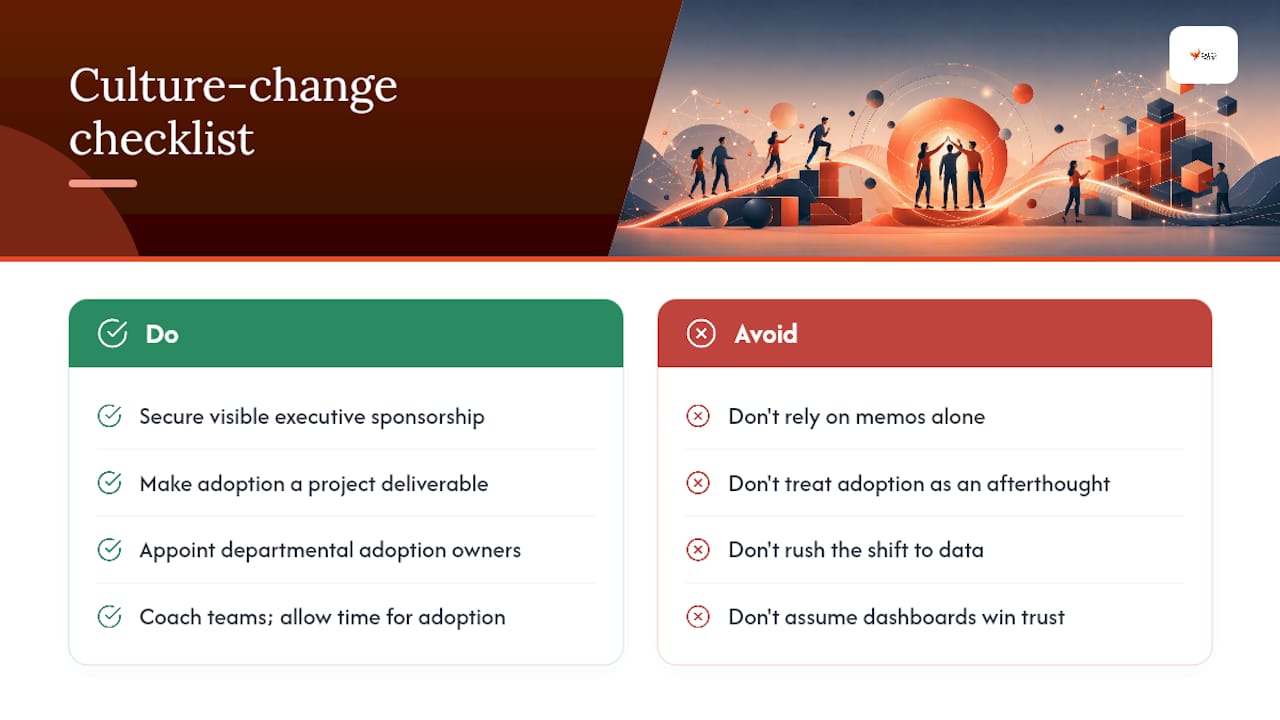
Staff who've watched three previous "transformation" attempts stall will resist a fourth on instinct, regardless of how good the new system is. Overcoming that requires visible executive sponsorship, not just a memo, and a change management plan that treats adoption as a project deliverable rather than an afterthought. Departmental adoption owners matter here because they translate abstract goals into "here's how this changes your Tuesday," which is the level staff actually care about.
The cultural shift that matters most is moving from opinion-based decisions to data-informed ones. That's a bigger change than any software migration, and it takes longer to stick. Teams accustomed to making calls on gut instinct need time, and often coaching, before they trust a dashboard over their own judgment. Rushing that transition is a common reason expensive systems sit underused six months after launch.
What Happens After Go-Live?
The most common mistake in transformation work is treating go-live as the finish line. It's the starting line for the phase that actually determines ROI.
Post-implementation support should include a defined support model: who staff calls when something breaks, how quickly issues get triaged, and who owns minor enhancement requests versus major scope changes. Without this clarity, small frustrations pile up until staff quietly reverts to the old workaround.
Continuous improvement works best on a cadence, not an ad hoc basis. Quarterly reviews of adoption and process metrics, compared against the original baseline, catch drift before it becomes a crisis. If usage is declining or a workflow isn't producing the expected time savings, that's the moment to adjust, not six months later when someone asks why the project didn't deliver.
Budget for this phase explicitly. Organizations that treat managed services or retainer support as optional almost always end up paying more later in emergency fixes and re-training than they would have paying for ongoing support upfront.
Do Industry-Specific Approaches Matter?
Generic transformation advice only goes so far. A professional services firm managing client engagements has different bottlenecks than a restoration contractor managing job scheduling and insurance claims, and the right approach reflects that.
For professional and service firms, the recurring pattern is fragmented client data across intake forms, email, and spreadsheets, which makes it nearly impossible to see where referrals or renewals are being lost. The fix usually starts with database reactivation and a unified system of record before any advanced analytics get added.
For field-based service businesses, like restoration or facilities companies, the bottleneck tends to be scheduling and job visibility rather than customer data. Foundational work here often means an operations platform that connects field crews to office scheduling in real time.
Sizing the initial scope to the industry's actual pain point, rather than a generic technology checklist, is what separates a useful engagement from a expensive one.
Where Do Transformation Initiatives Go Wrong?
Most pitfalls trace back to a handful of repeatable mistakes. Scope creep tops the list: a project that started as "fix the intake process" becomes "rebuild every system we own" somewhere around month three, usually because nobody had a documented backlog to point back to.
Underestimating change management is close behind. Buying the right software and skipping the training and communication plan produces expensive shelfware. Weak data governance causes a third common failure: migrating messy data into a new system just moves the mess, it doesn't clean it.
Finally, measuring the wrong things sinks otherwise solid projects. Tracking only implementation milestones, on schedule, on budget, while ignoring whether anyone adopted the new workflow, means the project can report success right up until leadership realizes revenue never moved. Avoiding these traps takes discipline more than budget, which is good news for companies that can't afford another failed rebuild.
What Should You Actually Do Next?
If there's one prioritized move for a mid-market leader reading this, it's an honest current-state audit paired with one foundational system fix, not five simultaneous initiatives. Sequence in small, provable steps rather than a big-bang rollout, and put governance in place before the first contract is signed, not after the first missed deadline.
Case studies and author credentials will be added by the editorial team.
— Hunter
How Sales-phoenix Can Help You Move Forward
Some transformation services are built to close the gap between strategy tied to revenue outcomes and technology rollouts that hope revenue follows. Unlike traditional systems integrators that sell infrastructure and move on, these services stay focused on identifying revenue leaks such as lost leads, missed follow-ups, and invisible revenue flows, then build the fix around those issues rather than a product catalog.
The Phoenix Growth Framework™ starts with a diagnostic, not a proposal. A revenue leak assessment shows you where deals are stalling and where operational friction is costing you close rate before anyone recommends a system change. From there, revenue intelligence dashboards give you visibility into what's actually happening in your pipeline, so decisions get made on data rather than guesswork about what's broken.
If your current systems feel disconnected and you're not sure where the revenue is actually leaking, book a growth assessment and get a clear picture before committing to a bigger engagement.
Sources
For deeper reading on the research and frameworks referenced above: the Springer review of digital transformation as a dynamic capability covers the academic foundation; Rework's mid-market framework offers practical sequencing guidance; Cio and Accenture provide practitioner and enterprise perspectives, respectively.
- From Stimuli to Strategy: Decoding the Complexities of Modern Digital Transformation (Springer)
- Digital Transformation Strategy — A Practical Framework for Mid-Market Leaders (Rework resources)