

Marketing sales alignment means both teams operate from one jointly owned revenue funnel, with shared metrics and signed service-level agreements defining every handoff. Get this right and the payoff shows up fast: less lead leakage, faster deal velocity, and higher close rates, since sales stops rejecting leads it never agreed to accept. Companies that build this structure consistently outgrow those that leave marketing and sales running parallel, competing systems.
TL;DR:
- Companies must formalize a single, jointly owned revenue funnel with clear stage definitions, ownership rules, and SLAs to prevent deal leakage.
- Misalignment often results from parallel funnels, mismatched KPIs, and unstructured handoffs, which reduce forecast reliability and increase customer acquisition costs.
- Building an agreed funnel takes about 90 days and involves documenting detailed criteria, SLAs, and structured rejection reasons before investing in automation or predictive tools.
- Achieving full alignment progresses through stages, from independent funnels to mature predictive analytics, with signed SLAs being the key transition point.
- The most effective way to fix revenue leaks starts with defining and agreeing on stage criteria and SLAs, rather than rushing into technology or incentives changes.
Table of Contents
- What Does Marketing Sales Alignment Actually Mean?
- Why Does Sales Alignment Actually Move Revenue?
- What Are the Warning Signs of Sales and Marketing Misalignment?
- How Do You Build an Agreed Funnel That Actually Holds?
- What Is the 90-Day Plan to Align Sales and Marketing?
- What Are the Stages of Alignment Maturity?
- What Should You Measure to Prove Alignment Is Working?
- What Technology and Data Rules Keep Alignment From Breaking?
- How Sales-phoenix Applies the Phoenix Growth Framework™
- Three Blind Spots Executives Miss When Sponsoring Alignment
- Fix the Leak Before You Scale the Funnel
- Sources
- FAQ
What Does Marketing Sales Alignment Actually Mean?
Alignment is not a meeting cadence or a shared Slack channel. It is a single, jointly owned revenue funnel, sometimes called the agreed funnel, that replaces the two separate systems most companies run by default: a marketing funnel that ends at "lead handed off" and a sales funnel that starts wherever a rep decides it starts. That gap between the two is where deals disappear.
A working agreed funnel usually runs through seven stages, from initial awareness to closed revenue, and each stage needs three things documented in writing: what marketing owns, what sales owns, and what both sides own jointly. Skip that documentation and you get exactly the fights alignment is supposed to prevent.
- Stage definitions. Every stage (visitor, lead, marketing qualified lead, sales qualified lead, opportunity, customer, expansion) has one written definition both teams sign off on, not two competing interpretations.
- Ownership rules. Marketing owns awareness and nurture; sales owns qualification calls and close; both own the messy middle where a lead becomes sales-ready.
- SLAs at every handoff. A first-touch time limit, a disposition window, and a return path for rejected leads.
The agreed funnel model exists specifically to kill attribution disputes and handoff arguments by giving both teams one shared source of truth instead of two dashboards that never reconcile. Once that structure exists, arguments about whose numbers are "real" mostly stop happening, because there's only one number.
Why Does Sales Alignment Actually Move Revenue?
Companies that align sales and marketing report faster growth and stronger profit growth than those that don't, largely because they stop optimizing for top-of-funnel activity and start optimizing for full-funnel conversion, according to Harvard Business Review. That shift changes what gets rewarded. A marketing team measured on leads generated has no reason to care whether those leads close; a marketing team measured on marketing-influenced revenue does.
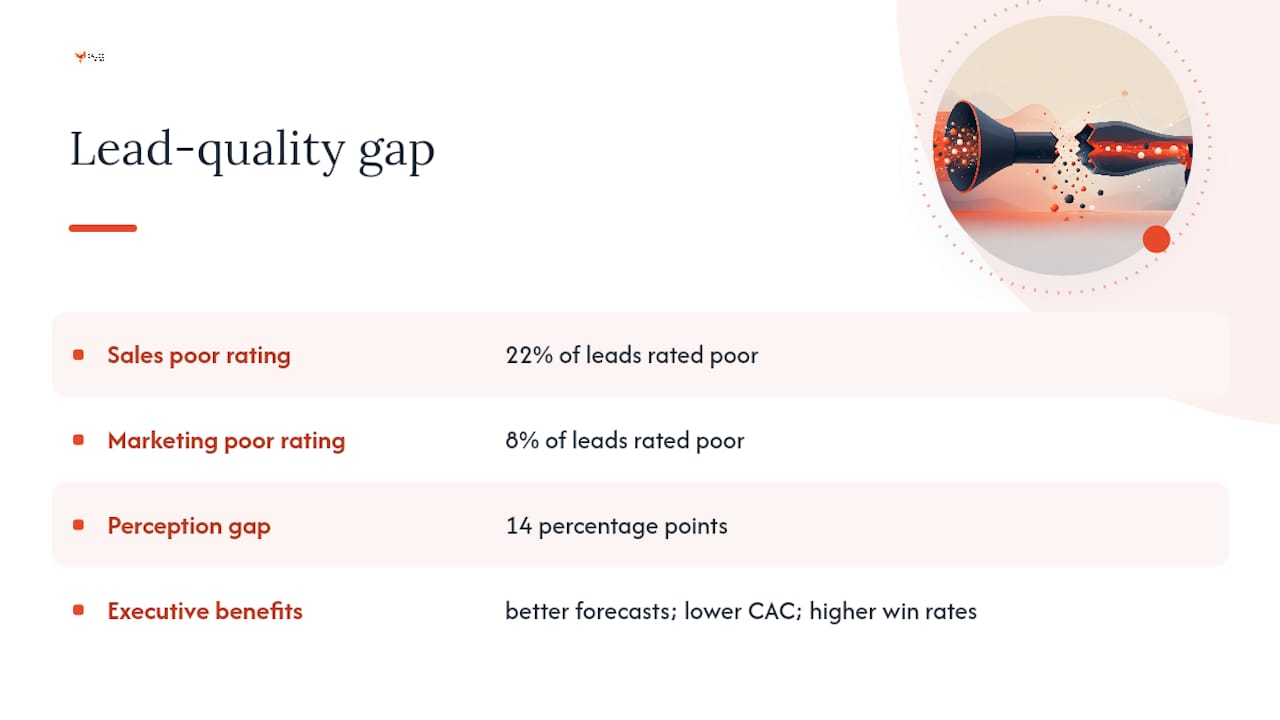
Perception gap: In a benchmark study of B2B revenue teams, sales reps rated lead quality as poor 22% of the time, while marketing rated the same leads as poor only 8% of the time, per the 2024 Norwest B2B benchmark report.
That 14-point gap is not a talent problem on either side. It is a definition problem. Sales and marketing are scoring the same leads against different rubrics, and until both teams agree on what "qualified" means, the fight over lead quality will repeat every quarter regardless of who is hired or fired.
For executives, the practical translation is straightforward: alignment improves forecast reliability because pipeline stages mean the same thing to everyone reading the report. It usually lowers customer acquisition cost, since fewer marketing dollars chase leads sales will reject anyway. And it lifts win rates, because reps spend selling time on opportunities that were actually vetted rather than sorting through noise.
What Are the Warning Signs of Sales and Marketing Misalignment?
Separate funnels are the single most common structural cause of misalignment, cited by 47% of companies as the primary driver, according to Gartner. Everything else on this list tends to flow from that one root cause.
- Parallel funnels exist. Marketing tracks its own stages in a marketing automation platform (MAP); sales tracks different stages in the CRM, and nobody has mapped one to the other.
- Stage-skipping is normal. Reps jump straight to "opportunity" without logging the qualification steps marketing assumed would happen.
- KPIs don't match. Marketing is graded on lead volume; sales is graded on closed revenue. Neither metric tells the other team anything useful.
- Handoffs have no SLA. Leads sit untouched for days because no one agreed on a response window.
- Data lives in silos. Marketing can't see what happens after handoff; sales can't see the touches that warmed a lead up.
Run a 15-minute audit before your next planning cycle: pull last month's MQL list, ask sales to mark each one accepted or rejected, and check whether the rejection reasons are structured data or a shrug. If most rejections have no documented reason, you have a definitions problem, not a lead-quality problem.
How Do You Build an Agreed Funnel That Actually Holds?
The agreed funnel only works when every stage has a written definition, an owner, and a time limit attached to it. Vague agreements ("marketing will send good leads, sales will follow up quickly") collapse within a month because nobody can point to a broken rule.
Start with the seven stages and document three things for each: the entry criteria, the exit criteria, and who is accountable for moving a record from one to the next. Then build the handoff mechanics around that structure.
- Handoff package. Every MQL passed to sales should carry firmographic data, engagement history, and the specific trigger that made it sales-ready, not just a name and email.
- First-touch SLA. Sales agrees to contact a new MQL within a fixed window, commonly 24 hours for inbound, longer for outbound-sourced leads.
- Disposition window. Reps log accept or reject with a structured reason code within a set number of days, not "whenever I get to it."
- Return routing. Rejected leads route back to marketing nurture automatically, with the rejection reason attached, instead of dying in a rep's queue.
Deal sub-stages inside the CRM (discovery call scheduled, proposal sent, verbal commitment) should map cleanly onto the seven macro stages rather than replacing them. If sales invents sub-stages that don't roll up into the agreed funnel, attribution breaks the moment someone tries to report on it.
Pro Tip: Build your SLA from 60 days of actual rejection data before you finalize it. An SLA written from guesses gets renegotiated within a quarter; one built from real disposition codes usually survives a full year.
What Is the 90-Day Plan to Align Sales and Marketing?
Alignment projects fail most often because they try to fix everything at once. Sequence the work instead, and treat the first quarter as a controlled rollout, not a company-wide mandate.
- Week 1 to 2: Leadership agreement. The CMO and CRO (or equivalent) hold a joint session to sign a shared ideal customer profile (ICP). Output: one written ICP document both leaders sign.
- Week 3 to 4: Pull rejection data. Gather 60 days of MQL disposition history and run an SLA workshop with both teams reviewing real rejected leads, not hypotheticals.
- Week 5 to 6: Sign the agreed funnel. Draft and formally sign the seven-stage funnel document with SLAs attached to every handoff point.
- Week 7 to 9: Build the dashboard. Implement one shared CRM dashboard, automate disposition codes, and retire any competing marketing-only or sales-only reports.
- Week 10 to 11: Launch joint cadences. Start a weekly operational huddle (30 minutes, both teams, pipeline and rejections only) plus a monthly strategic review.
- Week 12: Map content to objections. Have sales list the top ten objections they hear live, then have marketing map existing content, and gaps, to those exact moments. Content mapped to buyer problems rather than to asset type consistently improves how often reps actually use it.
- Ongoing: Close the loop. Feed structured rejection reasons and win/loss data back into next quarter's campaign planning so marketing adjusts targeting instead of repeating the same list.
Pro Tip: Protect the first 90 days from scope creep. Every team wants to add a new integration or a new report in week three; resist it until the SLA and dashboard are stable, or you'll never finish the baseline.
What Are the Stages of Alignment Maturity?
Alignment develops in a predictable sequence, and skipping ahead almost always backfires. Buying integration software before both teams agree on stage definitions just automates the disagreement, according to Oracle's staged framework, which frames maturity as strategy first, technology second, operations third, and revenue unification last.
- Stage 1, Separated. Marketing and sales run independent funnels, independent KPIs, and rarely meet. Most companies start here whether they admit it or not.
- Stage 2, Coordinating. Regular meetings exist, but no signed SLA. Handoffs still rely on individual relationships rather than process.
- Stage 3, Integrated. A signed agreed funnel and SLA are in place, built from real rejection data rather than assumptions, and both teams report from one dashboard.
- Stage 4, Optimized. Dedicated revenue operations (RevOps) capacity manages the funnel, automation enforces SLAs, and content is mapped to buyer objections systematically.
- Stage 5, Predictive. Predictive analytics inform pipeline forecasting and campaign targeting based on closed-loop data, not just historical averages.
An agreed funnel signed by both leaders, backed by 60 days of rejection data, is generally the unlock condition that moves a company from Stage 2 to Stage 3. Don't invest in Stage 4 or 5 capabilities, dedicated RevOps hires, predictive scoring, before that SLA is signed and stable. Companies that buy predictive tooling at Stage 2 usually end up automating a broken handoff faster.
What Should You Measure to Prove Alignment Is Working?
A workable measurement framework stays small on purpose. Five shared metrics cover most of what leadership actually needs to see, and every one of them should live in a single dashboard both teams check in the same weekly meeting.
| Metric | What it tells you | Owned by |
|---|---|---|
| MQL to SQL conversion rate | Whether marketing's qualification criteria match sales' real bar | Both |
| SQL to opportunity conversion rate | Whether sales is converting qualified leads into real pipeline | Sales |
| Pipeline velocity (days per stage) | Where deals stall inside the agreed funnel | Both |
| Marketing-influenced revenue | How much closed revenue touched marketing activity anywhere in the cycle | Marketing |
| Customer acquisition cost by channel | Which channels produce revenue efficiently versus just volume | Marketing |
One dashboard, one meeting, no exceptions. The moment marketing keeps a private version of these numbers and sales keeps another, you've rebuilt the parallel-funnel problem with better software. SLA reporting should sit right next to these five metrics: track first-touch response time and rejection-code frequency weekly, since a spike in "poor timing" rejections usually means marketing sourced the wrong segment, not that sales got lazy.
What Technology and Data Rules Keep Alignment From Breaking?
Treat the CRM as the single source of truth for the agreed funnel, with the marketing automation platform, engagement tools, and any conversational intelligence software feeding data into it rather than running as separate systems of record. Salesforce's guidance on alignment makes this the foundational step because every dashboard, SLA timer, and disposition report depends on clean, centralized data.
- Standardize fields. Lead source, disposition code, and SLA timestamp need identical formats across every record, or reporting breaks the moment volume scales.
- Enforce disposition codes. Require a structured rejection reason on every declined lead, not a free-text note nobody reads later.
- Route by intent, not by default. A high-intent consultation request, a referral, a dormant contact being reactivated, and a low-intent content download need different owners and different SLAs. Forcing all four through one handoff path is a common way alignment programs quietly fail.
- Decide RevOps timing deliberately. Small teams can run this manually with process discipline through Stage 3; past that volume, dedicated RevOps capacity or automation becomes worth the cost.
Partners like benchmarked focus specifically on building the AI-native commercial workflows that support this kind of centralized, intent-based routing once volume outgrows manual review.
How Sales-phoenix Applies the Phoenix Growth Framework™
Sales-phoenix built its Phoenix Growth Framework™ around the exact failure pattern described above: revenue that leaks out through undefined handoffs, unmeasured pipeline stages, and dashboards that don't agree with each other. The framework identifies where leads, dollars, and follow-up visibility disappear, then rebuilds the operational rules so they don't leak again.
Several client-facing services map directly onto the stages in this roadmap:
- Phoenix Revenue Intelligence builds the shared dashboard and revenue definitions that stages 3 through 5 require.
- Phoenix Database Reactivation (DBR) recovers dormant contacts sitting outside the current handoff path entirely.
- Phoenix Growth Operations implements the SLA, automation, and disposition-code infrastructure that Stage 3 and Stage 4 depend on.
- Fractional COO Advisory gives companies without a full RevOps hire the operational leadership to run the transition.
Sales-phoenix's own account of its work cites recovering more than $12 million in lost revenue across engagements and improving average close rates by 34%, figures it reports as part of its own client results.
Three Blind Spots Executives Miss When Sponsoring Alignment
Most executives reach for software first. That's backward. Buying an integration tool before both teams agree on what "qualified" means just automates an argument, it doesn't resolve one. Fix the definitions and the SLA on paper before anyone touches a new platform.
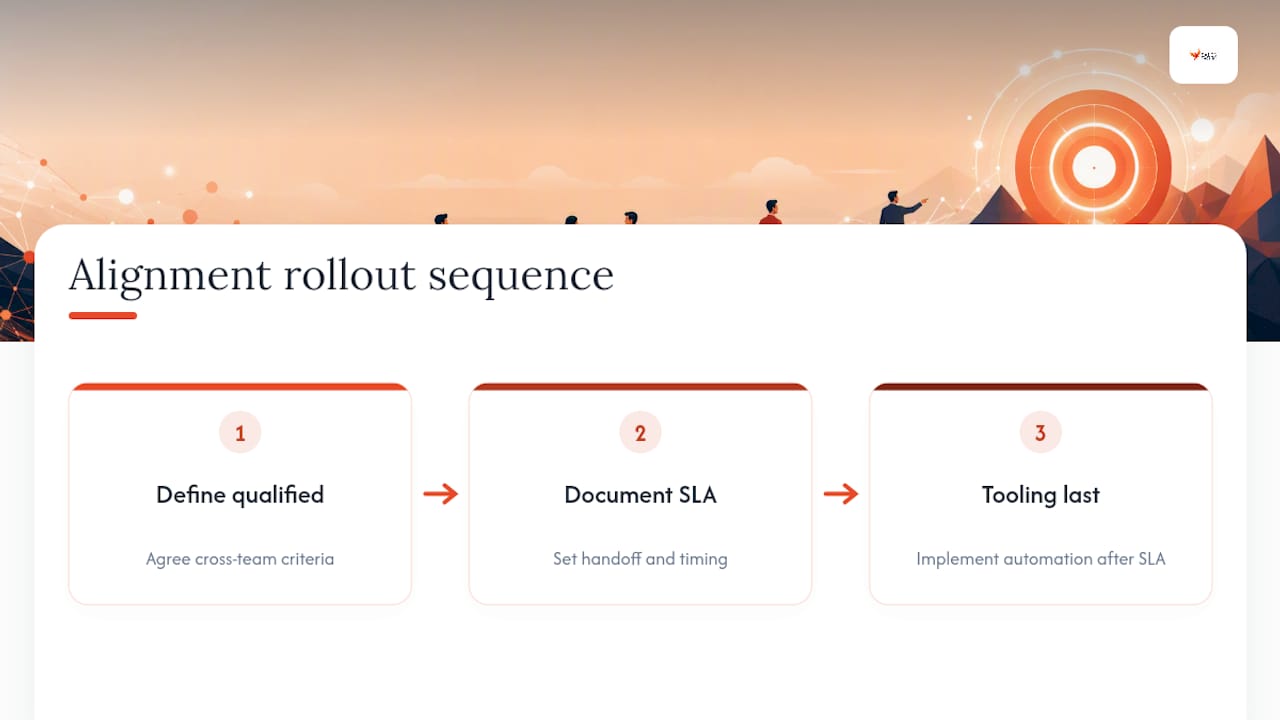
The second blind spot is impatience with the first 90 days. Leaders who add scope in week three, a new integration, a new report, almost always end up with a baseline that never stabilizes, because nobody can tell what actually changed versus what got added.
The third is incentive design. If sales comp still rewards closed deals regardless of lead source, and marketing bonuses still reward volume over influenced revenue, no dashboard will fix behavior that compensation actively contradicts. Align the budget and the incentive plan to the same revenue goal, or the agreed funnel stays a document nobody follows.
— Hunter
Fix the Leak Before You Scale the Funnel
Sales-phoenix exists for exactly the gap this article describes: the space between a marketing lead and a closed deal where revenue quietly disappears. Rather than selling a generic playbook, Sales-phoenix runs a hands-on engagement using the Phoenix Growth Framework™ to find where your specific funnel breaks, then rebuilds the SLA, dashboard, and handoff rules around your actual data instead of a template.
That starts with a straightforward look at your current numbers. Whether the fix is a Phoenix Revenue Intelligence dashboard, a database reactivation push to recover dormant contacts, or Fractional COO leadership to run the 90-day plan, the right starting point depends on where your leak actually is. Visit the Sales-phoenix services page to see the full engagement options and request a growth assessment before your next planning cycle.
Sources
- The Agreed Funnel Model: One Revenue Funnel Both Marketing and Sales Own
- 2024 Norwest B2B sales and marketing benchmark report
- The Four Stages of Marketing and Sales Alignment — Oracle
- Are your marketing and sales teams on the same page? — Harvard Business Review
FAQ
What Is the Agreed Funnel in Sales and Marketing Alignment?
The agreed funnel is a single revenue funnel that marketing and sales jointly own, replacing the separate systems each team usually runs on its own. It works because both sides sign off on the same stage definitions and handoff rules, per the agreed funnel model.
Why Is Sales and Marketing Alignment Important for Revenue Growth?
Alignment matters because companies that achieve it report faster growth and stronger profit performance, largely by shifting focus from activity metrics to shared revenue outcomes, according to Harvard Business Review. It also closes the perception gap on lead quality that shows up in most benchmark data.
How Long Does It Take to Align Sales and Marketing Teams?
A focused rollout can establish the core structure, signed ICP, agreed funnel, and SLA, within 90 days if leadership commits to the sequence rather than adding scope midway. Deeper maturity, including RevOps and predictive analytics, typically takes longer and should follow, not precede, a stable SLA.
What Are the Most Common Signs of Misalignment?
The clearest signs are parallel funnels, mismatched KPIs between marketing and sales, and handoffs with no agreed SLA. Separate funnels are the single most common structural cause, cited by 47% of companies according to Gartner.
Can Sales-phoenix Help Fix Misalignment and Recover Lost Revenue?
Yes. Sales-phoenix uses its Phoenix Growth Framework™ to diagnose where revenue leaks through broken handoffs and undefined SLAs, then implements the dashboards, database reactivation, and operational structure described in this roadmap. Current service details and pricing are listed on the Sales-phoenix services page.