

Quote-to-cash is the end-to-end workflow that turns a configured quote into recognized, collected revenue. Done right, it converts a sales conversation into billable, defensible cash without the errors, delays, or discount creep that quietly drain margin. Most companies fix it by putting finance in charge of the product catalog and automating the handoffs between quoting, billing, and revenue recognition.
TL;DR:
- Most revenue leaks stem from unaligned systems and manual processes, especially in proration, follow-up, and discount approvals.
- Automating approvals, follow-ups, and data flows from quote to revenue recognition significantly reduces billing errors and shortens cash cycle times.
- Fixes should start by centralizing and cleaning the product catalog, enforcing approval workflows, and explicitly linking quotes to CRM with expiration dates.
- A revenue leak assessment helps identify specific bottlenecks, saving time and money before investing in new software tools.
- The key KPIs to monitor are days to cash, quote-to-order conversion rate, and unbilled accounts receivable as a percentage of revenue.
Table of Contents
- What Is the Quote-to-Cash Process, Step by Step?
- Where Revenue Actually Leaks in the Q2C Cycle
- The Real Payoff of a Streamlined Q2C Process
- The Technology Layers That Make Q2C Actually Work
- Best Practices for Preventing Revenue Leakage
- Why Most Q2C Fixes Start in the Wrong Place
- Get a Clear Picture of Where Your Revenue Is Leaking
- Sources
- FAQ
What Is the Quote-to-Cash Process, Step by Step?
The quote-to-cash cycle, often shortened to Q2C, covers everything between "here's our price" and "the money is in the bank and booked correctly." The core stages run from configuration through revenue recognition, and each one has a different owner, a different failure mode, and a different fix. Understanding where your organization sits in this sequence is the fastest way to find where revenue is actually leaking.
-
Configuration. Sales or product teams select the right combination of products, services, and options for a deal. The failure mode here is a messy catalog: duplicate SKUs, outdated bundles, or pricing rules that live in someone's memory rather than a system. Automation helps most when the catalog itself is cleaned up first, since no CPQ tool can fix bad underlying data.
-
Pricing. Finance or sales operations set discount bands, approval thresholds, and margin floors. When pricing rules aren't codified, reps negotiate on instinct, and every deal becomes a special case that billing later struggles to process.
-
Quote creation. Sales builds the actual quote, tied to a CRM opportunity, with an explicit expiration date. Quotes without expiry dates tend to linger indefinitely, distorting pipeline reports long after the buyer has moved on.
-
Contract negotiation and execution. Legal and deal desk teams manage redlines and signatures, typically through contract lifecycle management (CLM) software. The common breakdown is version chaos: three people editing three copies of the same contract by email.
-
Order and subscription management. Operations provisions the deal and handles any mid-term amendments, like upgrades, downgrades, or added seats. This is where proration math either happens automatically or gets done by hand in a spreadsheet, which is the single biggest source of billing errors in subscription businesses.
-
Billing and invoicing. Finance generates and delivers invoices that match exactly what was quoted and contracted. Any mismatch between the CRM record and the billing system produces a rejected or disputed invoice, and disputes are what stall payment.
-
Payment collection. Accounts receivable manages payment methods and, when needed, dunning sequences for late accounts. Weak collections processes are often a communication problem more than a payment problem: customers who don't get timely reminders don't pay on time.
-
Revenue recognition and analysis. Finance applies recognition rules, often governed by ASC 606, and feeds clean data into reporting. This step depends entirely on everything upstream being accurate; a Q2C process with broken links between the earlier steps produces revenue recognition that requires manual correction every close.
Automating approvals, follow-ups, and status triggers across these steps is the fix most organizations reach for once they see how many hours their finance team spends reconciling stages that should never have disconnected in the first place.
Where Revenue Actually Leaks in the Q2C Cycle
Most leakage isn't dramatic. It's a slow accumulation of small breaks between systems and teams that never get audited.
- Siloed CRM and billing systems produce invoices that don't match what was sold, triggering disputes and rework.
- Manual proration, done in spreadsheets when a customer upgrades mid-cycle, creates unbilled accounts receivable that can sit unnoticed for months.
- Stale quotes with no follow-up die quietly. Quote management functions as ongoing lifecycle governance, not just document generation, and without expiry alerts and follow-up triggers, plenty of viable deals simply evaporate.
- Uncontrolled discounting happens when approval workflows are missing or easy to bypass, and it erodes margin one deal at a time.
- Approval bottlenecks slow quotes down at exactly the moment buyer momentum matters most.
The Real Payoff of a Streamlined Q2C Process
Fixing these breaks isn't an abstract efficiency exercise. It shows up directly on the balance sheet and in how fast a sales team can move.
- Shorter cycle time between quote and cash means working capital arrives faster instead of sitting in limbo.
- Fewer invoice disputes and write-offs, because billing matches what was actually quoted and signed.
- Better forecast accuracy, since finance is working from real data instead of reconciling spreadsheets after the fact.
- Automation across the chain measurably reduces unbilled AR and shortens close cycles by keeping structured data flowing from quote straight through to recognized revenue.
- Sales performance improves too, since reps trust the numbers they're quoting and stop second-guessing pricing.
The KPIs worth watching are simple: days to cash, quote-to-order conversion rate, and unbilled AR as a percentage of revenue.
The Technology Layers That Make Q2C Actually Work
A quote-to-cash process only holds together when its systems share one source of truth. A finance-first strategy built on a single data model is what unites CPQ, order management, billing, and revenue recognition instead of leaving each department to guess at what the others are doing.
- CPQ (configure, price, quote) should be driven by a financial product catalog, not a sales-built spreadsheet, so every quote generated is mathematically billable the moment it's signed.
- Contract lifecycle management enforces approval gating and version control, which keeps legal review from becoming a bottleneck or a source of contract drift.
- Order and subscription management handles mid-term amendments and proration automatically, removing the spreadsheet step that causes most billing corrections.
- Billing engines generate invoices and run payment processing with built-in dunning logic, so overdue accounts get consistent, automated reminders instead of ad hoc follow-up.
- Revenue recognition automation feeds the general ledger directly, maintaining an audit trail that satisfies ASC 606 requirements without a manual reconciliation project every quarter.
Complex deals, especially subscriptions or usage-based pricing, tend to need a dedicated quote-to-revenue engine sitting between CRM and ERP, because that layer is what prevents the classic pattern of proration handled by hand and unbilled AR piling up unnoticed. The integration pattern that works is straightforward: CRM feeds the Q2C engine, and the Q2C engine feeds the ERP and general ledger, with no manual re-entry anywhere in between.
Best Practices for Preventing Revenue Leakage
Fixing quote-to-cash doesn't require ripping out every system at once. It requires sequencing the right fixes in the right order.
- Centralize the product and pricing catalog under finance. Letting sales override catalog logic on the fly is how "dirty deals" get created that billing can't process cleanly.
- Require approval workflows for discounts and exceptions before a quote ever reaches the buyer, not after.
- Tie every quote to a CRM record with an explicit expiration date. Quotes without an owner or a deadline are the ones that quietly disappear.
- Set a standard follow-up cadence, for example day 3, day 7, and day 14 after a quote goes out, and automate the reminders. This single habit materially improves close rates because most lost deals aren't lost on price; they're lost on silence.
- Sequence automation in stages: start with approvals and follow-ups, then layer in billing integration, and finish with revenue recognition once the catalog itself is clean.
Pro Tip: Before buying any new software, measure two numbers you probably already have: your quote-to-order conversion rate and your unbilled AR balance. Those two figures tell you which end of the Q2C chain is actually bleeding, so you fix the real problem instead of the loudest complaint in the room.
Why Most Q2C Fixes Start in the Wrong Place
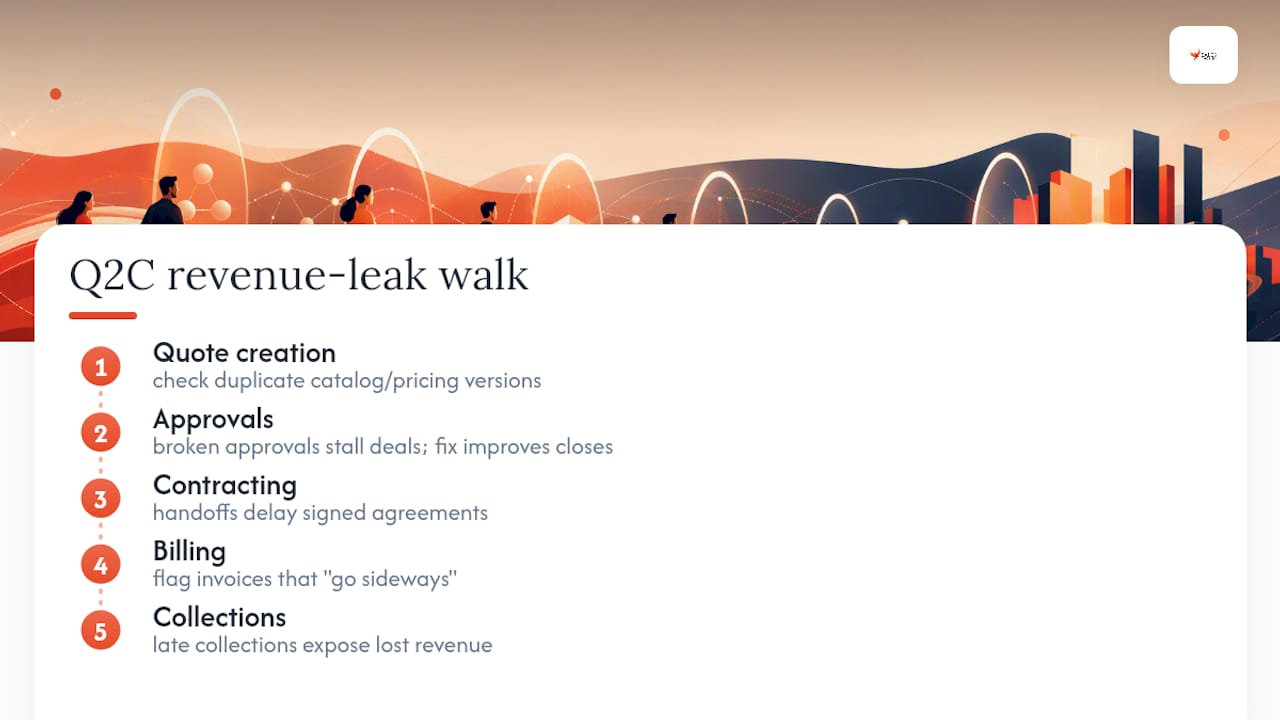
Most companies chase a new CPQ tool when the real problem is that nobody owns the follow-up sequence, or the catalog has three versions of the same product with three different price points. A revenue leak assessment, done properly, walks the entire Q2C chain, quote creation, approvals, contracting, billing, collections, and flags exactly where deals stall or invoices go sideways.
The recoveries tend to be uncomfortable at first. Sales-phoenix's Phoenix Growth Framework has surfaced over $12 million in lost revenue across engagements, largely because the leaks were operational, not strategic. Close rates improve significantly once approvals and follow-up cadences are fixed, not because reps get better at selling, but because fewer good deals are allowed to die of neglect.
— Hunter
Get a Clear Picture of Where Your Revenue Is Leaking
If this playbook sounds like your business, the fastest next step isn't a software purchase. It's a diagnostic. Sales-phoenix runs a Revenue Leak Assessment that maps your quote-to-cash chain end to end, flags where deals stall, where invoices go wrong, and where discounting has gone unchecked, and hands you a prioritized fix list with an ROI estimate attached.
Clients typically walk away with a short list of fixes, not a 12-month software rollout, and they see recovered revenue and faster cycle times within weeks of acting on it. If you want visibility into where your own Q2C process is losing money, book a Revenue Leak Assessment and get the diagnostic before you commit to any bigger overhaul.
Sources
- The Basics of the Quote-to-Cash Process | Salesforce
- The Finance Leader’s Guide To Quote-to-Cash (Q2C) | Zuora
- Quote-to-Cash Process: What It Is, Benefits, & Examples | NetSuite
FAQ
What is quote-to-cash processing?
Quote-to-cash processing is the full sequence of steps a business follows to turn a sales quote into collected, recognized revenue, covering configuration, pricing, contracting, billing, payment, and revenue recognition.
What is the O2C process in simple words?
Order-to-cash (O2C) starts one step later than Q2C, beginning at order placement rather than the initial quote, and covers fulfillment, invoicing, and collections through to recognized revenue.
What is the quote-to-cash process in Salesforce?
In Salesforce, Q2C typically runs through CPQ for configuring and pricing deals, then hands off to billing and revenue tools, following the same core stages common across the industry: configuration, pricing, quoting, contracting, order management, billing, collections, and revenue recognition.
What is the difference between O2C and C2C?
O2C (order-to-cash) begins at the order stage, while C2C usually refers to configure-to-cash, which starts even earlier at product configuration; both are narrower slices of the broader quote-to-cash cycle.
How does automation reduce revenue leakage in Q2C?
Automation closes the manual gaps, especially around proration, approvals, and follow-ups, that let deals stall or bill incorrectly, and it's the primary lever most finance teams use to cut unbilled AR and shorten the financial close.