

A renewal playbook is a repeatable, date-and-trigger-driven system that turns renewals from reactive scrambles into predictable motions. The single most important move you can make today is auto-creating the renewal record the moment a deal closes and naming an owner immediately. Run that motion on a 90 to 120 day clock, and most of what feels like renewal chaos disappears.
TL;DR:
- Automating renewal record creation at deal closure and assigning ownership immediately prevents missed renewals and reduces chaos.
- A risk-tier system based on measurable signals like usage decline and support tickets enables objective escalation and more targeted actions.
- Renewal timelines should begin at least 90 days before the contract end, with 120 days for accounts with complex stakeholder structures and slow decision processes.
- Only accounts with rising risk signals or high strategic value need the full renewal playbook, allowing for efficient prioritization.
- The renewal process fails mainly due to inconsistent ownership, outdated tiers, and lack of regular updates, not the playbook design itself.
Table of Contents
- What Is a Renewal Playbook and Why Does It Matter?
- What Core Components Does Every Renewal Playbook Need?
- How Long Should a Renewal Timeline Run: 90 Days or 120?
- Which Accounts Get the Full Playbook?
- What Actions Fire at Each Risk Tier?
- What Should Your Renewal Playbook Template Actually Contain?
- How Sales Phoenix Applies the Phoenix Growth Framework to Renewals
- How Do You Run a Renewal Playbook at Scale Without Burning Out Your Team?
- Where Do Renewal Playbooks Usually Break Down?
- What Does a Successful Renewal Playbook Implementation Look Like?
- How Often Should You Update Your Renewal Playbook?
- The One Anti-Pattern That Breaks Every Renewal Motion
- Where Sales Phoenix Fits in Building Your Renewal System
- Sources
What Is a Renewal Playbook and Why Does It Matter?
A renewal playbook is a short, written operating spec that tells any CSM exactly who owns a renewal, what triggers fire at each stage, and what "on track" looks like at every checkpoint. It's not the same as a checklist, and it's not a sales playbook wearing a different hat. A checklist tells you what to do; a renewal playbook tells you when to do it, who's accountable, and what happens when things go sideways. A sales playbook is built for net-new logos with linear stages toward a signature. A renewal motion has to account for existing relationships, sunk trust, usage history, and expansion potential all at once.
The complete template SWOTBee built breaks a functioning playbook into five parts: scope and owners, timeline triggers, risk-tiered plays, an expansion audit, and escalation rules. That structure exists because three goals matter more than any single tactic:
- Consistency — every account gets the same baseline attention regardless of who's assigned
- Predictability — leadership can forecast renewal revenue without guessing
- Expansion — the renewal conversation becomes a growth opportunity, not just a save
You measure whether the playbook works with a small set of numbers: gross renewal rate, net revenue retention (NRR), and the volume of logged risk signals per account. If signals aren't being captured, you're not running a playbook. You're running hope.
What Core Components Does Every Renewal Playbook Need?
A minimal viable playbook needs five working parts. Skip any one of them and the system breaks down exactly where it matters most, usually at the handoff or the escalation point.
-
Ownership and handoff spec. Define who owns the account at every stage, sales, onboarding, CSM, and exactly what fields must be logged when ownership transfers. A vague handoff is the single biggest source of dropped renewals, according to TheCScafe's breakdown of the five-stage renewal system, which found that most renewals are effectively decided well before anyone has "the renewal conversation."
-
Triggers and auto-created renewal records. The renewal record should generate itself the moment a deal reaches Closed Won, not 90 days before the contract ends. Manual creation is where accounts fall through.
-
A risk-tier system with objective criteria. Green, yellow, and red tiers only work if the criteria are measurable, things like usage decline percentage, support ticket volume, or a champion leaving, not a CSM's gut feeling. Subjective tiering collapses the first time someone new inherits the book of business.
-
A value case and expansion audit. This is the evidence packet: usage data, ROI proof points, and quotes from the customer's own language about what's working. Build it in terms the customer already uses internally, not your product's feature names. This is what turns a renewal from a defensive conversation into an expansion pitch.
-
Escalation rules and reason-code logging. Every time an account slips a tier or misses a checkpoint, someone logs why using a standardized reason code. Without this, you can't fix the systemic issues driving churn, you can only react to individual fires.
Notice/renewal timing also matters more than most CSMs realize. Contract language often includes a 60 or 90 day notice window, and Renewly's vendor contract checklist flags missed notice deadlines as one of the most common and expensive renewal mistakes. Your playbook should flag that window automatically, not rely on someone remembering to check the contract.
How Long Should a Renewal Timeline Run: 90 Days or 120?
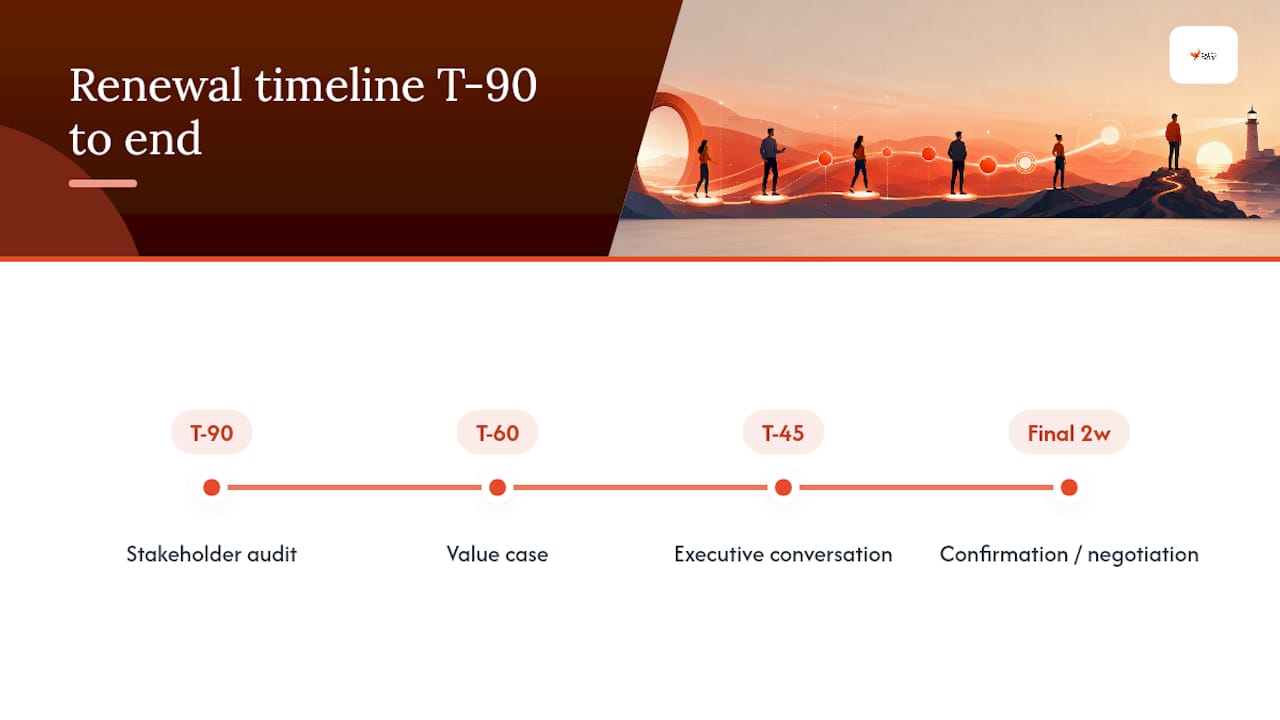
Ninety days is the floor, not a comfortable buffer. It's the minimum runway needed to run a stakeholder audit, build a value case, hold an executive conversation, and still have time left to negotiate before the contract lapses. Teams that consistently post net revenue retention above 100% start their renewal motion at least 90 days before contract end, and they follow a fixed weekly sequence rather than improvising.
Use 120 days instead of 90 when the account has multiple stakeholders across departments, a procurement layer that adds its own approval cycle, or a history of slow decision making. The extra 30 days isn't padding. It's the time it takes to multi-thread a buying committee that doesn't move on your schedule.
Here's what a 90-day cadence looks like when you map it to real dates:
| Days Before Renewal | Owner | Deliverable |
|---|---|---|
| T-90 | CSM | Stakeholder audit complete, risk tier assigned |
| — | CSM | Usage and health data pulled, gaps flagged |
| T-60 | CSM + team lead | Value case drafted with customer-language proof points |
| T-45 | CSM + AE | Executive conversation scheduled or held |
| T-30 | CSM | Renewal proposal delivered |
| — | CSM | Final terms confirmed, contract routed for signature |
| — | CSM | Renewal closed and logged, or escalated if unresolved |
That sequencing isn't arbitrary. It reflects the order stakeholders actually need to move in: you can't build a credible value case before you know who's in the room, and you can't have the executive conversation before the case exists.
For accounts that don't warrant the full sequence, a lighter variant compresses the checkpoints into three touches, an early health check, a mid-cycle value nudge, and a renewal confirmation, rather than seven. More on when to use that variant next.
Which Accounts Get the Full Playbook?
Not every account needs the full sequence, and forcing it everywhere burns capacity you don't have. The clearest prioritization rule intersects two conditions: the account is renewing this quarter, and it's showing elevated risk. That combination beats sorting purely by annual contract value, because a high-ACV account renewing 10 months from now doesn't need attention today, and a low-ACV account with a churning champion might need it urgently.
Beyond that intersection, weigh a handful of dimensions when you're deciding how deep to go:
- Annual contract value (ACV) — bigger accounts justify more manual touch, but only when timing aligns
- Risk signals — usage decline, support escalations, sentiment drops, missed check-ins
- Strategic value — logo recognition, case study potential, reference-ability
- Consolidation risk — is this customer actively evaluating fewer vendors across their stack
An account renewing in five months with green health and stable usage gets the light-touch variant: automated check-in, a quarterly business review, done. An account renewing in six weeks with a lapsed executive sponsor and declining logins gets the full nine-week sequence, stakeholder remap included, regardless of its ACV. Capacity is finite. Spend it where the outcome can still change.
What Actions Fire at Each Risk Tier?
Risk tiers only function when the criteria triggering them are objective and the plays attached to them are specific. A tier assigned on instinct will drift the moment a new CSM inherits the account.
-
Green tier. Requires at least two positive signals: stable or growing usage, and an active champion who's responded to outreach in the last 30 days. Play: standard cadence, quarterly business review, no manual escalation needed.
-
Yellow tier. Triggered by at least two warning signals together, examples: usage down 20% or more, or a champion who's gone quiet for two-plus weeks, plus a missed check-in. Play: CSM initiates a health call within five business days and logs findings. Team lead reviews the account within the week.
-
Red tier. Two or more severe signals: usage decline over 40%, an unresponsive economic buyer, or a stated intent to evaluate alternatives. Play: CSM escalates to leadership immediately. An executive sponsor from your side joins the next call. This is where the account leaves the CSM's sole ownership.
Every tier change and every escalation gets a reason code logged against it, the standard set both SWOTBee and TheCScafe recommend for playbook governance. Without that log, you're guessing at why accounts slip next quarter too.
Pro Tip: Cap your tier criteria at two objective signals minimum before a tier change fires. One signal alone (say, a single skipped meeting) causes false-positive escalations that burn leadership's attention on accounts that were never actually at risk.
What Should Your Renewal Playbook Template Actually Contain?
The best renewal playbook template is short enough that someone opens it under pressure instead of ignoring it. A five-page document nobody reads during a real renewal crisis isn't a playbook, it's shelf-ware.
Build these four artifacts directly into your CRM or wiki, not a slide deck that goes stale in a folder:
- Handoff meeting agenda. Mandatory fields: account history, known stakeholders, contract terms, prior escalations, and current risk tier. No handoff completes without every field populated.
- Renewal timeline checklist with trigger rules. Each checkpoint (T-90, T-60, T-45, T-30) lists its exact trigger condition and who's accountable if it's missed.
- Value case template in customer language. Structure it around the customer's own stated goals, quoted directly from QBR notes or support tickets, paired with the usage data that proves progress against them.
- Escalation reason-code table. A fixed list, examples: "champion departure," "budget freeze," "competitive evaluation," "usage decline unexplained," so every escalation gets classified the same way across the whole team.
Keep the whole document living inside the CRM record itself rather than a separate file. The moment a playbook lives somewhere other than where the work happens, people stop using it.
How Sales Phoenix Applies the Phoenix Growth Framework to Renewals
Sales-phoenix built its Phoenix Growth Framework™ around one premise: renewal risk is a symptom of a broader visibility gap, not an isolated CS problem. The framework pulls renewal signals, usage data, and pipeline health into one operating system instead of scattering them across disconnected tools.
The pattern shows up the same way in nearly every service business we've assessed: revenue isn't lost in one dramatic moment. It leaks quietly through missed handoffs, unlogged risk signals, and renewals nobody owned until it was too late.
In practice, implementation looks like building an executive dashboard that surfaces renewal risk automatically, wiring escalation triggers into existing workflows, and running a quarterly reason-code review cadence so leadership sees the systemic issues, not just the individual account fires.
How Do You Run a Renewal Playbook at Scale Without Burning Out Your Team?
Once you're managing more than a handful of renewals per quarter, manual tracking collapses. The fix isn't more headcount, it's a monitoring layer that watches signals automatically so your CSMs spend time on conversations, not spreadsheet audits.
Automate the parts that don't need judgment: renewal record creation at Closed Won, checkpoint reminders at T-90 and T-60, and escalation triggers when a risk tier changes. RetainSure's research is clear that automation should run the constant watch, not the actual renewal conversations, human judgment still decides when to escalate and who gets the executive call.
Track these operational health metrics monthly:
- Playbook coverage — percentage of renewing accounts with an active, up-to-date playbook record
- Time-to-first-touch — days between Closed Won and the first logged CSM action
- Logged signals per account — a rough proxy for whether risk tiering reflects reality or guesswork
A customer intelligence layer that unifies these signals across your CRM and product data is what makes tiering trustworthy instead of anecdotal.
Where Do Renewal Playbooks Usually Break Down?
The most common failure isn't a bad template. It's inconsistent adoption. A CSM under pressure skips the stakeholder audit "just this once," and that one skip is usually the account that churns.
Fuzzy ownership causes the second most common breakdown. When sales hands off an account without a clean transfer of context, usage history, prior objections, the person who inherited the champion relationship, the new owner spends the first 30 days rebuilding knowledge instead of managing risk. Fix this with a hard rule: no handoff completes without every mandatory field populated, no exceptions, no "I'll fill it in later."

A third pitfall is treating risk tiers as static. A green account can slide to yellow inside two weeks if a champion leaves, but teams that only review tiers quarterly miss that window entirely. Tiers need to update as signals change, not on a fixed calendar.
Finally, teams often build an elaborate playbook and then never revisit it. Six months in, half the triggers no longer match how the team actually works, so people quietly stop following it. The Gainsight community's guidance on renewal management points to the same fix every mature CS org lands on eventually: build the playbook inside the platform your team already lives in daily, not a separate document that requires someone to remember it exists.
What Does a Successful Renewal Playbook Implementation Look Like?
The pattern across teams that get this right is boring in the best way: they run the same sequence every time, and the sequence is short enough to actually execute under pressure.
A mid-market SaaS team following the structure RetainSure documented ties every checkpoint to a calendar date rather than a vague "check in periodically" instruction. Stakeholder audit at T-90, value case by T-60, executive conversation at T-45. The result isn't magic, it's that nothing gets decided in the final two weeks anymore, because the groundwork happened months earlier.
Teams applying ChurnZero's guidance on aligning health scores with outreach cadence report a similar shift: once health scores directly trigger the next outreach action instead of sitting in a dashboard nobody checks, escalations happen earlier and with less drama. The renewal conversation stops being a negotiation and becomes a confirmation of work already done.
What both examples share is discipline around the handoff and the trigger, not a clever tactic. Nobody wins renewals with a brilliant final call. They win by not letting risk sit unaddressed for eight weeks because ownership was unclear.
How Often Should You Update Your Renewal Playbook?
Treat the playbook as a living document, reviewed on a fixed cadence, not something you build once and trust forever. Set a quarterly review specifically to examine exception data: every account where the playbook's standard plays didn't apply cleanly, and every reason code logged during an escalation.
That reason-code data is the most valuable input you have for iteration. If "champion departure" keeps showing up as the top escalation trigger, that's a signal your stakeholder mapping step needs to happen earlier or more thoroughly, not that your escalation process is broken. Both SWOTBee and TheCScafe point to this same quarterly review habit as the mechanism that keeps a playbook from calcifying into rules nobody trusts anymore.
Resist the urge to add complexity every time something goes wrong. The instinct after a bad renewal is to add another checkpoint, another approval step, another field to log. That's how a five-page playbook becomes a twenty-page one nobody opens. Instead, ask whether an existing checkpoint failed to catch the problem, and fix that step specifically rather than layering on more process.
Version the document itself. Note what changed and why, so when a new CSM joins the team, they're not reverse-engineering three years of undocumented tribal knowledge. A playbook that nobody can explain the history of is a playbook people will eventually just ignore.
The One Anti-Pattern That Breaks Every Renewal Motion
Late starts and fuzzy ownership are the same failure wearing two names. Teams wait until 30 days out to think seriously about a renewal, and by then nobody's sure whether sales or CS owns the conversation. That's not a communication problem. It's a design problem, and it's fixable with one rule.
Make the handoff mandatory and automatic: the renewal record creates itself at Closed Won, with a named owner assigned before the ink dries. Everything downstream, the stakeholder audit, the value case, the risk tiering, depends on that single fix existing first. Skip it, and the rest of the playbook is decoration.
Sales-phoenix built the Phoenix Growth Framework™ around exactly this kind of structural fix, and it's part of why the approach has recovered more than $12 million in client revenue that was leaking through gaps like this one.
— Hunter
Where Sales Phoenix Fits in Building Your Renewal System
Sales-phoenix gives service businesses and professional firms the missing piece most renewal playbooks lack: a data layer that catches risk signals before they become churn conversations, instead of a template sitting unused in a shared drive. If you already have a playbook draft but no reliable way to see which accounts actually need attention this month, that's a visibility gap, not a process gap.

The Revenue Leak Assessment identifies exactly where renewal risk is going undetected in your current process, whether that's a handoff gap, an unlogged signal, or a stalled expansion conversation. From there, the Revenue Intelligence service builds the monitoring layer that makes your risk tiers trustworthy instead of anecdotal, feeding directly into an executive dashboard your leadership can actually forecast against.
Start with a Growth Assessment to see where your current renewal process is leaking revenue, and what it would take to fix it.
Sources
- SaaS Renewal Playbook - Your 90 Day Game Plan
- The Customer Success Renewal Playbook: A Complete Template | SWOTBee
- Vendor Contract Renewal Checklist: 15 Steps (2026) | Renewly
- Customer Success Renewal Playbook: The 5-Stage System
- Customer Success Renewal Playbook, Strategy & Best Practices — ChurnZero