

Revenue leakage is earned income your business never collects because of billing errors, missed renewals, unbilled scope, or stale pricing that nobody caught in time. Estimates from NetSuite put typical losses around 5% of revenue, and because that money already covers its own delivery cost, recovering it drops almost straight to profit. The fastest path to closing the gap is a structured leakage scan, not another dashboard nobody checks.
TL;DR:
- Revenue leakage typically ranges from 1% to 5% of revenue, with higher amounts in complex multi-contract environments, making regular detection essential.
- Focus on measuring leaks by the revenue leakage rate, price realization, and contract-to-invoice variance to identify the largest dollar-impact issues first.
- Manual processes, disconnected systems, stale pricing, and unbilled scope changes are key drivers of leakage, often caused by lack of ownership at handoffs.
- Prioritizing fixes by recoverability, permanence, and dollar impact ensures the most valuable leaks are addressed efficiently, with real-time detection tools accelerating recovery.
- Implementing an organized leakage audit with clear ownership, deadlines, and targeted fixes can recover most losses within weeks and generate a nearly 100% profit margin on recovered revenue.
Table of Contents
- What Revenue Leakage Actually Costs You
- What Counts as Revenue Leakage (And What Doesn't)
- Where Do Revenue Leaks Actually Form?
- How Do You Measure Revenue Leakage?
- How Do You Stop Revenue Leaks and Recover Lost Revenue?
- What Does a Revenue Leakage Audit Actually Look Like?
- What's the Financial Case for Fixing Revenue Leakage?
- The Phoenix Growth Framework in Practice
- Where Revenue Leakage Shows Up Beyond SaaS and Services
- How Silos Create Revenue Leakage
- Cross-Department Practices That Actually Reduce Leakage
- Legal and Compliance Risks Tied to Revenue Leakage
- What Successful Leakage Recovery Actually Looks Like
- Why Most Leakage Advice Stops One Step Too Early
- Get a Revenue Leak Assessment That Finds Real Dollars
- Sources
What Revenue Leakage Actually Costs You
Most managers underestimate leakage because it never shows up as a single dramatic mistake. It shows up as a hundred small ones.
- Billing and pricing gaps often cluster at handoffs between CRM, CPQ, and invoicing systems, according to MGI Research.
- Subscription and professional-services firms are especially exposed because leakage compounds across every renewal cycle, per Stripe.
- The first three moves that matter: measure the gap, rank leaks by dollar impact, then fix the highest-value ones first.
Statistic to remember: third-party detection vendors commonly report leakage ranges of roughly 1% to 5% of revenue for many B2B firms, climbing higher in complex, multi-contract environments, according to RevCapture. On a $20 million book of business, even the low end of that range is real money walking out the door every year.
What Counts as Revenue Leakage (And What Doesn't)
Not every dollar you fail to collect is leakage in the strict sense, and lumping everything together makes the problem harder to fix. It helps to sort leaks into three buckets.
Billing leakage happens when work is delivered but never invoiced correctly, or invoiced at all. A consultant logs 12 extra hours on a project, the scope change never reaches accounting, and the client is billed for the original 40. Recognition leakage is a timing and accounting problem: revenue is earned and even collected, but booked in the wrong period or against the wrong contract line, distorting your reported numbers without actually losing cash. Entitlement leakage is subtler still. It is when customers use more than their contract allows, at prices they were never charged for, because nobody is checking usage against the agreement.
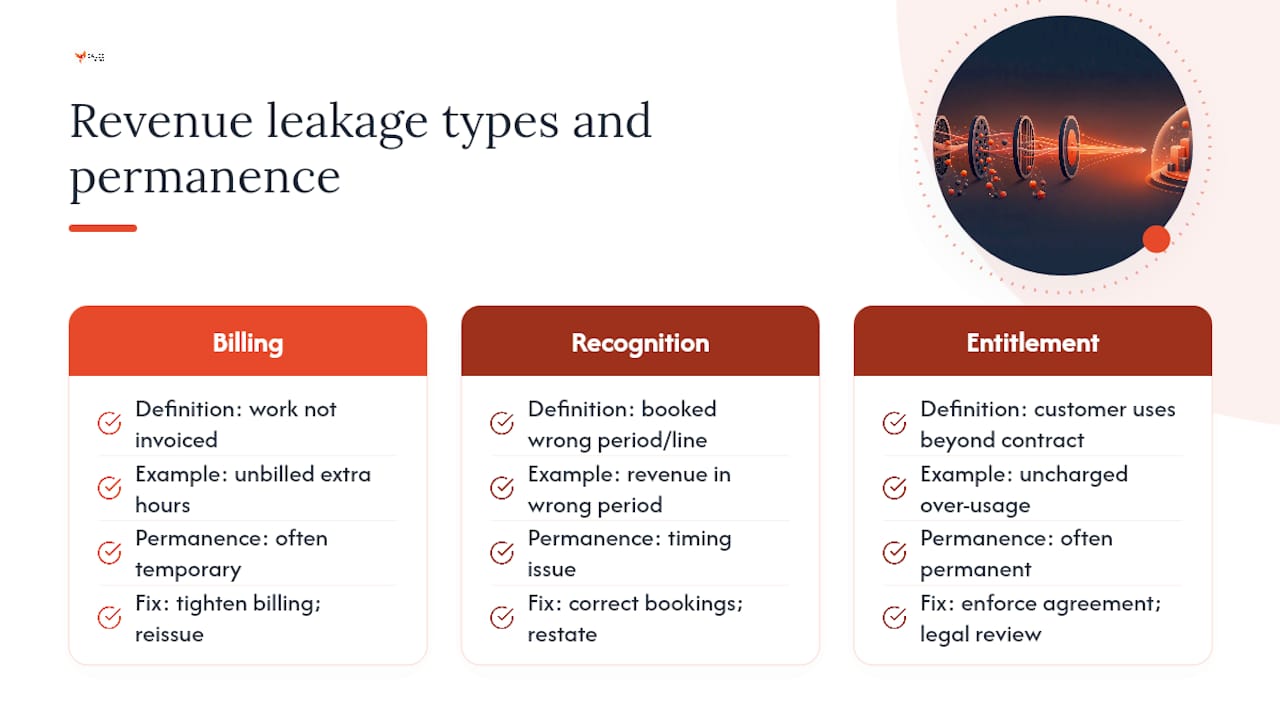
Permanence is the variable that determines your response. Temporary leakage, like a late invoice that eventually gets sent, resolves itself once you tighten the billing cycle. Permanent leakage, like a discount applied outside your approval policy that no one will ever go back and correct, requires a legal and contractual review before you attempt to back-bill, according to MGI Research.
It is worth drawing a clean line between leakage and three things it often gets confused with. Churn is a customer choosing to leave, not revenue slipping through a process crack. Refunds are intentional, policy-driven returns of money you did collect. Authorized discounts, approved through the right channel, are a pricing decision, not a leak. Revenue leakage is specifically the money you earned and meant to keep, but lost through error rather than choice.
Where Do Revenue Leaks Actually Form?
Leaks rarely start as a single catastrophic failure. They accumulate at the seams between people, systems, and policies. Salesforce frames revenue leakage as a byproduct of internal errors and process gaps rather than external market pressure, and the operational reality backs that up.
- Manual processes and spreadsheets. Anywhere a human re-keys a number from one system into another is a place where that number can quietly change or vanish.
- Disconnected systems. When your CRM, CPQ, billing platform, and ERP don't talk to each other automatically, every handoff between them is a chance for a deal to get lost or mispriced.
- Stale pricing and missed escalators. Contracts with annual price increases built in are worthless if nobody actually triggers the increase when the date arrives.
- Unbilled scope changes and verbal agreements. A client asks for "just one more thing" over email, the team delivers it, and it never makes it onto an invoice.
- Policy noncompliance. Sales reps offering unauthorized discounts to close a deal faster, with no deal-desk check to catch it before the contract is signed.
NetSuite identifies manual processes and stale pricing as two of the most common drivers across industries, and both share a root cause: nobody owns the handoff. A CRM record becomes a CPQ quote becomes a signed contract becomes an invoice, and at each step, the number that should carry forward unchanged instead gets typed in again by someone new.
How Do You Measure Revenue Leakage?
You cannot fix what you have not quantified, and vague suspicion that "something feels off" in the numbers won't get budget approved for a fix. Start by pulling five data sources: signed contracts, sent quotes, issued invoices, usage or delivery logs, and CRM/CPQ exports covering at least the last 12 months.
Once the data is in hand, a handful of calculated metrics turn a gut feeling into a dollar figure.
| Metric | What it measures | How to calculate it |
|---|---|---|
| Revenue leakage rate | Share of billable revenue never collected | (Contracted revenue minus collected revenue) ÷ contracted revenue |
| Price realization | Gap between list price and actual invoiced price | Average invoiced price ÷ average list price |
| Contract-to-invoice variance | Mismatches between what was signed and what was billed | Count and dollar value of line items that differ between contract and invoice |
| Billing accuracy | Rate of error-free invoices | Invoices with no correction ÷ total invoices issued |
| Usage-to-billing alignment | Whether billed amounts match actual consumption | Billed units ÷ metered or logged usage units |
A price waterfall that tracks list price down through every discount layer to net price is one of the better leading indicators here, because it catches margin erosion at the quote stage rather than after the deal has already closed and the damage is done.
Once you have a list of specific leaks, rank them by three factors: recoverability (can you legally and practically get this money back), permanence (is this a one-time timing issue or a recurring structural problem), and total dollar impact. A $40,000 leak with an 80% chance of recovery beats a $200,000 leak with a 5% chance every time, because the expected value math almost always favors the sure thing.
Statistic to remember: continuous, real-time checks at system handoffs detect leaks faster than quarterly spreadsheet reviews, according to xfactrs, which matters because every month a leak runs undetected is another month of compounding loss.
How Do You Stop Revenue Leaks and Recover Lost Revenue?
Fixing leakage is really two separate jobs done in parallel: stopping new leaks from forming, and going back to recover the ones already sitting in your books. Both need attention, or you end up plugging one hole while three new ones open.
- Automate renewals, dunning, and price propagation. Connect CPQ, contract lifecycle management, and billing so a signed price increase flows automatically into the next invoice, with no manual re-entry step where it can get dropped. Stripe points to automated renewal and dunning workflows as one of the more reliable defenses against this exact failure mode in subscription businesses.
- Enforce discount policy through deal-desk approval. Any discount past a defined threshold routes to a second reviewer before the contract goes out, closing the gap where reps quietly overdiscount to hit quota.
- Centralize the product catalog. One source of truth for pricing means sales, billing, and finance are always quoting off the same numbers, instead of three teams working from three slightly different spreadsheets.
- Integrate quote-to-cash end to end. Every handoff between systems is a place data can drop or change; the fewer manual handoffs, the fewer chances for it to happen.
- Run a tactical recovery sprint. Pull the backlog of identified leaks, back-bill what is legally recoverable, and prioritize the cases with the highest expected value first.
For recovery specifically, treat it like a structured campaign rather than an apology email. Draft an outreach script that names the specific discrepancy, references the original agreement, and proposes a fair resolution, whether that is a corrected invoice, a payment plan, or a credit against future work. Customers generally respond better to a precise, documented correction than to a vague request for "additional payment."
Pro Tip: Before you back-bill anything, check whether the leak is temporary or permanent. Timing errors usually just need a faster invoice cycle to self-correct. Structural errors, like a discount that was never authorized, need a contract or legal review first, or you risk a dispute that costs more than the recovery.
What Does a Revenue Leakage Audit Actually Look Like?
A leakage audit works best as a defined program with a start and end date, not an open-ended initiative that quietly dies in month three. MGI Research describes the strongest audits as moving through diagnostic, tactical, and strategic phases, in that order.
- Phase 1: Scope and data pull (2 weeks). Identify stakeholders across sales, finance, and operations, then export contracts, quotes, invoices, and usage data for the trailing 12 months.
- Phase 2: Variance analysis and hotspot list (2 to 3 weeks). Run the metrics above, flag the largest gaps between contracted and collected revenue, and build a ranked list of specific leaks.
- Phase 3: Tactical recoveries and process fixes (30 to 90 days). Back-bill what is recoverable, fix the two or three process breaks causing the most damage, and document new approval workflows.
- Phase 4: Embed continuous controls. Move from a one-time audit to standing dashboards and automated checks so the same leaks cannot silently reopen.
| Phase | Owner | Timing | Deliverable |
|---|---|---|---|
| Scope and data pull | RevOps or finance lead | 2 weeks | Data export and stakeholder map |
| Variance analysis | Finance or consulting team | 2 to 3 weeks | Ranked hotspot list with dollar values |
| Tactical recovery | Sales, billing, and legal | 30 to 90 days | Back-billed revenue and fixed workflows |
| Continuous controls | RevOps with executive sponsor | Ongoing | Live dashboard and recurring checks |
Businesses running this kind of audit internally often lean on tools like an executive dashboard to keep the hotspot list visible after the initial sprint ends, since the biggest risk to any audit is that it produces a great one-time report and then nobody looks at it again.
What's the Financial Case for Fixing Revenue Leakage?
The business case writes itself once you have real numbers, because recovered revenue behaves differently than new revenue. NetSuite puts typical leakage around 5% of revenue for firms that have not audited their quote-to-cash process, and vendors specializing in detection commonly cite leakage ranges of a few percent for many B2B firms, according to RevCapture, with higher figures common in complex contract environments.
The key financial detail managers tend to miss: leaked revenue is close to 100% margin when recovered, because you already paid to acquire the customer and deliver the work. A $150,000 recovery does not need new sales headcount, new marketing spend, or a new product. It converts almost directly into profit.
Run the math for your own business: take last year's revenue, apply a conservative 2% leakage estimate, and compare that dollar figure against the cost of a focused audit. For most mid-size service firms, the payback period runs weeks, not years.
The Phoenix Growth Framework in Practice
Sales-phoenix built the Phoenix Growth Framework™ specifically because most leakage audits stop at diagnosis and never get to remediation. The framework maps every quote-to-cash handoff, quantifies the gap in dollars, and then implements the process and system fixes that keep the leak from reopening.
Those numbers come from real client work, not a theoretical model, and they reflect what happens when detection is paired with actual operational change rather than a report that sits in a shared drive. The framework treats leakage as a solvable operations problem, not an inevitable cost of doing business.
Where Revenue Leakage Shows Up Beyond SaaS and Services
SaaS and professional services get most of the attention in leakage discussions, but manufacturers and retailers lose just as much money through the same kinds of process gaps.
In manufacturing, leakage often hides in rebate programs and freight terms. A distributor negotiates a volume rebate, sales approves it verbally, and the finance system never updates to reflect the new terms, so every subsequent invoice quietly overpays the rebate for months. Custom orders with change requests create a similar problem: a factory floor adjusts specs mid-run, and the added materials or labor never make it back to the quote.
Retail leakage tends to concentrate around promotions and returns processing. A promotional price gets loaded into the point-of-sale system but never expires on schedule, so customers keep getting the discount weeks after the campaign ended. Shrinkage from inventory that is sold but never properly reconciled against the order system is its own quiet drain, distinct from theft but just as costly.
Both industries share the SaaS and services pattern: the leak forms at a handoff, between sales and finance, between the factory floor and billing, between a marketing calendar and a point-of-sale system. The fix is the same too. Fewer manual handoffs, and a single source of truth for pricing that every department pulls from.
How Silos Create Revenue Leakage
Departments that don't talk to each other are one of the most reliable leakage generators in any organization, because leakage almost always forms in the gap between two teams, not inside one.
Sales closes a deal with a custom term that finance never sees until the first invoice bounces back with a client complaint. Operations delivers a scope change that never gets logged anywhere billing can find it. Legal negotiates a contract amendment and assumes CRM will be updated automatically, when in most companies, that update depends on someone remembering to do it manually.
The pattern is consistent enough that it is worth naming directly: leakage concentrates at system and team handoffs, and organizations with the cleanest cross-team data flow tend to have the smallest gaps, a pattern MGI Research highlights as a leading indicator of leakage risk.
The communication gap is often more damaging than the technology gap. Even companies with fully integrated CRM, CPQ, and billing systems still leak revenue when the people using those systems don't have a shared understanding of who owns what. A deal desk that exists on paper but that reps route around because "it's faster" defeats the purpose of the control entirely.
Cross-Department Practices That Actually Reduce Leakage
Fixing the silo problem takes more than a memo asking teams to "communicate better." It needs specific, enforced mechanics that make the right behavior the easy behavior.
A shared deal-desk workflow that routes any nonstandard contract term through finance and legal before signature closes the biggest gap between sales and revenue operations. This only works if the routing is built into the CRM itself, so skipping the step is harder than following it.
Joint quarterly reviews between sales, finance, and operations, focused specifically on contract-to-invoice variance, catch problems while they are still small. Waiting for an annual audit to surface the same issues means a full year of compounded loss before anyone notices.
A single owner for the product and pricing catalog, with clear escalation rights when a department needs an exception, prevents the "three spreadsheets, three prices" problem that shows up constantly in growing companies. Tools like a shared revenue intelligence dashboard can make the same numbers visible to every department at once, so disagreements happen over real data instead of conflicting reports.
Finally, tie a portion of sales and operations incentive structures to billing accuracy, not just bookings. When the metric that gets rewarded is only "deal closed," nobody has a reason to care whether the invoice matches the contract six months later.
Legal and Compliance Risks Tied to Revenue Leakage
Revenue leakage is not just a financial problem. Left unaddressed, it can create real legal exposure, particularly around back-billing and revenue recognition.
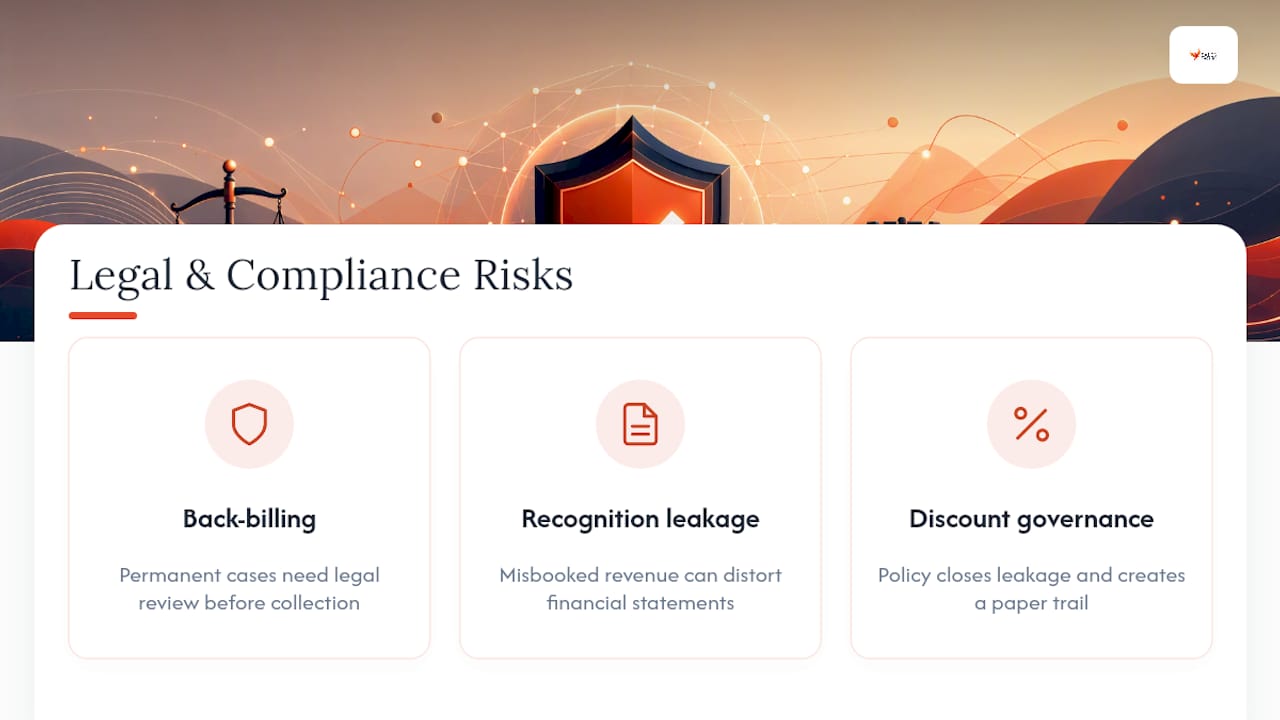
Back-billing a client for work delivered months ago requires care. If the original agreement did not clearly authorize the additional charge, or if too much time has passed, attempting to collect can trigger a contract dispute or damage the client relationship beyond the dollar value of the recovery. This is why permanent leakage, unlike temporary timing gaps, generally needs a legal review before any collection attempt, a distinction MGI Research treats as a prerequisite for tactical recovery work.
Recognition leakage carries its own compliance weight. Revenue booked in the wrong period, or against the wrong contract line, can distort financial statements in ways that matter to auditors, lenders, and, for public companies, regulators. A pattern of recognition errors that goes uncorrected long enough can become a reporting problem well beyond the original dollar amount.
Discount and pricing governance also has a compliance dimension in regulated industries, where inconsistent pricing across similar customers can raise fair-dealing concerns. A documented, consistently enforced discount approval policy protects the business on two fronts at once: it closes the leakage gap and creates a paper trail showing pricing decisions followed a defined process rather than an ad hoc one.
What Successful Leakage Recovery Actually Looks Like
The companies that make real progress on leakage share a common pattern: they treat it as a defined project with an owner and a deadline, not an ongoing background worry that everyone acknowledges and nobody schedules time for.
A services firm that discovers unbilled scope changes hiding in project notes, rather than in its invoicing system, typically finds the fix is procedural before it is technical. Requiring every scope change to generate a change order, routed automatically to billing, closes that gap without needing new software. The recovery on the backlog of unbilled work is often the single largest one-time win in an entire audit.
A subscription business that finds its price escalators were never triggered on renewal usually needs a smaller fix: connecting the contract management system to billing so an anniversary date automatically flags the price change for review. The forward-looking value of that fix, compounded across every future renewal, tends to dwarf the one-time back-billing recovery.
Across engagements applying the Phoenix Growth Framework™, the consistent theme has been that the largest recoveries come from a handful of high-value, high-probability fixes identified early, not from chasing every small discrepancy at once. That prioritization discipline, more than any single tool, is what separates an audit that produces a report from one that produces recovered dollars.
Why Most Leakage Advice Stops One Step Too Early
Most guidance on revenue leakage is strong on diagnosis and weak on follow-through. Plenty of resources will tell you to calculate a leakage rate or build a price waterfall, and then leave you there, as if identifying the gap were the same as closing it. It isn't. A hotspot list without an owner, a deadline, and a recovery script is just an expensive spreadsheet.
The conventional advice also tends to treat every leak as equally urgent, which wastes effort. Chasing a $2,000 timing discrepancy with the same intensity as a $200,000 structural discount problem burns hours you don't have. Prioritization by dollar impact and recoverability isn't a nice extra step. It's the difference between a program that pays for itself in weeks and one that quietly stalls out in month two.
What I'd tell any manager starting this work: run the audit fast, rank ruthlessly, and fix the top three leaks before you worry about the twentieth. Speed and focus recover more revenue than perfect measurement ever will.
— Hunter
Get a Revenue Leak Assessment That Finds Real Dollars
Sales-phoenix built the Revenue Leak Assessment specifically for firms that suspect they're losing money somewhere in their quote-to-cash process but don't have the internal bandwidth to run a full audit themselves.
The assessment applies the Phoenix Growth Framework™ to your actual contracts, quotes, and invoices, mapping every handoff where revenue commonly slips, and ranking what we find by dollar impact and recoverability so you know exactly where to focus first. Most engagements move from initial data pull to a prioritized findings report within weeks, not months, giving you a concrete recovery plan instead of a vague sense that something's off. Unlike a generic software audit, this is a hands-on engagement built around your specific systems and contracts. If you want a clear picture of what you're leaving on the table, book a Revenue Leak Assessment and get a prioritized recovery plan back in weeks.
Sources
- Revenue Leakage: A Guide for Identifying and Preventing — Salesforce
- What is revenue leakage? Here's how to detect it and prevent it — Stripe
- What Is Revenue Leakage? Causes and How to Prevent — NetSuite
- Revenue leakage series part 1 — MGI Research