

A sales operating model is the connected system of roles, processes, technology, and metrics that turns your sales strategy into repeatable revenue. Treat it as your revenue system, not an org chart. Some client work in the revenue intelligence space, along with Fullcast's research on strategic sales operations, points to the same conclusion: companies that design this system deliberately outgrow those that let it happen by accident.
TL;DR:
- Companies should base their sales operating model on deal size, team growth, and complexity, not industry trends, to ensure effective scalability.
- Key components include clear ownership of roles, defined processes with strict stage exit criteria, integrated technology aligned with the process, and measurable metrics like pipeline coverage and quota attainment.
- Starting with small team structures like island or pod models is recommended before shifting to assembly line or command center as headcount and deal volume increase.
- Successful transformation benefits from a phased approach—assessing current leaks, designing target models, piloting with specific success criteria, and scaling only after data confirms effectiveness.
- Technology investments should support well-defined processes, with the CRM acting as the system of record and analytics embedded early to predict revenue leaks accurately.
Table of Contents
- What Are the Core Components of a Sales Operating Model?
- What Are the Main Types of Sales Operating Models?
- How Do You Design or Transform a Sales Operating Model?
- Who Should Own Sales Ops, Enablement, and Analytics?
- How Should You Design Sales Process Stages and Playbooks?
- Which Technologies and Data Rules Actually Matter?
- What KPIs and Meeting Cadence Keep a Sales Operating Model Alive?
- How Does the Phoenix Growth Framework™ Apply This in Practice?
- Three Transformation Traps I'd Warn Any CRO About
- Where Sales-phoenix Fits When You're Ready to Execute
- Sources
- FAQ
What Are the Core Components of a Sales Operating Model?
Forrester's research on high-performing sales organizations identifies five components that matter: leadership, sales operations, sales enablement, channel strategy, and measurement. Miss one, and revenue leaks through the gap.
- Structure and roles — unclear ownership between AEs, SDRs, and customer success creates dropped handoffs and duplicate outreach.
- Process — without defined stages, reps invent their own version of "qualified," which wrecks forecast accuracy.
- Technology — tools bought before process exists become expensive filing cabinets nobody trusts.
- Metrics — vanity numbers (activity counts) hide the real problem: stalled deals nobody's chasing.
- Governance — no one owns updating the playbook, so it rots within two quarters.
Each component compounds the others. A clean process without CRM enforcement is just a wish. Clean data without governance decays within a year.
What Are the Main Types of Sales Operating Models?
Your ideal model depends on average contract value (ACV), team size, and deal complexity, not on what's fashionable. Fullcast's guidance on sales operations structures maps four common patterns worth knowing before you pick one.
- Island (full cycle) — one rep owns prospecting through close; fits small teams, high-touch deals, or founder-led sales under 10 reps.
- Assembly line — SDRs, AEs, and CSMs each own a stage; fits high-volume, lower-ACV motions where speed beats relationship depth.
- Pod — a small cross-functional team (AE, SDR, solutions engineer) owns a segment; fits mid-market complexity without full specialization overhead.
- Command center — a centralized RevOps hub coordinates planning and execution across specialized teams; fits scaling orgs above roughly 50 reps.
The heuristic: start with island or pod below 15 reps, shift toward assembly line or command center as headcount and deal volume grow past that point.
How Do You Design or Transform a Sales Operating Model?
Skipping straight to reorg charts is the fastest way to waste a transformation budget. A phased approach protects momentum while still forcing rigor.
- Assess — build a current-state map, a revenue leak inventory (where deals stall or vanish), and a tech stack audit.
- Design — draft a one-page target model, a RACI for every handoff, service-level agreements between teams, and explicit quota and territory rules. Gartner's sales strategy template is a solid starting artifact for documenting current state, target state, and required actions.
- Pilot — run the new model with one team or region for 60 to 90 days against defined success criteria before wider rollout.
- Scale — hand off ownership to permanent process governance once pilot metrics hold steady for two consecutive cycles.
Pro Tip: Never scale a pilot on gut feel. Write your pilot's success criteria down before it starts, or you'll retrofit the definition of "working" to match whatever happened.
Who Should Own Sales Ops, Enablement, and Analytics?
Staffing follows a rough progression: analysts handle reporting and data hygiene, managers own process design and cross-team coordination, and a director or VP sets strategy and owns the budget. PulseRevOps guidance on org structure ties staffing ratios to ARR and rep count rather than arbitrary headcount targets.
- RevOps typically reports to the CRO, not the CFO, because forecasting and pipeline decisions need to sit close to revenue accountability.
- Deal desk sits close to sales operations since pricing exceptions and approval routing overlap heavily with process enforcement.
- Enablement can report to sales or marketing depending on whether onboarding or content velocity is the bigger current bottleneck.
- Centralize analytics early; embed it into pods only once a segment is large enough to justify a dedicated analyst.
How Should You Design Sales Process Stages and Playbooks?
Process defines what happens at each stage. Methodology (MEDDIC, Sandler, Command of the Message) defines how reps execute within it. Confusing the two is why so many "process rollouts" fail. SyncGTM's guidance on process design recommends 5 to 7 stages with entry and exit criteria specific enough that two reps would categorize the same deal identically.
- Discovery — exit requires a confirmed budget range and a named economic buyer.
- Solution validation — exit requires a documented business case tied to a quantified outcome.
- Proposal — exit requires a signed mutual action plan with a target close date.
- Negotiation — exit requires legal or procurement engaged, not just verbal interest.
Enforce these through required CRM fields and stage gating that blocks advancement without the exit criteria met. Playbooks should include a discovery question bank, demo scripts by segment, and documented objection responses.
Which Technologies and Data Rules Actually Matter?
Buy tools to support a defined process, never to replace the work of defining one. Salesforce's process guidance is blunt about this: a well-integrated stack surfaces revenue leaks; a stack bolted onto chaos just digitizes the chaos.
- CRM is the system of record; everything else should sync to it, not compete with it.
- Enrichment tools keep contact and account data current so lead routing doesn't misfire.
- Revenue intelligence platforms flag stalled deals, missed follow ups, and rep behavior patterns tied to lost revenue, which is exactly the kind of visibility a revenue intelligence practice is built to deliver.
- CPQ enforces pricing rules so deal desk isn't fielding the same exceptions weekly.
Pro Tip: Audit your CRM for fields nobody's filled in for 90 days. Those are the process gaps your reps are quietly telling you about.
What KPIs and Meeting Cadence Keep a Sales Operating Model Alive?
A model without a review rhythm degrades within a quarter, no matter how well it was designed. Five metrics form the essential floor: pipeline coverage, win rate, deal velocity, leak rate (deals stalled past expected stage duration), and quota attainment.
- Pipeline coverage is owned by sales leadership, reviewed weekly.
- Win rate and deal velocity are owned by sales ops, reviewed biweekly.
- Leak rate is owned by RevOps, reviewed monthly against the revenue leak inventory built during assessment.
- Quota attainment is owned by the CRO, reviewed monthly and tied directly to compensation design.
Companies that treat sales operations as a strategic function, not spreadsheet support, report measurably higher revenue growth and fewer quota misses. An executive dashboard tied to these five metrics can turn quarterly guesswork into a weekly habit.
How Does the Phoenix Growth Framework™ Apply This in Practice?
The Phoenix Growth Framework™ addresses the common gap most operating models have: leaders can usually describe their process on a whiteboard, but nobody can point to where revenue is actually leaking. The framework starts by finding that leak, then fixing the operational cause behind it, not just the symptom.
A typical engagement follows a familiar arc:
- Assess — map current revenue flow and quantify where deals or dollars go missing.
- Prioritize — rank leaks by dollar impact and speed to fix.
- Implement — rebuild the specific process, tooling, or governance causing the leak.
- Measure — track close rate and revenue recovery against baseline.
Hiring outside help makes the most sense when internal teams lack bandwidth for the assessment phase or when leadership needs an unbiased read on where the model is actually breaking.
Three Transformation Traps I'd Warn Any CRO About
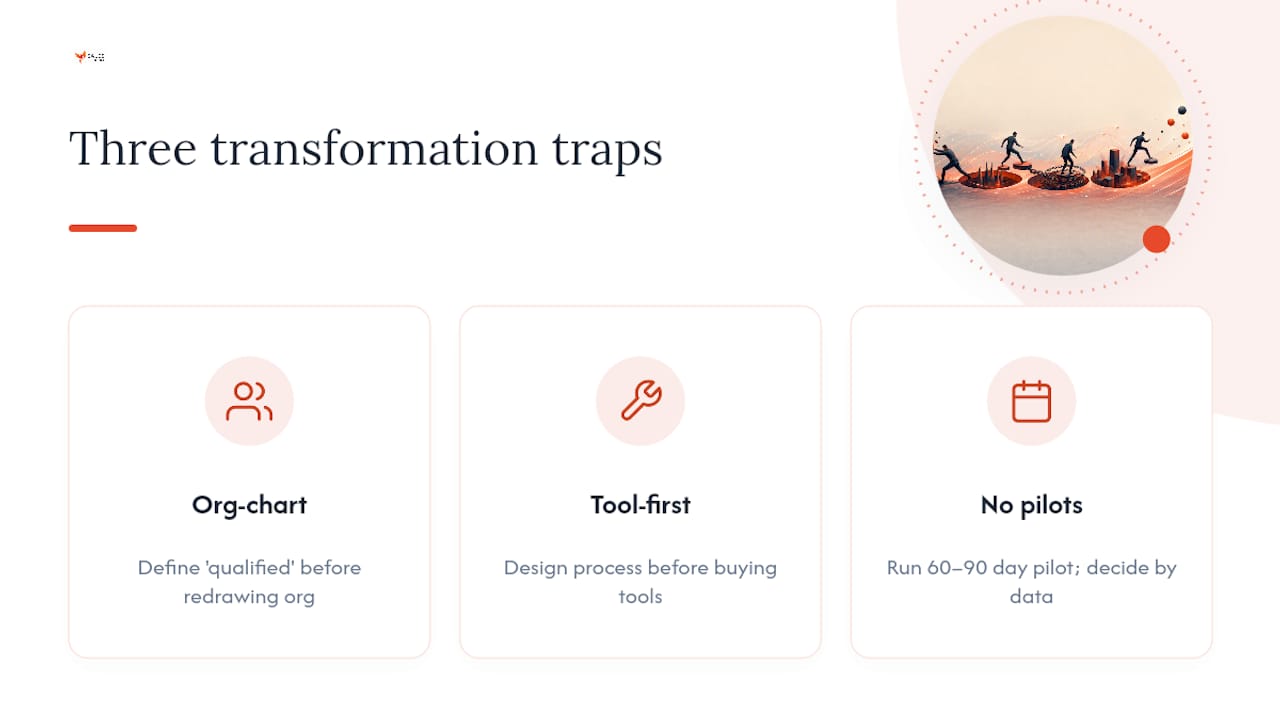
The biggest waste of time in sales operating model work is org-chart obsession, redrawing boxes before anyone's agreed what "qualified" means. Close behind it is tool-first buying: leaders license a shiny platform hoping it'll impose discipline that should have come from process design first. The third trap is skipping pilot measurement entirely, rolling out company-wide changes on conviction instead of 60 days of evidence.
Accept some temporary inefficiency in the pilot phase. Speed to a validated decision beats a perfect rollout plan that never gets tested. If I had 90 days as a new CRO: week one, build the leak inventory. Week four, ship one pilot. Week twelve, decide to scale or kill it, based on data, not opinion.
— Hunter
Where Sales-phoenix Fits When You're Ready to Execute
Reading about revenue leaks is one thing. Finding the exact dollar amount stalling in your pipeline right now is another. A Revenue Leak Assessment offering is designed to help with the assessment phase described above, mapping your current-state process and quantifying leaks before you touch a single tool or org chart.
From there, Growth Operations services may cover the pilot and scale phases, implementing the process, technology, and governance fixes the assessment surfaces. For leaders who need ongoing operational leadership without a full-time hire, the Fractional COO engagement fills that gap. A typical first engagement starts with the assessment, moves into a prioritized fix list within weeks, and gives you a measurable baseline to track recovered revenue against. If your pipeline coverage numbers look fine but your close rate doesn't match them, that gap is usually where the leak is hiding. Start with the assessment and find out.
Sources
- Gartner — sales strategy template
- Forrester — Six Components of a Highly Effective Sales Machine
- Fullcast — How to Design a Sales Operations Team Structure
- SyncGTM — How to develop a sales process
FAQ
What Are the Four Types of Operating Models?
The four common sales operating models are island (full cycle), assembly line, pod, and command center, distinguished mainly by how specialized roles are across the deal cycle.
What Is the 30-60-90 Rule in Sales?
It's a ramp framework for new reps or new initiatives: an initial learning phase, followed by applying skills with supervision, then operating independently against quota or KPI targets.
What Are the 5 Core Operating Model Functions?
Based on Forrester's framework, the five core functions are leadership, sales operations, sales enablement, channel strategy, and measurement.
What Are the 7 Stages of Sales?
A common 7-stage version runs prospecting, qualification, discovery, solution validation, proposal, negotiation, and close, though many effective processes compress this to 5 stages.
How Long Does a Sales Operating Model Redesign Take?
A focused assessment and pilot typically runs 60 to 90 days, with full-scale rollout following once pilot metrics hold steady across two consecutive review cycles.