

The fastest way to get value from a sales playbook template is to skip the 80-page binder and launch a Minimum Viable Playbook instead: one ideal customer profile, three core plays, clear entry and exit criteria for each pipeline stage, and a handful of KPIs. That single document shortens ramp time and keeps every rep telling the same story to prospects. Templates and fill-in examples for each piece follow below.
TL;DR:
- A minimum viable sales playbook should include one ideal customer profile, three core plays, clear stage entry and exit criteria, and a KPI dashboard to ensure adoption.
- Building the playbook in a structured, iterative process ensures it reflects actual call data and pipeline stages, reducing leaks and improving consistency.
- Storing the playbook as a live digital workspace enables real-time updates and ensures content remains relevant as market conditions and competitive landscapes shift.
- Focusing on simplicity—such as a one-page strategy and three key objection scripts—boosts usage and effectiveness during deal cycles.
- Regular reviews and enforcement by sales managers are crucial to prevent the playbook from becoming outdated or ignored within the first two quarters.
Table of Contents
- What Is a Sales Playbook Template?
- Why a Structured Sales Playbook Pays Off
- Core Components to Include in a Sales Playbook Template
- Step-by-Step Workflow to Build Your Playbook Template
- Ready-Made Templates and Examples for Notion, Docs, Sheets, or Your CRM
- The 30-60-90 Ramp Plan to Embed in Your Playbook
- Metrics and KPIs to Track Playbook Adoption
- Make the Playbook a Living Digital Workspace, Not a PDF
- Sales-phoenix: Applying the Phoenix Growth Framework™ to a Playbook Build
- Common Pitfalls and a Manager's Launch Checklist
- How Sales-phoenix Builds and Pilots Production-Grade Playbooks
- Sources
- FAQ
What Is a Sales Playbook Template?
A sales playbook template is the operational reference that tells reps exactly how to sell, to whom, and at what stage of the deal. It combines your ideal customer profile, your documented sales process framework, your messaging by persona, and the scripts and battle cards reps pull up mid call. Done right, it reads less like a manual and more like a cheat sheet built from what your best reps already do.
It's easy to confuse a playbook with two other documents, and mixing them up is one reason playbooks fail to get adopted.
- A strategy document covers the "why": market position, revenue targets, and competitive stance. Gartner recommends keeping this piece to a one-page strategic plan so leadership themes stay clear without burying the operational detail.
- A training curriculum teaches skills over weeks: discovery technique, objection handling fundamentals, product certification.
- A playbook is the daily reference: the specific talk track for a healthcare persona, the exact criteria that move a deal from "qualified" to "proposal," the battle card for your top competitor.
You need a playbook once results start varying wildly rep to rep, once ramp time creeps past what your hiring plan can absorb, or once you've grown past the size where tribal knowledge travels naturally between desks. A five-person team selling one product to one buyer type can often survive without one. A team of 15 reps, two segments, and three competitors cannot.
Why a Structured Sales Playbook Pays Off
A documented process changes outcomes in ways that show up in your CRM within one quarter, not in vague culture terms.
New hires ramp faster when the first 90 days follow a fixed script instead of shadowing whoever happens to be free that week. A written 30-60-90 plan gives new reps a clear finish line and gives managers a way to spot who's behind before it costs a quarter's quota.
Messaging consistency compounds too. When every rep pitches the same value proposition to the same persona, buyers get a coherent experience across a multi-call sales cycle, and marketing's messaging actually survives contact with the field.
Consistent process also gives managers something concrete to coach against. Without a documented set of plays, coaching turns into gut-feel feedback after a lost deal. With one, a manager can pull up the actual objection script a rep used, compare it to the standard version, and coach the gap directly.
- Faster ramp: a documented onboarding path shortens the runway to full quota.
- Sharper coaching: managers compare rep behavior against a written standard, not memory.
- Repeatable wins: plays that worked once get reused instead of reinvented.
- Lower variance: win rates across reps tighten instead of spreading wide.
None of that works if the document itself becomes the obstacle. LinkedIn's guidance on sales playbooks makes a direct case for starting with a Minimum Viable Playbook, core scripts, your top three objections, and stage exit criteria, and expanding only after a pilot proves the format works. Teams that try to document everything before launch usually ship nothing.
Core Components to Include in a Sales Playbook Template
Every effective sales playbook template covers the same ground, whether it lives in a 20-page PDF or a Notion workspace. Copy this list directly into a template file or a new CRM page and fill in each section with your own numbers.
- One-page strategic context. Revenue goal, target segments, and the two or three reasons buyers should act now. Keep it to one page, per Gartner's strategy guidance, so it doesn't compete with the operational content for attention.
- Ideal customer profile (ICP) and personas. Firmographic fit (size, industry, tech stack) plus buyer-level pain points and buying triggers for each persona involved in the deal.
- Process stages mapped to your CRM. Every stage needs explicit entry and exit criteria, not vague labels like "engaged" or "interested."
- Play library. Outreach cadences by segment, a discovery question set, a demo checklist, objection-handling scripts for your top five objections, and competitive battle cards for your two or three most common competitors.
- Messaging and talk tracks. The specific language that works for each persona, drawn from calls that actually closed, not from a marketing brief.
- Compensation summary and performance KPIs. How reps get paid and which numbers determine whether the play is working.
- Onboarding checklist with 30-60-90 milestones. A visible ramp timeline new hires can track themselves.
A few of those items deserve a closer look because they're where most templates fall apart in practice.
Stage entry and exit criteria matter more than the stage names themselves. "Qualified" means nothing until you define it: budget confirmed, economic buyer identified, timeline inside two quarters. Without written criteria, every rep's pipeline report becomes a matter of opinion, and forecast accuracy collapses.
Objection scripts work best when they come from real call transcripts rather than a marketing team's guess at what buyers might say. If your top objection is price, write the actual rebuttal your best closer uses, not a generic "value over cost" paragraph.
Battle cards need to answer one question per competitor: where do we win, and where do we lose. A card that just lists competitor features is trivia. A card that tells a rep "when they mention Competitor X's lower entry price, pivot to implementation time" is a play.
Sales-phoenix's customer intelligence work often starts exactly here, pulling ICP and persona data from closed-won and closed-lost deals rather than assumptions, because a playbook built on guessed personas repeats the same mistakes the sales team already made without one.
Step-by-Step Workflow to Build Your Playbook Template
Building a sales playbook template in the right order matters as much as what goes in it. Skip steps and you end up with beautiful documentation nobody uses.
- Set strategic context first, on one page. Write your revenue target, target segments, and the top three reasons prospects buy now. This anchors everything that follows and keeps the operational sections from wandering off message.
- Define your ICP from closed-won deals, not assumptions. Pull your last 20 to 30 closed-won accounts and look for what they actually share: company size, tech stack, trigger event. Segment by sales motion if you sell to more than one buyer type.
- Map process stages and write entry/exit criteria. Keep this to your current CRM stages. Don't invent new ones for the playbook; align to what's already tracked so the document and the data stay connected.
- Pull talk tracks from recorded calls, not a whiteboard session. If your team uses conversation intelligence software, pull the transcripts from your last 10 won deals. Write your top three objection scripts from what actually got said, not from what sounds good in a meeting.
- Build outreach cadences and a demo checklist. Document the artifacts each play requires: which email sequence, which discovery questions, what a rep needs to bring to a demo call.
- Wire KPIs and pipeline coverage math into a dashboard. Connect the playbook's metrics section to a live report so the numbers update automatically instead of living in a static document nobody revisits.
- Run a pilot with one team or one segment first. Collect feedback from reps and their manager weekly for the first month, then move to monthly review cycles once the format stabilizes.
Pro Tip: Build your first objection script from your single most-lost deal of the past quarter, not your most-won one. Losses expose exactly where the current pitch breaks, and that's the gap the playbook needs to close first.
The sequence matters because each step depends on data the previous one produced. Building talk tracks before you've defined your ICP means writing scripts for the wrong buyer. Wiring KPIs before you've mapped stages means measuring numbers nobody agrees on the definition of.
Real call data beats invented scripts every time. Seismic's guidance on sales training makes this point directly: drills and scoring rubrics built from actual lost deals accelerate skill transfer far faster than hypothetical role-play scenarios, because reps recognize the situations as things that actually happen to them.
Set a real deadline for the pilot, two to four weeks depending on your sales cycle length, and resist the urge to add more sections before that pilot produces feedback. A playbook is a hypothesis about what works. Test it before you expand it.
Ready-Made Templates and Examples for Notion, Docs, Sheets, or Your CRM
The format you choose depends less on preference and more on team size and how your reps already work. Here's what to build and where it typically lives.
- One-page strategy doc: revenue target, ICP summary, top three reasons to buy now. Works as a single Notion page or a pinned Google Doc.
- Play library: one page per play (cadence, discovery script, demo checklist, top objections, battle cards). Best as a set of linked Notion pages or CRM knowledge articles so reps can jump straight to the play they need mid-call.
- Onboarding 30-60-90 tracker: a checklist with dates and manager sign-off fields. A Google Sheet with checkboxes works fine for teams under 20 reps; larger teams often wire this into their CRM's onboarding module.
- KPI dashboard: live pipeline coverage, conversion by stage, and ramp metrics pulled automatically rather than typed in by hand.
For SMB teams, a Notion workspace or a shared Google Docs folder usually covers everything without extra tooling cost. Mid-market teams tend to move the play library into CRM knowledge pages so reps never leave their workflow to check a script. Enterprise teams with multiple segments typically need a dedicated content platform with version control and role-based permissions, because a battle card wrong for one region can misdirect an entire team.
A few fill-in snippets to copy directly:
ICP example: "Series B SaaS company, 50 to 200 employees, recently hired a VP of Sales in the last six months, using a CRM without pipeline reporting."
Discovery question set starter: "What triggered you to start looking at this now? Who else is involved in this decision? What happens if you do nothing for another two quarters?"
Stage-exit example: "Discovery to Qualified requires: confirmed budget range, identified economic buyer, and a stated timeline inside two quarters."
Store the working version in your CRM or a live workspace, not a PDF. A static file is a snapshot of the day it was written, and by the following quarter it's already wrong.
The 30-60-90 Ramp Plan to Embed in Your Playbook
New reps need a visible finish line, and a written 30-60-90 plan gives them one instead of leaving ramp time to whatever their manager remembers to mention.
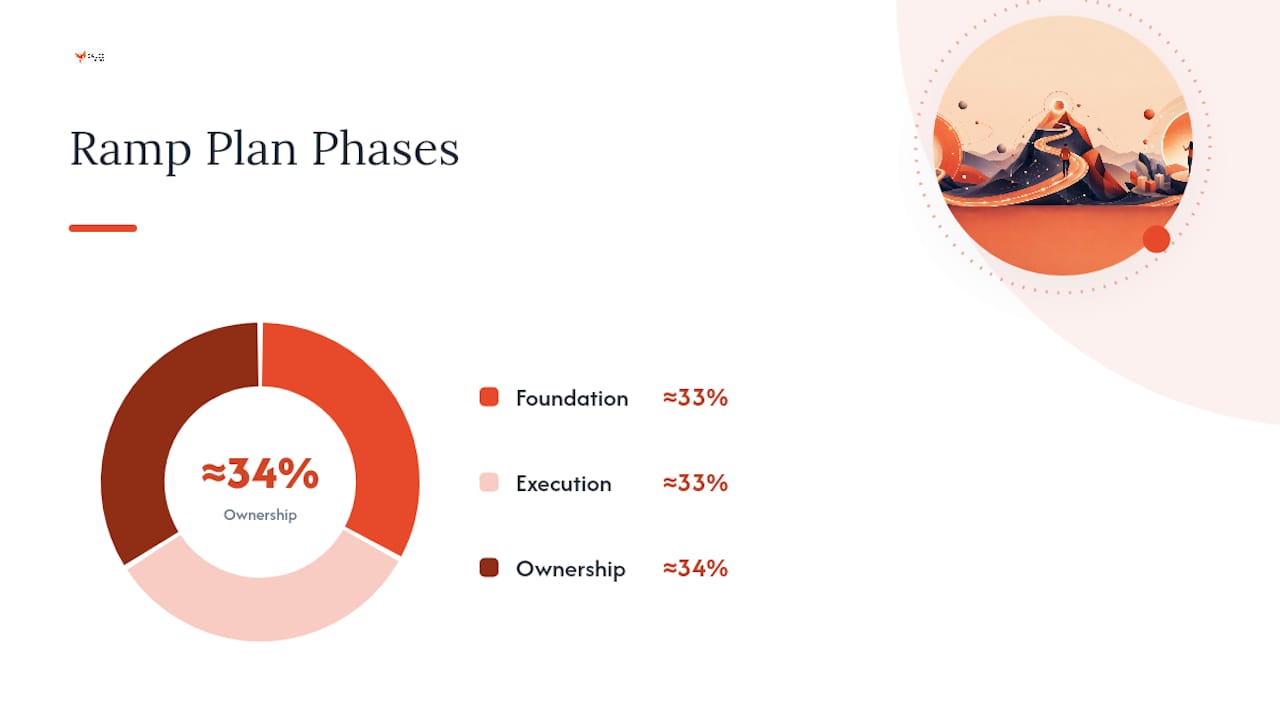
- Days 1 to 30: foundation. Product certification, CRM setup, shadowing calls, and a baseline knowledge assessment. The goal is readiness, not results. Highspot's research on sales training points to starting with fundamentals, discovery, qualification, and objection handling, before layering on advanced technique, because reps who skip fundamentals struggle later even if they close a lucky early deal.
- Days 31 to 60: monitored execution. The rep starts running plays independently but under close review. Set specific activity targets (calls, demos booked, emails sent) and expect the first self-sourced pipeline to appear by day 60.
- Days 61 to 90: ownership. The rep carries a partial quota, runs full deal cycles, and starts contributing documented feedback on what in the playbook worked and what didn't.
- Readiness certification. Before day 90 ends, require a minimum call count, a scored mock demo, and manager sign-off before the rep is considered fully ramped.
Pro Tip: Score the day-60 mock demo against the same rubric you'll use for real deal reviews later. Reps who struggle with the mock almost always struggle with the same gaps in live calls, and catching it at day 60 costs far less than catching it at a lost deal in month four.
Tie every milestone to a number a manager can check without asking the rep how it's going. "Feels ready" isn't a milestone. "Scored 8 out of 10 on the objection-handling rubric across three recorded calls" is.
Metrics and KPIs to Track Playbook Adoption
A playbook without a KPI dashboard is a guess dressed up as a document. Track adoption and impact with a small set of numbers your CRM should already surface.
| Metric | What it tells you |
|---|---|
| Activity targets (calls, demos, emails) | Whether reps are executing the prescribed cadence |
| Conversion rate by stage | Where deals stall relative to the documented process |
| Win rate | Whether the plays are actually closing business |
| Average deal size | Whether messaging is attracting the right segment |
| Time in stage | Whether stage-exit criteria are enforced or ignored |
| Ramp time to full quota | Whether the 30-60-90 plan is working as designed |
Pipeline coverage is the number most managers underuse. A common baseline: if your average close rate across the funnel is 25%, you need roughly 4x your quota in active pipeline to hit target reliably. Prospeo's sales strategy template builds this exact coverage math directly into its planning framework, alongside activity targets and KPI cadence, so managers can adjust the multiplier by segment rather than using one blanket number across a team selling different deal sizes.
Review activity and conversion metrics weekly. Review win rate, deal size, and ramp time monthly, since those numbers need more volume to mean anything. If your team uses conversation intelligence software, cross-check whether reps are actually using the scripted objection handling in live calls, not just whether they say they are in a stand-up meeting.
Make the Playbook a Living Digital Workspace, Not a PDF
A playbook stored as a static PDF is out of date the moment your top competitor changes their pricing page. The Alexander Group's research on playbook execution makes the case plainly: playbooks that function as living digital workspaces, built in Notion, CRM pages, or shared sheets, let teams update content in real time as deal flow surfaces new objections or a competitor shifts positioning. A PDF can't do that; someone has to notice it's stale, then re-export and re-distribute it, and by then reps have already stopped opening it.
The structure that tends to hold up over time separates the strategic and operational layers:
- A one-page strategy section that changes quarterly at most.
- Modular play pages that update whenever a new objection or competitor move surfaces.
- A KPI dashboard pulling live numbers instead of a screenshot pasted in last quarter.
Version control matters more than it sounds like it should. Note the date and reason for every change to a play, especially objection scripts and battle cards, so reps trust that what they're reading reflects this month's reality. Set clear permissions too: most reps should be able to suggest edits, but only sales leadership should be able to publish changes to core scripts, or you'll end up with five versions of the same objection response floating around.
Small teams do fine with a shared Notion workspace and light permission controls. Larger, multi-segment organizations usually need role-based access tied to the CRM itself, so a battle card built for one region doesn't accidentally surface to a rep working an entirely different market.
Sales-phoenix: Applying the Phoenix Growth Framework™ to a Playbook Build
A consultant-led build follows roughly the same sequence a manager runs internally, just with an outside audit layered in first. A proprietary growth framework maps to playbook construction in four phases: assessment, MVP build, pilot, and scale.
The assessment phase surfaces where revenue is actually leaking, often in stage definitions nobody's questioned in years or objection responses that quietly stopped working after a competitor repositioned. The MVP build phase turns those findings into the smallest usable playbook: ICP, three plays, stage criteria, KPIs. The pilot phase tests that MVP against live deals for a few weeks before anyone commits to scaling it. Only after the pilot validates the approach does the framework move to full documentation and rollout across the team.
Revenue rarely disappears in one dramatic failure. It leaks quietly through undefined stage criteria, objection scripts nobody updated after a competitor changed tactics, and onboarding gaps that cost every new hire an extra month of ramp. A playbook built from an actual audit closes those leaks instead of guessing at them.
Consultants prioritize the first plays by looking at where the pipeline data shows the biggest drop-off, then measure pilot ROI against that specific stage's conversion rate before expanding the build. More detail on how that assessment process runs sits in case studies from past engagements.
Common Pitfalls and a Manager's Launch Checklist
Most playbooks fail for the same three reasons, and none of them are about the content being wrong.
Over-detailing kills adoption before it starts. A 60-page playbook feels thorough to the person who wrote it and unusable to the rep trying to find one script during a live call. Start with the MVP: one ICP, three plays, stage criteria, and a handful of KPIs. Add complexity only after reps have proven they'll actually open the document.
Poor update cadence is the second killer. A playbook that gets written once during a big initiative and never touched again becomes fiction within two quarters. Assign someone, usually the sales manager, ownership of a monthly review, even if that review is just five minutes checking whether the top objection scripts still match what's happening on calls.
Lack of enforcement is the quiet third failure. If managers don't reference the playbook in coaching sessions and pipeline reviews, reps learn fast that it's optional. Make the connection explicit: pull up the actual play during a deal review, not just during onboarding.
For a launch checklist: confirm every rep has access before day one, walk through the top three plays live in a team meeting rather than emailing a link, and schedule the first feedback session for two weeks out, not two months. Enforce it in the first 90 days by referencing it in every one-on-one, or it never becomes habit.
— Hunter
How Sales-phoenix Builds and Pilots Production-Grade Playbooks
Revenue Intelligence work identifies exactly where a sales process is leaking deals before a single page of the playbook gets written, so the plays you build target the stages actually losing you revenue instead of the ones that feel like a problem.
A typical engagement starts with a Revenue Leak Assessment that maps your current pipeline against stage-by-stage conversion data, then moves into building the MVP playbook itself: ICP validation, the top three plays, documented stage criteria, and a KPI dashboard wired to live pipeline numbers rather than a quarterly spreadsheet update. From there, consultants coach the pilot directly with your managers, adjusting scripts and battle cards against real call outcomes before the team commits to scaling the format across the full roster.
If your current process feels inconsistent from rep to rep and you're not sure where the actual gaps are, a Revenue Leak Assessment is the place to start. It gives you the audit data a playbook needs before you write a single script.
Sources
A few external resources are worth bookmarking alongside your own template build:
- Sales playbook (LinkedIn Business)
- Gartner — Sales strategy resources
- Prospeo — Sales strategy template
FAQ
What Should Be in a Sales Playbook?
At minimum, an ICP with pain points, documented process stages with entry and exit criteria, messaging and talk tracks by persona, objection-handling scripts, and competitive battle cards. Sales-phoenix's approach starts with an MVP version of this list, then expands after a pilot validates the format.
What Are the 5 P's of Sales?
Definitions vary across sales organizations, and there's no single standard version. Rather than force-fitting your playbook into a specific "5 P's" model, build it around the components that actually appear in effective playbooks: ICP, process, plays, positioning, and performance metrics.
What Is the 30-60-90 Rule in Sales?
It's a ramp framework that splits a new rep's first 90 days into three phases: days 1 to 30 for training and shadowing, days 31 to 60 for monitored execution and early pipeline generation, and days 61 to 90 for full deal ownership and quota contribution.
What Four Elements Should Your Sales Playbook Include?
At a minimum: an ICP with clear buying triggers, documented process stages with exit criteria, a play library covering objections and messaging, and a KPI dashboard tracking adoption and results. Everything else is expansion once those four are working.
How Do I Keep a Sales Playbook From Going Stale?
Store it as a living digital workspace, Notion, CRM pages, or shared sheets, rather than a static PDF, and assign someone ownership of a monthly review tied to real deal outcomes. Playbooks that skip this step tend to fall out of use within two quarters.