

Sales process optimization is the continuous, data-driven work of refining each stage of your sales cycle so deals move faster and close more often. Done right, it shortens cycle time, lifts win rates, and gives reps back hours currently lost to admin work. This guide gives you a checklist, a diagnostic method, and a 90-day plan to make it happen.
TL;DR:
- Conduct an activity audit to identify bottlenecks, focusing on stages with low conversion rates or long time-in-stage that indicate qualification or workflow issues.
- Rebuild your ideal customer profile quarterly, emphasizing behavioral and technographic signals that predict actual buying behavior over firmographics alone.
- Prioritize fixing high-impact, low-effort changes first, such as routing rules or MQL criteria, and test these changes over 30 days with clear success metrics.
- Automate repetitive admin tasks through data enrichment, auto-logging, lead routing, and templates to free up significant selling time, while using AI signals carefully to target outreach.
- Shift stage exit criteria from activity-based to buyer decision-based statements like problem, evaluation, value, and commercial agreements to improve forecast accuracy and deal health.
Table of Contents
- Sales Process Optimization Checklist: 8 Steps to Start Now
- How Do You Audit Your Sales Process for Bottlenecks?
- How Do You Build an ICP That Actually Predicts Who Buys?
- Which Fix Should You Prioritize First?
- What Automation and AI Actually Move the Needle?
- How Should Stage Exits Reflect Buyer Decisions, Not Rep Activity?
- What Should You Measure and How Often?
- Your 90-Day Sales Process Optimization Plan
- How Does the Phoenix Growth Framework Map to This Playbook?
- Where Do Most Sales Optimization Projects Actually Go Wrong?
- Get Expert Help Fixing Your Revenue Leaks
- Sources
Sales Process Optimization Checklist: 8 Steps to Start Now
You don't need a six-month overhaul to see movement. Most gains in sales process optimization come from a small number of high-leverage fixes, applied in the right order. Here's the sequence, with a quick-win note for each step so you know what to expect before you commit resources.
- Diagnose with an activity audit. Have reps log time for one full week. Expect uncomfortable surprises within days.
- Refresh your ideal customer profile (ICP). Pull firmographic and behavioral data from your last 90 days of closed-won deals. Takes about a week to rebuild.
- Identify the single biggest pipeline leak. Calculate stage-to-stage conversion; the worst stage is usually obvious within an afternoon.
- Prioritize by impact versus effort. Pick one fix, not five. Decision made in a single meeting.
- Redesign stage exit criteria around buyer decisions. Rewrite what "qualified" and "committed" actually mean. Draft in a week, test for a month.
- Automate the admin tax. Enrichment, logging, and routing free up selling hours almost immediately.
- Roll out signal-driven outreach. Route intent signals to reps before competitors see them. Early lift shows in two to three weeks.
- Measure, review, and iterate. Weekly tactical check-ins, monthly operational reviews, quarterly strategic resets.
Each step gets its own detailed section below, starting with the diagnostic that tells you where to point steps 3 through 8.
How Do You Audit Your Sales Process for Bottlenecks?
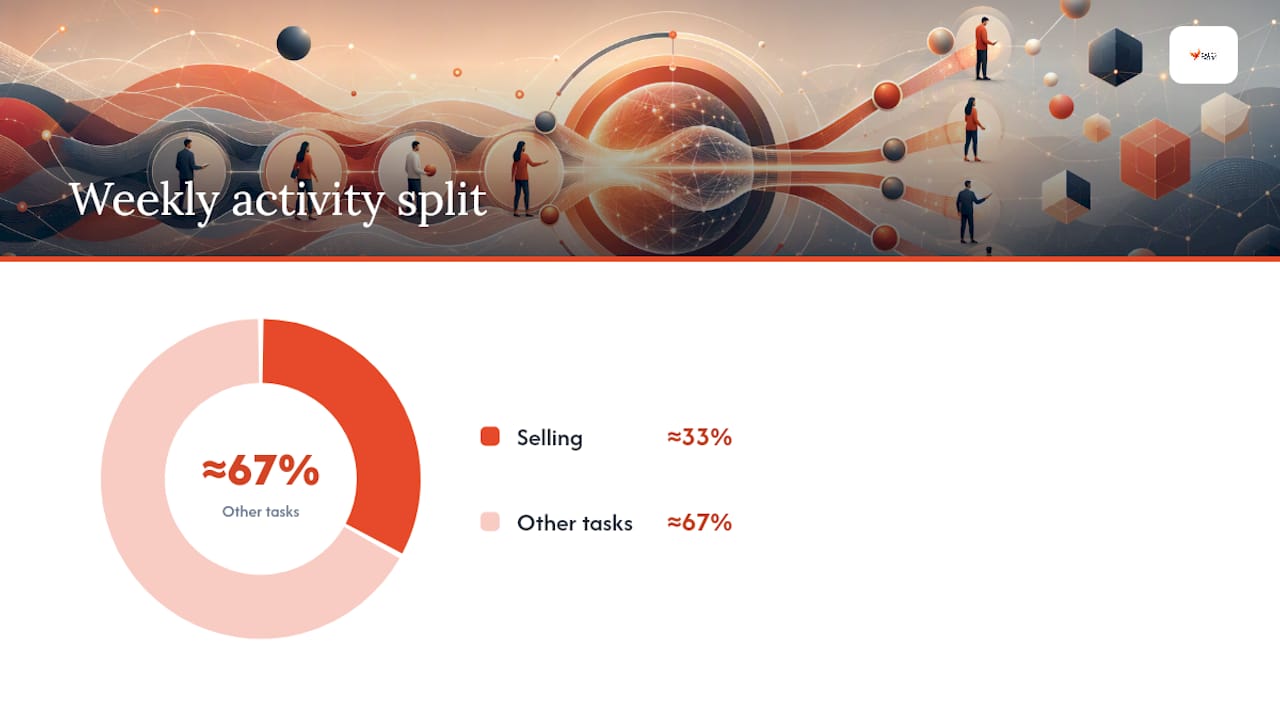
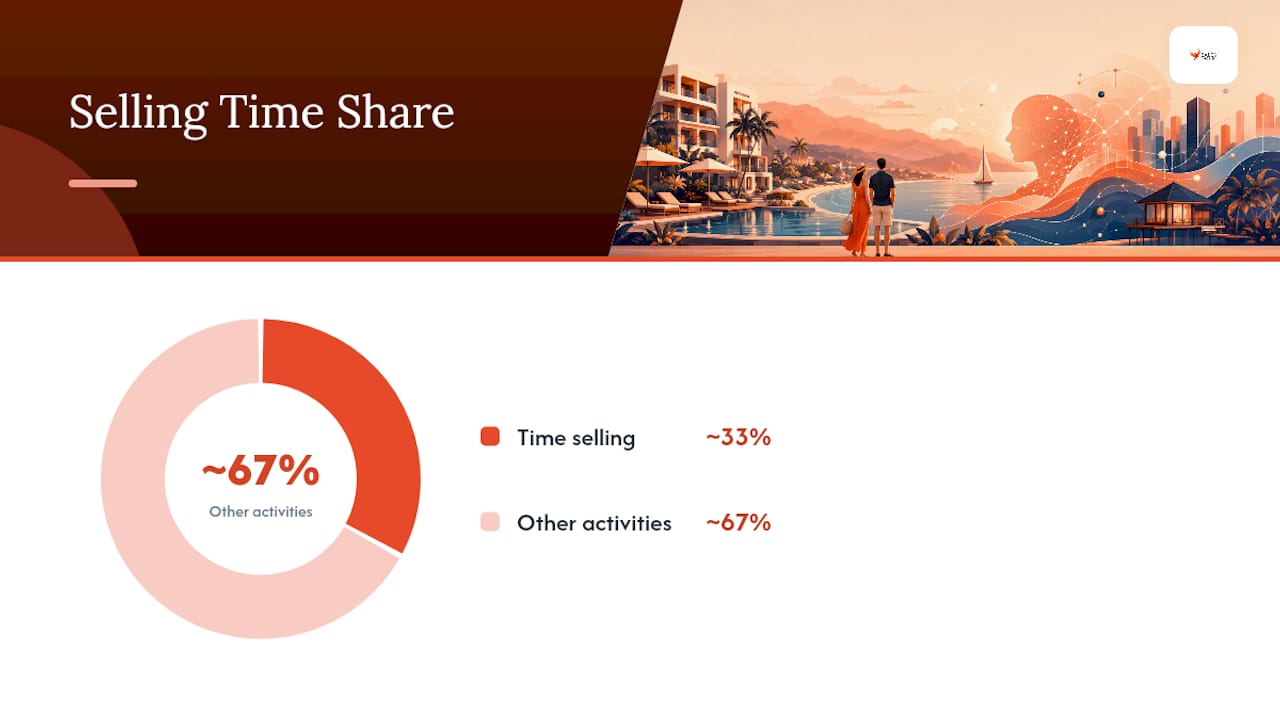
Start by comparing what your CRM says happens to what actually happens. Ask five reps to log every activity for one week, in 15-minute blocks, including the parts they'd rather not admit to: chasing internal approvals, reformatting proposals, waiting on legal. The gap between the documented process and this raw log is where your real problems live. It's rarely subtle. A SPOTIO survey of field sales teams found reps spend roughly a third of their week on actual selling, with the rest consumed by data entry, travel, and internal coordination.
Once you have a week of real activity data, calculate two numbers for every stage: stage-to-stage conversion rate and average time-in-stage. A stage with low conversion but fast time-in-stage usually signals a qualification problem, meaning the wrong deals are entering that stage in the first place. A stage with high conversion but long time-in-stage usually signals a process or resourcing problem, meaning good deals get stuck waiting on something (a demo slot, a legal review, an internal signature).
That distinction changes what you fix:
- Low conversion, short time-in-stage → fix the entry criteria upstream, not the stage itself.
- High conversion, long time-in-stage → fix the workflow or remove a bottleneck resource.
- Low conversion, long time-in-stage → you likely have both a qualification and an execution problem, and need to fix qualification first.
- High conversion, short time-in-stage → leave it alone. It's not broken.
Pro Tip: Run the activity audit before you touch your CRM reports. Reps will describe their week differently once they know you're watching the dashboard, and you'll lose the honest picture you need.
How Do You Build an ICP That Actually Predicts Who Buys?
A useful ICP goes beyond firmographics. Company size and industry tell you who could buy; they don't tell you who will. Build your ICP in three layers instead.
- Firmographic layer: revenue band, employee count, industry, geography. This is your first filter, not your final one.
- Technographic layer: the tools and systems a prospect already runs. A company using a specific CRM or a fragmented tech stack often signals readiness for what you sell.
- Behavioral layer: engagement patterns pulled from your last 90 days of closed-won and closed-lost deals. Which content did winners consume before a rep ever called? Which job titles showed up in the buying committee?
Rebuild this profile every quarter, not once a year. Markets shift, your product changes, and last year's winning segment can quietly become this year's churn risk. Watch for signals like a rising share of deals from a new vertical, a drop in win rate among a previously strong segment, or new technographic patterns among your best accounts.
Once the ICP is current, turn it into a simple scoring table reps and marketing both use:
| Signal | Weight | MQL threshold | SQL threshold |
|---|---|---|---|
| Firmographic fit | Medium | Meets 2 of 3 criteria | Meets 3 of 3 criteria |
| Technographic fit | Medium | Uses 1+ compatible tool | Uses 2+ compatible tools |
| Behavioral engagement | High | 1 high-intent action | 2+ high-intent actions in two weeks |
Buyers now complete most of their research before ever talking to a vendor, closer to 70% of the journey happens before first contact, so behavioral signals deserve the heaviest weight in this table.
Which Fix Should You Prioritize First?
Rank every candidate fix on two axes: impact on revenue and effort to implement. A change that touches one qualification form beats a full CRM migration nine times out of ten, purely on speed to proof.
- High impact, low effort: fix routing rules, tighten MQL criteria, template your top-performing proposal. Do these first.
- High impact, high effort: redesign stage exit criteria, rebuild onboarding for new hires. Schedule these for month two or three.
- Low impact, low effort: cosmetic CRM cleanup. Fine to batch later.
- Low impact, high effort: anything that sounds good in a planning meeting but doesn't move a metric. Skip it.
Once you've picked the single highest-leverage fix, run it as a 30-day experiment, not a permanent policy change. Write a one-sentence hypothesis ("Routing enterprise leads to senior reps within 15 minutes increases stage-two conversion"), define the treatment group, and hold a control if your volume allows it. A structured 30-day test protects you from scaling a fix that only worked because of a lucky month.
Pro Tip: Write down what "success" looks like numerically before you launch the experiment. Teams that skip this step almost always redefine success after the fact to match whatever happened.
What Automation and AI Actually Move the Needle?
The admin tax is the real enemy here, not lack of effort. Four automations consistently reclaim hours without adding new failure points:
- Data enrichment that fills firmographic and technographic fields automatically instead of manual research.
- Auto-logging of calls, emails, and meeting notes directly into the CRM.
- Lead routing rules that assign leads by territory, score, or product line within minutes, not hours.
- Proposal and contract templates that cut drafting time from hours to minutes for standard deal types.
Beyond admin relief, signal-driven outreach is where AI earns its place. Intent data (a prospect researching a competitor, visiting a pricing page repeatedly, or downloading a specific asset) lets you route the right accounts to reps before a form is ever filled out. The catch: signals are only useful when they cut down irrelevant outreach. Piled onto a rep's existing task list without filtering, they become one more source of noise instead of focus.
Rollout governance matters more than the tools themselves. Before automating a handoff, map exactly where data currently drifts or breaks between systems. A revenue intelligence layer that surfaces these breaks before you automate around them prevents you from scaling a broken handoff faster. Partners like HarbourSide Digital offer a useful outside view on where automation and operations intersect if you want a second opinion before committing internal engineering time.
How Should Stage Exits Reflect Buyer Decisions, Not Rep Activity?
Most stage-exit criteria describe what the rep did (sent a proposal, held a demo), not what the buyer decided. That's a forecasting problem in disguise. A rep can "complete" every activity in a stage while the buyer hasn't actually agreed to anything.
Rewrite your exit criteria around four buyer-side agreements instead:
- Problem agreement: the buyer has confirmed, in their own words, that the problem you solve costs them something measurable.
- Evaluation agreement: the buyer has agreed on how they'll compare options and who's involved in that comparison.
- Value agreement: the buyer has confirmed your solution's business case holds up against their own numbers.
- Commercial agreement: the buyer has aligned on budget, timeline, and procurement path.
Compare "rep sent a proposal" against "buyer confirmed the business case internally and named a decision date." The second version tells you something real about deal health; the first tells you a rep did their job. Reframing exits this way has a documented side effect worth calling out: it makes forecast accuracy go up, because stage progression finally reflects buyer commitment instead of seller motion. To preserve that context across handoffs, require a short buyer-language summary (not a rep-activity checklist) before any deal moves stages.
What Should You Measure and How Often?
Track five metrics by stage and by segment: conversion rate stage-to-stage, time-in-stage, overall win rate, pipeline velocity, and cost-per-acquisition by stage. Segment every one of these by ICP tier, deal size, and lead source. Blended averages hide the exact problems this whole exercise is meant to surface.
Set a three-tier review cadence:
- Weekly tactical review: pipeline movement, stuck deals, rep-level activity anomalies.
- Monthly operational review: conversion trends by stage, experiment results, automation performance.
- Quarterly strategic review: ICP refresh, win-rate trends by segment, whether the 90-day plan's changes actually held.
The most common failure mode isn't picking the wrong metric. It's checking too soon. One analysis of optimization initiatives found teams routinely abandon structural changes before they've had time to compound, mistaking a slow first month for a failed fix. Quick automation wins (routing, templates, auto-logging) tend to show measurable results in two to four weeks. Structural changes (new exit criteria, ICP shifts, redesigned handoffs) need a full pipeline cohort to cycle through, often 60 to 90 days, sometimes a full one to two quarters for longer sales cycles.
Statistic to remember: field reps in the SPOTIO research spend roughly a third of their week actually selling. Every automation you implement should be judged against whether it increases actual selling time, not just whether it looks good on a dashboard.
Your 90-Day Sales Process Optimization Plan
Sequencing beats intensity. Trying to fix everything in week one guarantees you'll measure nothing correctly. A staged approach across three months, consistent with how most modern sales optimization playbooks structure activation, gives each change time to show real signal before you build on top of it.
- Month 1: Run the activity audit, refresh the ICP, set up intent-signal capture, and establish a clean measurement baseline for every stage.
- Month 2: Launch your prioritized 30-day experiment, roll out one or two automations from the admin-relief list, and begin coaching reps on the new exit criteria.
- Month 3: Scale whatever treatment worked in month two, document the new process as a repeatable playbook, and set the quarterly review cadence going forward.
Change management determines whether any of this survives past day 90. Bring frontline reps into the redesign of exit criteria before you announce it, not after. Reps who helped write the new rules enforce them; reps who were handed the rules quietly route around them. Pair every process change with short, specific coaching, not a slide deck. A 15-minute role-play on the new qualification questions beats a one-hour training session nobody remembers by Friday.
Build a feedback loop that outlasts the 90 days. Monthly, ask reps what's still friction-heavy and ask customers (through win/loss calls) what almost stopped the deal. Both inputs belong in your next quarterly ICP refresh, not in a separate initiative six months later.
How Does the Phoenix Growth Framework Map to This Playbook?
A growth framework can be built around the same sequence this article walks through: diagnose the leak, redesign around buyer decisions, automate the admin tax, then scale what works. Such a framework can add a structured diagnostic layer and an implementation roadmap for teams that don't have the internal bandwidth to run all eight checklist steps simultaneously while still hitting quota.
Those are the firm's own reported outcomes, offered here as a benchmark, not a guarantee for every business.
DIY works well when your pipeline is simple, your team is small, and you have someone who can own the audit full time. Consulting-led work tends to make more sense once you're running multiple segments, multiple product lines, or a sales team large enough that a broken handoff compounds fast. A Revenue Leak Assessment or a look at the Phoenix Framework itself is a reasonable place to start if you're unsure which category you fall into.
Where Do Most Sales Optimization Projects Actually Go Wrong?
The failure I see most isn't a bad idea. It's bad patience. Leaders check results at week two, see nothing dramatic, and either kill the initiative or pile on a second change before the first one had a real chance to show up in the numbers. The second most common trap: optimizing for a metric that looks good in a review deck (activity volume, calls dialed) instead of one tied to buyer commitment.
Handoff design fails just as often, usually because it's designed by whoever's in the room, not by whoever owns the stage on either side of it. Optimization work should sit with someone who has authority over both sales and the systems around it, not a single department acting alone.
— Hunter
Get Expert Help Fixing Your Revenue Leaks
Some practices are built around one specific gap: most companies can describe their sales process but can't see where it's actually leaking revenue. Where a traditional consulting engagement often starts with assumptions, others begin with a diagnostic that maps your real stage-to-stage conversion and time-in-stage data before recommending a single fix.
A Revenue Leak Assessment gives you exactly what this article walked through, applied to your own pipeline data: a diagnostic of where deals actually stall, a prioritized fix list ranked by impact and effort, and an implementation roadmap sequenced like the 90-day plan above. Engagements typically build from there into Revenue Intelligence dashboards and Growth Operations support, depending on what the assessment surfaces.
If the audit steps in this guide turned up more problems than you have internal bandwidth to fix, start with a Growth Assessment and get a second set of eyes on the priority list before you commit a quarter to the wrong fix.
Sources
- Sales Process Optimization: How to Build a Scalable Revenue Engine
- Sales Optimization: A Field Sales Leader’s Playbook
- 9 Sales Funnel Optimization Tactics for 2026 | Similarweb
- Sales optimization playbook (HubSpot)
- Sales Optimization Process: 7 Steps to Close Faster