

Service capacity planning matches your available people, skills, and operational hours against the demand you expect, so you catch shortfalls before they hit a client deadline. The goal is headroom, not just staffing. Start today with a 15 to 30 day capacity snapshot: tally billable hours available versus committed work, and you'll know within an afternoon where the pressure point actually is.
TL;DR:
- Capacity planning should be a continuous process, with monthly snapshots for short-term adjustments and quarterly reviews for medium- and long-term strategies.
- Accurate demand forecasting across three horizons, combined with scenario modeling, is essential for building reliable capacity plans that avoid overprovisioning or underfunding.
- Selecting the right model—top-down, bottom-up, or SLO-driven—depends on your organization's maturity and workload predictability, with hybrid approaches being common.
- Four key metrics—utilization rate, response time, backlog, and error budget—guide headroom decisions and ensure service level commitments remain intact during demand spikes.
- Linking capacity gaps directly to revenue and client SLOs enables better decision-making and prevents firefighting by tying staffing to measurable financial and operational impacts.
Table of Contents
- What Is Service Capacity Planning, Exactly?
- Why Does Capacity Planning Matter for a Service Business?
- Which Capacity Planning Model Fits Your Team?
- What Metrics Actually Drive Headroom Decisions?
- How Do You Actually Perform Capacity Planning?
- What Goes Wrong, and How Do You Fix It?
- Which Tools and Templates Should You Use?
- How Sales-Phoenix Applies Capacity-Aware Revenue Intelligence
- What Managers Get Wrong About Capacity Planning
- Ready to Turn Capacity Gaps Into Revenue?
- Sources
- FAQ
What Is Service Capacity Planning, Exactly?
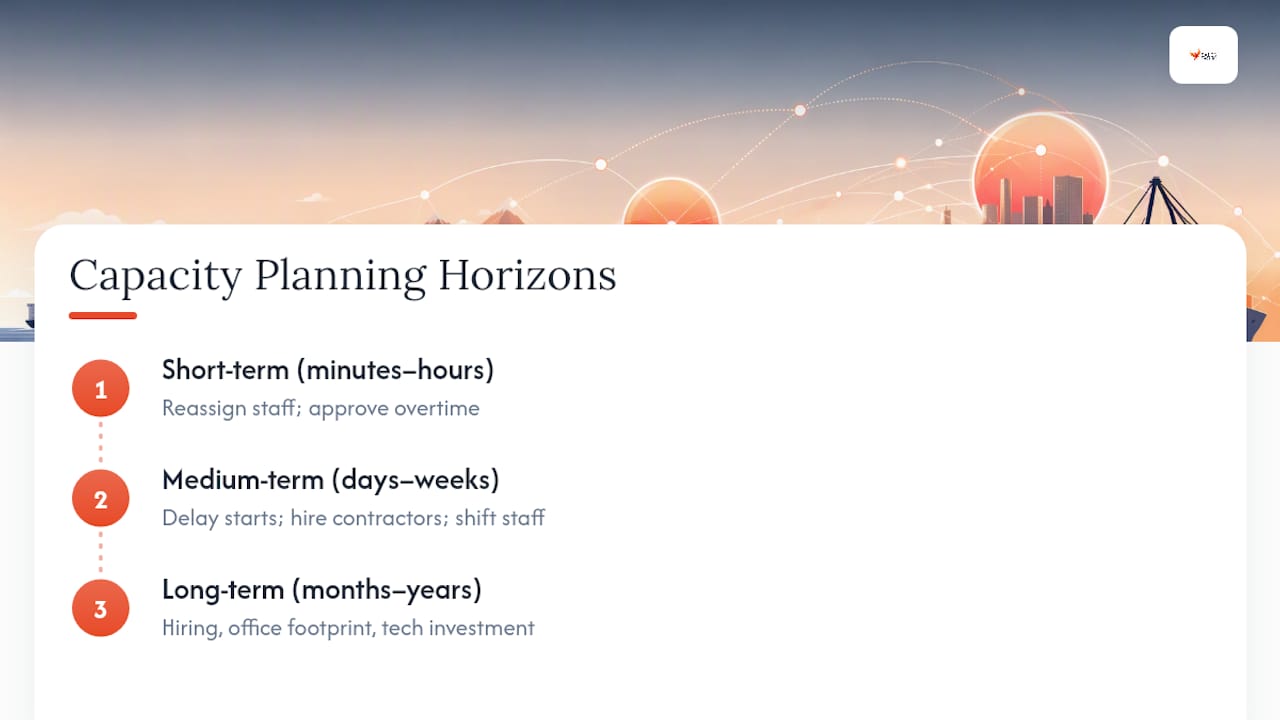
Service capacity planning is the practice of forecasting demand and matching it against the human, technical, and operational resources a firm has on hand, then closing whatever gap shows up. It covers three time horizons, and each one drives a different kind of decision.
Short-term planning covers minutes to hours. Think reassigning a consultant mid-week when a project runs hot, or approving overtime for a launch. Medium-term planning spans days to weeks. That's where you decide whether to delay a project start, bring in a contractor, or shift a junior staffer onto billable work. Long-term planning stretches across months to years and covers hiring plans, office footprint, and technology investment. IBM's framework for these horizons was built for infrastructure teams, but the same logic governs a 40-person consulting shop deciding whether to open a fourth practice group.
Capacity planning is often confused with resource planning and workforce management, but they answer different questions. Resource planning asks who works on which project this week. Workforce management handles scheduling, time tracking, and compliance. Capacity planning asks a bigger question first: do we have enough total capability, across all horizons, to meet what's coming? Finance usually sits downstream of this, translating your capacity gaps into headcount budgets and contractor spend.
Why Does Capacity Planning Matter for a Service Business?
Capacity planning matters because unaccounted demand shows up first as missed deadlines, then as client churn, and only later as a line item on a spending report. Getting ahead of it protects revenue before it's lost, not after. Considering inputs, delivery processes, and output constraints together, rather than staffing reactively, is what separates firms that hit their commitments from those that scramble every quarter, according to Wolters Kluwer's analysis of capacity planning for service organizations.
A handful of triggers should push capacity planning onto your calendar immediately:
- A new service line or product launch with unknown demand curves
- Sustained growth that's outpacing your current headcount for two or more consecutive quarters
- Client SLAs or SLOs at risk of breach, even occasionally
- Rising labor costs pushing you to squeeze more value from existing staff before hiring
The payoff shows up in three measurable places: fewer missed deadlines, tighter utilization rates (the ratio of billable hours to available hours), and less burnout on your highest performers. Tie those capacity decisions directly to revenue outcomes and SLOs, and the conversation with finance gets a lot easier, since you're no longer asking for headcount on gut feel.
Which Capacity Planning Model Fits Your Team?
Four modeling approaches cover almost every service organization's needs, and picking the wrong one is a common reason capacity plans stall out.
Top-down (capacity-led) starts with what you already have and asks how much demand it can absorb. It's fast and works well for firms with stable, predictable workloads. Bottom-up (demand-led) starts with the forecasted work and builds staffing up from there, role by role. It's more accurate but takes longer to build. Most mature firms end up running a hybrid: top-down for a quick sanity check, bottom-up for the actual staffing plan.
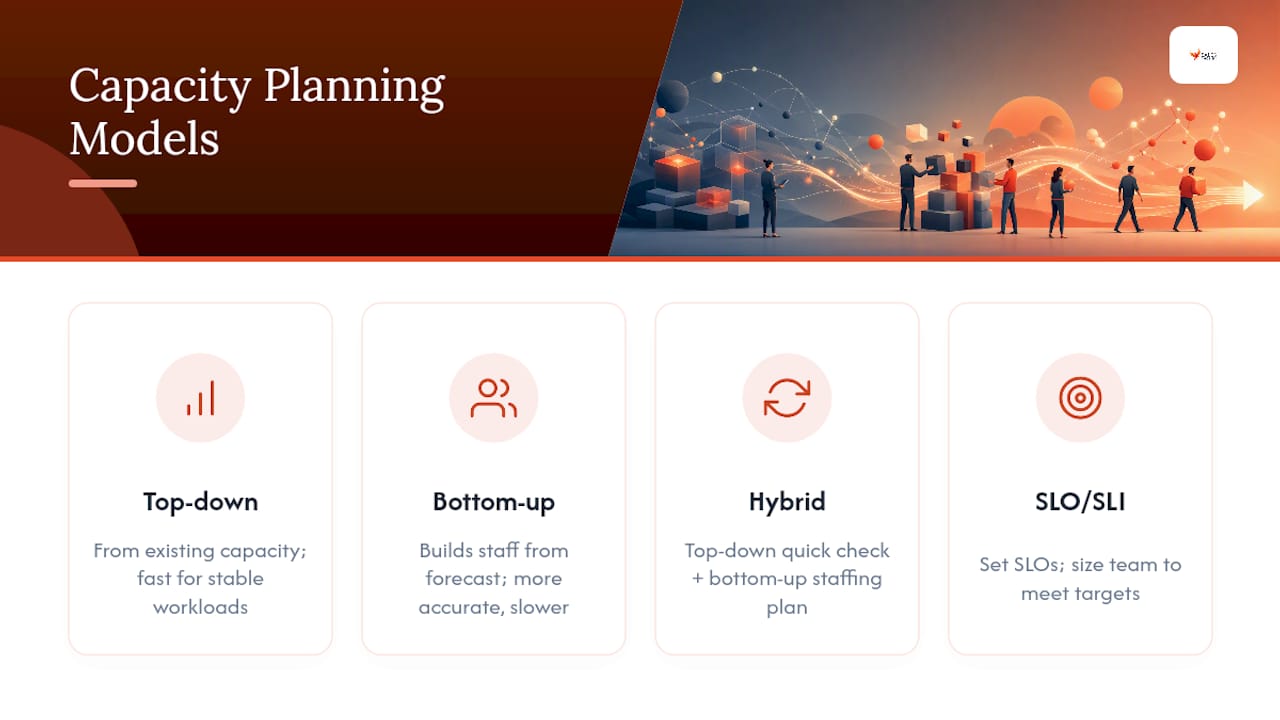
SLO/SLI-driven planning borrows from operations engineering. You set a service level objective (say, respond to client requests within four business hours), track the service level indicator that measures it, and size your team to hit that target with margin to spare. This works especially well for delivery teams with contractual response commitments, and it's the model Microsoft's Azure Well-Architected guidance recommends pairing with forecasting and autoscaling.
Finally, separate tactical allocation from strategic investment. Reassigning someone for a week is tactical. Opening a new office or hiring five specialists is strategic, and it deserves scenario modeling: build two or three demand scenarios (flat, moderate growth, aggressive growth) and cost out the staffing response to each before you commit.
What Metrics Actually Drive Headroom Decisions?
Four metrics do most of the work: utilization rate (billable hours divided by available hours), average response time against your SLO target, backlog length (open requests waiting on assignment), and your error budget, which is the tolerance you've built into a service commitment before you're technically in breach.
Converting an SLO into headroom is simpler than it sounds. If your SLO promises a four-hour response time and your historical data shows response times creeping toward five hours under peak load, you need enough spare capacity to absorb that swing without breaching the commitment.
Pro Tip: A rough rule of thumb is to build headroom above your average forecasted demand for any service with a contractual SLO, ensuring capacity to handle demand spikes without breaching commitments. Below that, a single bad week turns into a breach.
Here's the math worked out. For example, a team needing 400 billable hours weekly to meet forecasted demand should include a buffer to handle demand spikes without breaching response commitments. If each full-time employee delivers around 32 productive hours weekly after accounting for internal meetings and admin, calculate the needed FTEs accordingly, not relying solely on raw demand numbers.
How Do You Actually Perform Capacity Planning?
Building a workable plan takes five stages, and skipping any one of them is how plans end up too vague to act on.
- Collect telemetry and demand signals. Pull project hours, ticket volumes, or client request logs at whatever granularity matches your decision cycle: hourly for operational services, daily for project work, role-level for anything involving specialized skills.
- Build a baseline of productive capacity and a skill inventory. Calculate real productive hours per person (not calendar hours), and catalog who can do what at what competency level. A senior consultant and a junior analyst are not interchangeable units of capacity.
- Forecast demand across all three horizons and run scenario models. Build a short-term forecast for the next 30 days, a medium-term one for the next quarter, and a long-term one tied to your growth plan. Run what-if scenarios: what happens to headroom if a client doubles their scope, or if two senior staffers leave.
- Calculate headroom and list your candidate actions. Once you know the gap, weigh hiring against upskilling, reallocating existing staff, or outsourcing to contractors. Estimate cost and time-to-implement for each, since a hire that takes ten weeks to onboard doesn't solve a problem that hits in three.
- Validate with tests and set up ongoing monitoring. Run a pilot reallocation or a small canary test before rolling a plan out organization-wide, then build a feedback loop so you're updating the forecast monthly, not annually.
Saviom's seven-step resource capacity framework follows a nearly identical sequence, and it's worth building your own checklist around it rather than reinventing each step from scratch. When specialist skills are the real constraint, model capacity in two dimensions at once: raw hours and skill units by role and competency level, since a shortage of generalist hours and a shortage of one specific certification require completely different fixes.
What Goes Wrong, and How Do You Fix It?
Most capacity plans fail for one of four predictable reasons, and each has a fast, workable patch.
Data gaps. You don't have clean historical utilization data. Run a two-week manual scan and pair it with short interviews with team leads to fill the gaps fast, a tactic Atlassian recommends precisely because it builds credibility for a bigger platform investment later.
Specialist bottlenecks. One certified expert can't scale linearly. Cross-train a backup, bring in a contractor for overflow, or make a targeted hire rather than waiting to solve it with generalist headcount.
Long lead times. Hiring and procurement rarely move fast enough to match a sudden demand spike. Stage your response: temporary contractors now, permanent hires once the trend confirms itself over two or three cycles.
Overprovisioning. Padding every plan with excess headroom protects nothing but your anxiety and drains your margin. Set explicit risk-tolerance thresholds per service tier, and cost out each scenario before adding staff you may not need.
Which Tools and Templates Should You Use?
Tool choice should track your organization's maturity, not the other way around. A ten-person firm building its first capacity plan doesn't need the same stack as a 200-person agency running automated forecasting.
- Manual stage: a spreadsheet template tracking hours available, hours committed, and gap by role or team, updated weekly.
- Intermediate stage: centralized resource platforms and forecasting tools that pull telemetry automatically instead of requiring manual entry.
- Advanced stage: observability platforms paired with scenario simulators, and in some infrastructure-heavy environments, machine-learning models like CapPredictor that extrapolate headroom beyond your observed data range.
A workable starter template needs six columns: role or team, available hours, committed hours, forecasted demand (next 30/60/90 days), current gap, and recommended action. Atlassian's own guidance points to exactly this kind of lightweight tracking as the right first move before adopting a dedicated platform. Firms scaling toward more automated systems often lean on operations-focused partners like Autonomousfirm to build out predictive provisioning once the manual stage stops keeping up.
How Sales-Phoenix Applies Capacity-Aware Revenue Intelligence
Capacity gaps and revenue leaks are usually the same problem viewed from two different departments. A growth framework can start by mapping demand visibility directly into sales and delivery decisions, so a capacity shortfall shows up as a dollar figure before it shows up as a missed deadline.
The sequence runs in three stages: an initial revenue and capacity assessment, a working dashboard that surfaces where demand and delivery capacity are misaligned, and a prioritized roadmap for closing the gap. This is the same logic behind long-term growth operations planning and behind aligning consultant availability with client demand in sales performance work.
What Managers Get Wrong About Capacity Planning
Most managers treat capacity planning as a one-time headcount exercise instead of an ongoing discipline, and that's the single biggest mistake I'd flag. Start small: a 30-day baseline beats a perfect annual model you never finish building. Pair that short-term scan with a long-term hiring plan so you're not perpetually firefighting.
Three trade-offs deserve real attention: cost versus risk versus time-to-act. Every capacity decision leans on one more than the others, and pretending they're balanced is how plans go sideways. Get finance, delivery, and sales in the same room before you finalize a plan. Capacity decisions made in a silo tend to solve the wrong problem.
— Hunter
Ready to Turn Capacity Gaps Into Revenue?
Most capacity planning stalls at the spreadsheet stage because nobody connects the staffing gap back to what it's actually costing in lost revenue. Sales-phoenix closes that loop directly: Revenue Intelligence gives you the demand visibility and leak detection that turns a vague staffing worry into a specific, prioritized fix.
The typical engagement starts with a Revenue Leak Assessment to find out exactly where demand and delivery capacity are misaligned, moves into a pilot dashboard so you can see the gap in real numbers, and ends with a prioritized implementation roadmap your team can actually execute. If you're staring at a capacity plan that doesn't tie back to revenue impact, book a Revenue Leak Assessment and get that connection made in weeks, not quarters.
Sources
- Capacity planning — IBM
- Capacity planning — Azure Well-Architected
- What is capacity planning? — Atlassian
- Mastering resource capacity planning — Saviom
- CapPredictor — LinkedIn/academic workshop paper
FAQ
What Are the Three Types of Capacity Planning?
Most frameworks split capacity planning into lead, lag, and match strategies: building capacity ahead of demand, adding it after demand appears, or adjusting incrementally as demand shifts. Service organizations often overlay this with the three time horizons, short, medium, and long-term, to decide which strategy fits which decision.
Can You Give an Example of a Capacity Plan?
A basic plan lists each team's available hours, current committed hours, forecasted demand for the next 30, 60, and 90 days, the resulting gap, and a recommended action like hiring, cross-training, or outsourcing.
What Is the Best Tool for Capacity Planning?
The right tool depends on your maturity stage: a spreadsheet template works fine for a manual first pass, while centralized resource platforms and forecasting engines suit teams ready to automate telemetry collection. Sales-phoenix's Executive Dashboard approach fits teams that want capacity gaps tied directly to revenue visibility rather than tracked in isolation.
How Do You Perform Capacity Planning Step by Step?
Collect demand and telemetry data, build a baseline of productive hours and skills, forecast demand across short, medium, and long horizons, calculate the resulting headroom gap, and validate your plan with a small pilot before rolling it out fully. Ongoing monitoring closes the loop so the plan updates as real demand shifts.
How Often Should a Service Business Revisit Its Capacity Plan?
Short-term capacity snapshots should run monthly, while medium and long-term forecasts deserve a full review each quarter or whenever a major client, hire, or service line changes the demand picture.