

A unified customer view is a single, continuously updated profile that merges every customer interaction, transaction, and preference into one record any team can trust. It replaces fragmented CRM contacts and spreadsheet exports with one source of truth that speeds up service, sharpens personalization, and lifts revenue. The rest of this guide covers how to build one, what it costs to get wrong, and how to prove it worked.
TL;DR:
- Most organizations should start with a pilot that focuses on their top five data sources, using deterministic identity matching to quickly identify revenue leaks.
- A unified customer view combines data from all touchpoints and sources, including behavioral, transactional, and consent information, into a single, continuously updated profile.
- Building the profile involves normalizing records, resolving identities carefully with human review for ambiguous matches, and deploying it through APIs or streaming for real-time activation.
- Prioritizing identity resolution and running a focused pilot offers more immediate business value than attempting a full platform overhaul or perfect architecture.
Table of Contents
- What Is a Unified Customer View, Exactly?
- Why a Unified Customer View Pays for Itself
- How Do You Build a Unified Customer View?
- Identity Resolution: The Decision That Determines Everything Else
- Where Governance and Consent Break Unified Customer View Projects
- How to Measure Whether Your Unified Customer View Is Working
- What a Growth Consultant Sees That Internal Teams Often Miss
- Real-World Examples of Unified Customer View Payoffs
- AI, Machine Learning, and the Future of the Unified Customer View
- The One Move That Actually Moves the Needle
- How Sales-phoenix Helps You Skip the Trial-and-Error Phase
- Sources
- FAQ
What Is a Unified Customer View, Exactly?
A unified customer view, often called a customer 360 or single customer view, is different from a typical CRM contact record in one key way: it pulls from every system a customer touches, not just the ones sales owns. A CRM record usually holds a name, a deal stage, and a few notes. A unified profile adds behavioral events, purchase history, support tickets, marketing engagement, consent status, and often predictive scores like churn risk or lifetime value.
The core components usually include:
- Identity data: name, email, phone, and the identifiers that link them across systems.
- Behavioral and event data: clicks, page visits, app usage, in-store scans.
- Transactional data: orders, refunds, subscription changes, payment history.
- Preferences and consent: opt-ins, channel preferences, consent timestamps by source.
- Predictive attributes: propensity scores, segment tags, next-best-action flags.
Vendors and teams use different labels for roughly the same idea. "Single customer profile" tends to describe the record itself; "customer 360" describes the strategic goal; "integrated customer data" describes the pipeline feeding it. Pick one term internally and stick with it, or your data team and your marketing team will spend months arguing about semantics instead of building anything.
Why a Unified Customer View Pays for Itself
Retailers that connect every touchpoint into one commerce stack report an average 8.9% uplift in annual gross merchandise value, driven mostly by sharper merchandising and cross-channel analytics that a fragmented data setup simply can't produce. That's not a marginal number for a mid-size retailer. It's the difference between a flat quarter and a genuinely good one.
Quick stat: Brands running on a unified commerce platform can launch personalization campaigns roughly 20% faster than teams working across disconnected legacy systems, mostly because they skip the manual data-stitching step entirely.
The operational gains matter just as much as the revenue ones. A support agent who can see a customer's last three orders, their open ticket, and their preferred channel resolves a case in one call instead of three transfers. That consistency shows up everywhere:
- Segmentation and personalization that reflect actual behavior, not stale demographic guesses.
- Support agents working from full context instead of asking customers to repeat themselves.
- Cross-sell and upsell timing based on real purchase patterns.
- Analytics that answer "who are our best customers" without a week of manual joins.
How Do You Build a Unified Customer View?
Building one is a sequence, not a single project. Skip a step and you end up with a database that looks unified but produces bad matches and worse decisions.
- Inventory your data sources. List every system holding customer data: CRM, e-commerce platform, support desk, email tool, point-of-sale, billing. Map who owns each one and how clean it actually is.
- Choose your runtime layer. A customer data platform (CDP) centralizes and activates profiles quickly but adds another system to maintain. A unified commerce platform bundles this natively but locks you into its ecosystem. A warehouse-backed approach gives you full control but takes longer to activate data in real time. Pick based on how fast you need to move versus how much control you need to keep.
- Ingest and normalize records. Pull data from each source, standardize field formats, and preserve lineage so you always know where a value came from.
- Resolve identity. Start with deterministic matching (exact email or phone matches), then layer in probabilistic matching with human review for ambiguous cases. Never auto-merge low-confidence matches without a review step.
- Enrich and activate. Add consent history, behavioral scores, and predictive attributes, then expose the resolved profile through APIs or streaming so downstream systems query one current source instead of building their own copies.
- Run a pilot. Choose one audience segment, one channel, and one measurable business outcome. Define the runbook and set a go/no-go metric before you launch, not after.
Pro Tip: Run your identity resolution pilot on your smallest, messiest data source first, not your cleanest one. If deterministic rules can handle your worst data, they'll handle everything else without surprises later.
The practical architecture behind this: ingest from CRM, marketing, analytics, and warehouse systems, resolve identity at ingestion rather than per-system, persist one resolved profile with full lineage, and let every consuming system query that same resolved context instead of running its own matching logic.
Identity Resolution: The Decision That Determines Everything Else
Deterministic matching links records using exact identifiers like email address, phone number, or a shared loyalty ID. It's fast, explainable, and rarely wrong. Probabilistic matching infers a link from a combination of weaker signals like name similarity, device fingerprint, or shared address, and it catches connections deterministic rules miss. The trade-off is real: probabilistic matching creates false positives if you don't guardrail it with confidence thresholds and human review on anything below your comfort line.

A 360-degree view stitches together clicks, carts, chats, and in-store swipes into a profile that updates continuously rather than through nightly batch jobs, which matters for anything customer-facing in real time, like a support agent or a checkout flow.
A few architecture decisions carry outsized weight:
- Where the resolved profile lives determines latency. A profile queried from a warehouse batch job is fine for a marketing segment; it's useless for a live chat agent who needs the answer in under a second.
- Lineage and match evidence should be preserved for every merge, so a bad match can be split apart later without losing history.
- Integration pattern matters more than tooling. Streaming events suit real-time activation; batch ETL suits analytics; APIs suit on-demand lookups. Most mature setups use all three for different consumers.
Teams building this in-house often underestimate the identity layer specifically. A partner like Vetros, which focuses on data product and identity-layer architecture, is a useful reference point for how dedicated identity resolution should function as its own layer rather than logic scattered across five different systems.
Where Governance and Consent Break Unified Customer View Projects
Consent management is the single most common thing teams get wrong, and they get it wrong by treating consent as one flag instead of a history. A customer can opt into email marketing and out of SMS on the same day, and six months later reverse both. If your system only stores current status, you lose the audit trail regulators and your own legal team will eventually ask for.
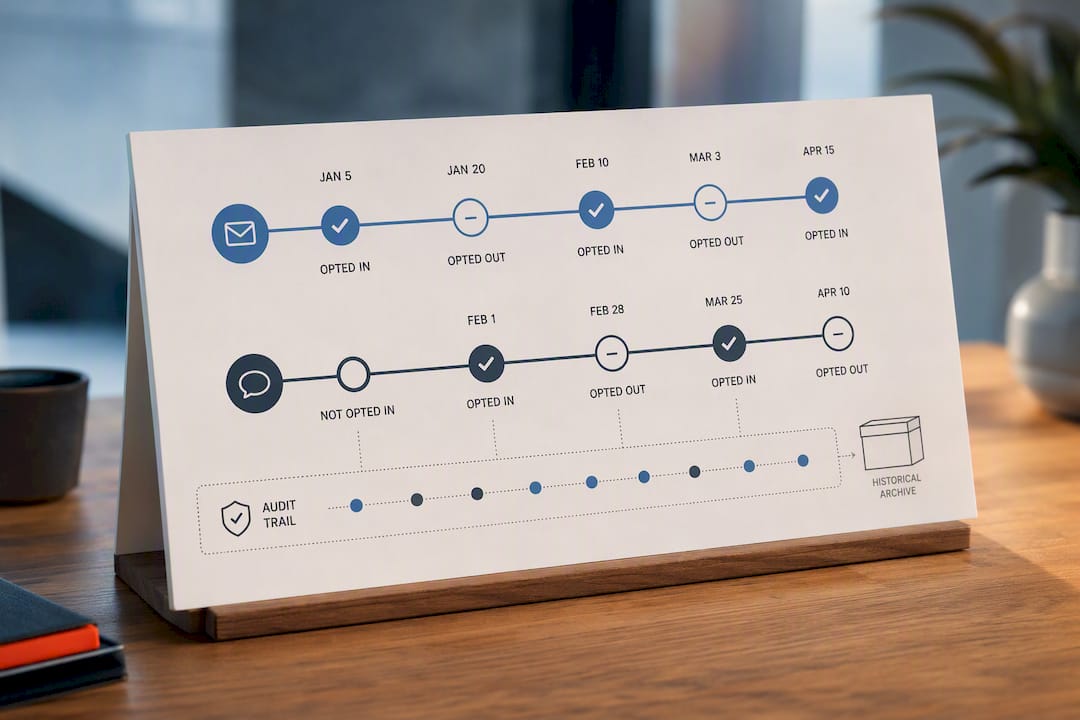
Ownership breaks projects almost as often as consent does. Someone needs explicit authority to approve schema changes, fix bad merges, and enforce SLAs on data quality issues, or every team will assume it's someone else's job.
Common pitfalls to watch for:
- Match rules that worked at launch but go stale as new data sources get added.
- Data ownership split across five teams with no single accountable owner.
- No audit trail for merges, making bad matches nearly impossible to unwind.
- Consent stored as a single current flag instead of a timestamped history per channel.
Pro Tip: Assign one small, cross-functional team to own the pilot phase entirely, then automate quality checks (duplicate rate, match confidence, missing consent fields) before you scale to a second data source. Scaling governance problems is far more expensive than fixing them small.
How to Measure Whether Your Unified Customer View Is Working
Track two categories of metrics from day one, not after the pilot ends. Business KPIs prove the investment: average order value, repeat purchase rate, and CSAT or NPS movement among customers whose profile the pilot touched. Operational KPIs prove the pipeline is healthy: duplicate-record rate, time from data change to profile update (activation latency), and segmentation precision, meaning how often a segment actually matches its intended definition.
Retailers connecting their full customer data stack report an 8.9% average GMV uplift annually, a useful benchmark for setting your own pilot targets.
For a 30 to 90 day pilot, reasonable early targets include cutting duplicate records by half, activation latency under a few minutes for behavioral triggers, and a measurable CSAT lift in the support queue included in the test. A revenue-focused dashboard that tracks these side by side keeps the business case visible to executives who don't want to dig through raw data.
What a Growth Consultant Sees That Internal Teams Often Miss
Internal teams building their first unified customer view often spend months arguing over which data source is "correct" before touching identity rules. A consultant-led diagnostic skips that stall by benchmarking your data inventory and identity logic against patterns that have already worked elsewhere, which compresses the inventory and identity-design phase significantly.
Sales-phoenix approaches this through its Phoenix Growth Framework™, built around finding revenue leaks hiding in disconnected data before recommending any system change. Typical deliverables include:
- A revenue intelligence audit that identifies where leads or transactions fall through data gaps.
- An executive dashboard built around the KPIs that actually move your board meeting, not vanity metrics.
- A phased implementation plan that separates quick operational wins from longer identity-architecture work.
Building in-house makes sense when you have dedicated data engineering capacity and time to spare. Hiring outside help can make sense when the goal is a working pilot with measurable revenue impact inside a relatively short timeframe.
Real-World Examples of Unified Customer View Payoffs
Retail is where unified customer view results show up most visibly, mainly because purchase behavior is easy to measure against a clear before-and-after. Brands that connect point-of-sale, e-commerce, and customer service into one profile consistently report the kind of merchandising and personalization gains reflected in that 8.9% GMV uplift figure, driven by recommendations that reflect actual purchase history instead of generic category browsing.
Aggregating first-party behavioral and transactional data into one profile also reduces total cost of ownership compared to running several disconnected middleware integrations that each need separate maintenance. Service businesses see a quieter but equally real version of this: a client calls with a billing question, and the agent already sees their contract history, last three interactions, and renewal date without transferring the call twice.
Professional services firms tend to see the identity resolution piece pay off hardest, since their customer records often live across a practice management tool, an email platform, and a separate billing system that were never designed to talk to each other. Once identity resolution links those three sources, cross-sell timing improves because the team can finally see which clients are approaching a renewal or a natural service expansion point instead of guessing from memory or scattered notes. None of this requires a massive platform migration. Most of these wins came from resolving identity across three or four systems and building one dashboard, not from replacing the entire tech stack.
AI, Machine Learning, and the Future of the Unified Customer View
Modern AI agents need clean, governed data to function at all. Without it, personalization and automated decisions become inconsistent across channels, because an AI agent making a recommendation from an incomplete profile will confidently make the wrong one. A unified customer view isn't a nice complement to AI initiatives; it's the data foundation those initiatives fail without.
A unified customer view now forms the foundation for real-time personalization and AI-driven agents, meaning the profile itself has shifted from a reporting asset into something an autonomous system actively reads and writes to during a live customer interaction. That's a meaningful shift from five years ago, when most "360 views" existed purely for a quarterly business review deck.
Machine learning is also changing identity resolution itself. Probabilistic matching used to require heavy manual rule tuning; newer models learn from confirmed matches and adjust confidence scoring automatically, which reduces the ongoing maintenance burden that used to make probabilistic matching a scary proposition for smaller data teams. The practical implication for decision-makers: budget for AI-readiness now, not as a separate future project. A profile built with clean identity resolution and preserved lineage today is a profile your AI initiatives can actually use next year without a rebuild.
The One Move That Actually Moves the Needle
Prioritize identity resolution and a small commercial pilot over a full platform rebuild. Most stalled projects chase a perfect architecture before proving a single business outcome. Start with three moves: inventory your top five data sources this month, run a deterministic-matching pilot on one segment, and baseline two KPIs before you touch a second system.
— Hunter
How Sales-phoenix Helps You Skip the Trial-and-Error Phase
Building a unified customer view in-house usually means months of arguing over data ownership before anyone touches a real pilot. Sales-phoenix works differently: it starts with a revenue intelligence diagnostic that finds where your current data gaps are actually costing you money, then builds the identity and reporting layer around fixing that specific leak first.
Instead of a generic platform recommendation, you get a customer intelligence assessment scoped to your actual data sources and an executive dashboard built around the KPIs your leadership team already cares about. If you want a clear picture of where your revenue is leaking before you commit to a platform, start with a Revenue Leak Assessment.
Sources
- What Is a 360 Degree Customer View? | Shopify
- What Is a 360 Degree Customer View? | Salesforce
- Building a Single Customer View Across CRM, Marketing and Analytics — Tilores
- How to create a 360-degree customer view | HubSpot
FAQ
What Does "Unified Customer View" Mean?
It means every interaction a customer has with your business, across sales, support, marketing, and billing, lives in one continuously updated profile instead of scattered across separate systems. That single profile is what teams query to see a complete picture of who the customer is and what they need.
What Is a Unified View in a Business Context?
A unified view combines identity, behavioral, transactional, and consent data into one record that any authorized system can read from and write to. It's the practical alternative to teams manually cross-referencing five different tools to answer one customer question.
What Is a Unified Account View?
A unified account view applies the same concept at the account or company level rather than the individual contact level, common in B2B settings where multiple people interact with your business under one organization. It combines every contact's activity, every deal, and every support ticket tied to that account into one consolidated record.
What Is an ICP Example?
An ideal customer profile (ICP) describes the type of company or individual most likely to buy and get value from your product, typically defined by firmographics, budget, and pain points. An example: a mid-size professional services firm with around 20 employees, no dedicated data team, and visible gaps between its CRM and billing system, the exact profile a unified customer view project tends to help most.